Haven from Harm
رَبِّ نَجِّنِی وَأَهلِی مِمَّا یَعمَلُونَ
My Lord, save me and my family from what they are doing.
But in the Qur’an, prayer is never the last resort. It is the turning point.
Again and again, Allah shows us moments when one sincere duʿā from one servant changed everything. It reshaped the earth, healed what seemed impossible, protected life in the darkest place, and built a city that hearts would yearn for until the end of time.
Here are four of those moments.
Nūḥ (ʿalayhis-salām) called his people to Allah for 950 years. They mocked him, rejected him and threatened him. After centuries of patience, he turned to his Lord with a few heartfelt words:
فَدَعَا رَبَّهُ أَنِّي مَغْلُوبٌ فَانتَصِرْ فَفَتَحْنَا أَبْوَابَ السَّمَاءِ بِمَاءٍ مُّنْهَمِرٍ
“So he invoked his Lord, ‘Indeed, I am overpowered, so help.’ Then We opened the gates of the heavens with rain pouring down.” (Surah Al-Qamar 54:10–11)
“I am overpowered.” That was the whole duʿā: a simple admission of weakness. Allah answered by opening the heavens and the earth, and victory came to His servant.
The lesson: You don’t need eloquent words. An honest “Ya Allah, I can’t do this alone” is enough to open the gates of the heavens.
Zakariyyā (ʿalayhis-salām) was old, his bones had weakened, and his wife was barren. By every worldly measure, having a child was out of the question. Still, he called upon his Lord:
وَزَكَرِيَّا إِذْ نَادَىٰ رَبَّهُ رَبِّ لَا تَذَرْنِي فَرْدًا وَأَنتَ خَيْرُ الْوَارِثِينَ فَاسْتَجَبْنَا لَهُ وَوَهَبْنَا لَهُ يَحْيَىٰ وَأَصْلَحْنَا لَهُ زَوْجَهُ
“And [mention] Zakariyyā, when he called to his Lord, ‘My Lord, do not leave me alone [with no heir], while You are the best of inheritors.’ So We responded to him, and We gave to him Yaḥyā, and amended for him his wife.” (Surah Al-Anbiyāʾ 21:89–90)
Allah didn’t only give him a son. He healed his wife so she could carry that child.
The lesson: “Impossible” is a word for our limits, not Allah’s. Never stop asking just because the odds say no.
Yūnus (ʿalayhis-salām) found himself in layers of darkness: the darkness of night, of the sea, and of the belly of the whale. There was no human way out. From there he called out:
لَّا إِلَٰهَ إِلَّا أَنتَ سُبْحَانَكَ إِنِّي كُنتُ مِنَ الظَّالِمِينَ فَاسْتَجَبْنَا لَهُ وَنَجَّيْنَاهُ مِنَ الْغَمِّ ۚ وَكَذَٰلِكَ نُنجِي الْمُؤْمِنِينَ
“There is no deity except You; exalted are You. Indeed, I have been of the wrongdoers. So We responded to him and saved him from the distress. And thus do We save the believers.” (Surah Al-Anbiyāʾ 21:87–88)
Notice the end of the verse: “And thus do We save the believers.” This duʿā wasn’t only for Yūnus. It is for us too.
The Prophet ﷺ said:
«دَعْوَةُ ذِي النُّونِ إِذْ دَعَا وَهُوَ فِي بَطْنِ الْحُوتِ: لَا إِلَهَ إِلَّا أَنْتَ سُبْحَانَكَ إِنِّي كُنْتُ مِنَ الظَّالِمِينَ، فَإِنَّهُ لَمْ يَدْعُ بِهَا رَجُلٌ مُسْلِمٌ فِي شَيْءٍ قَطُّ إِلَّا اسْتَجَابَ اللَّهُ لَهُ»
“The supplication of Dhun-Nūn (Yūnus) when he called upon Allah from the belly of the whale was: ‘There is no deity except You; exalted are You. Indeed, I have been of the wrongdoers.’ No Muslim ever supplicates with it for anything except that Allah answers him.” (Tirmidhī)
The lesson: However deep the darkness, a duʿā made with tawḥīd, praise and humility can turn the very thing that swallowed you into the place that keeps you safe.
Ibrāhīm (ʿalayhis-salām) left his wife Hājar and baby Ismāʿīl in a barren valley with no water, no crops and no people. Before he walked away, he raised his hands:
رَّبَّنَا إِنِّي أَسْكَنتُ مِن ذُرِّيَّتِي بِوَادٍ غَيْرِ ذِي زَرْعٍ عِندَ بَيْتِكَ الْمُحَرَّمِ رَبَّنَا لِيُقِيمُوا الصَّلَاةَ فَاجْعَلْ أَفْئِدَةً مِّنَ النَّاسِ تَهْوِي إِلَيْهِمْ وَارْزُقْهُم مِّنَ الثَّمَرَاتِ لَعَلَّهُمْ يَشْكُرُونَ
“Our Lord, I have settled some of my descendants in an uncultivated valley near Your sacred House, our Lord, that they may establish prayer. So make hearts among the people incline toward them and provide for them from the fruits that they might be grateful.” (Surah Ibrāhīm 14:37)
“Make hearts among the people incline toward them.” Thousands of years later, millions of people travel to Makkah every year, weeping at the sight of the Kaʿbah and longing to return. That longing is the answer to one man’s prayer in an empty valley.
The lesson: Some duʿās are answered in your lifetime; others echo for generations. No sincere prayer is ever wasted.
It’s easy to read these stories and think, “They were Prophets. My duʿā isn’t the same.”
But Allah speaks to every one of us:
وَقَالَ رَبُّكُمُ ادْعُونِي أَسْتَجِبْ لَكُمْ
“And your Lord says, ‘Call upon Me; I will respond to you.’” (Surah Ghāfir 40:60)
And the Prophet ﷺ said:
«الدُّعَاءُ هُوَ الْعِبَادَةُ»
“Duʿā is worship.” (Abū Dāwūd & Tirmidhī)
So when you raise your hands, you aren’t only asking for something. You are worshipping Allah in that very moment.
Today holds a special opportunity. The Prophet ﷺ said about Friday:
«فِيهِ سَاعَةٌ لَا يُوَافِقُهَا عَبْدٌ مُسْلِمٌ وَهُوَ قَائِمٌ يُصَلِّي يَسْأَلُ اللَّهَ تَعَالَى شَيْئًا إِلَّا أَعْطَاهُ إِيَّاهُ»
“There is an hour on Friday in which no Muslim servant stands in prayer asking Allah for something except that He gives it to him.” (Bukhārī & Muslim)
Whatever feels scattered in your life right now (your health, family, work, studies or heart), take it to Allah today. Ask like Nūḥ, with honesty. Ask like Zakariyyā, without giving up hope. Ask like Yūnus, with humility. Ask like Ibrāhīm, for those who come after you.
]]>
This week’s reflection is a takeaway from the Roots workshop held at the University of Leicester, where we are journeying through the Seerah of the Prophet ﷺ over the first semester. Looking at the earliest chapters of his life, one theme stood out clearly.
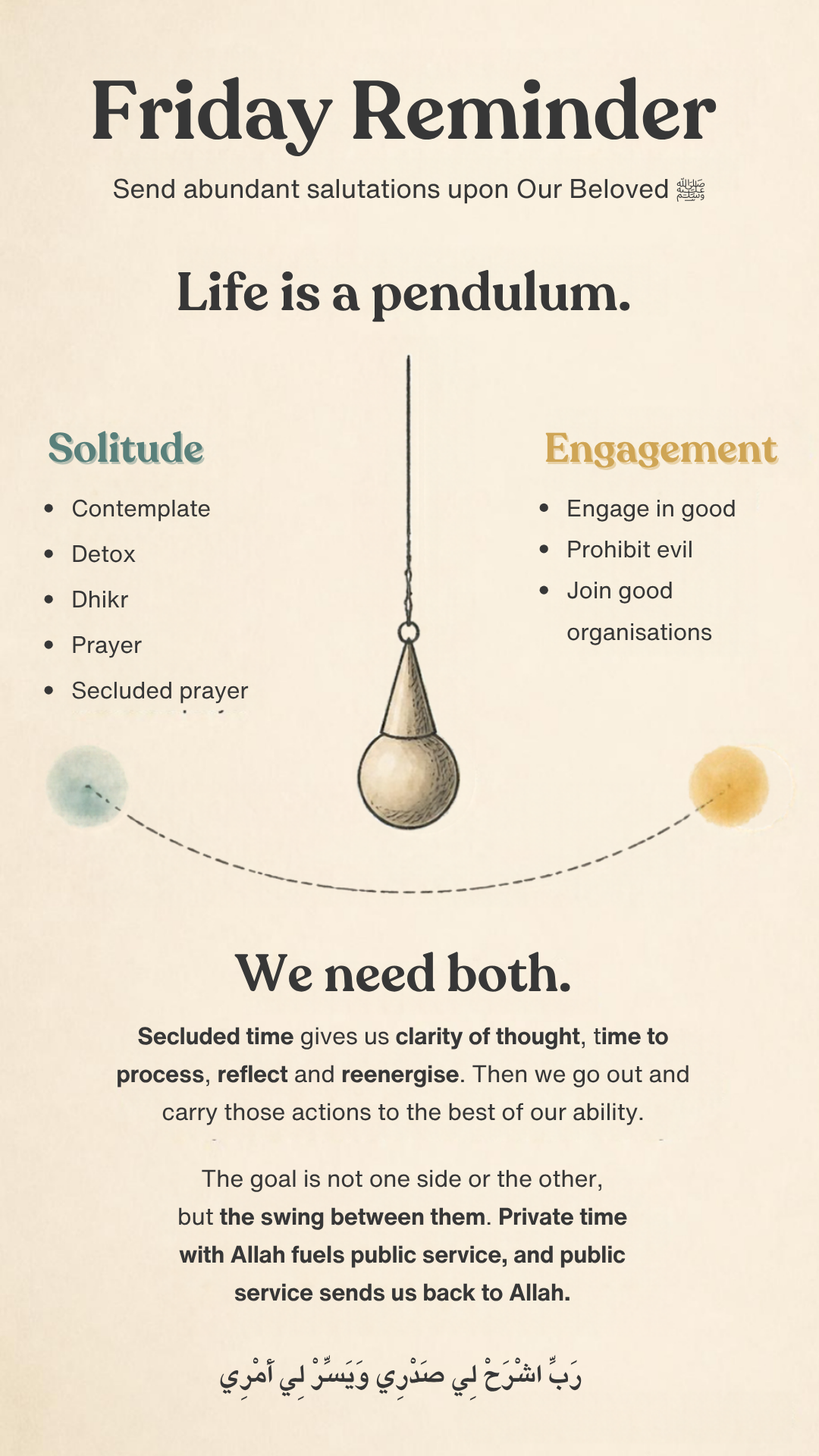
Life is a pendulum.
Some seasons pull us inward. We want quiet, space and time alone with our thoughts and with Allah. Other seasons pull us outward. There is work to be done, people to help, causes to stand for.
Many of us feel guilty about whichever side we’re on. When we withdraw, we worry we’re not doing enough for others. When we’re busy serving, we worry our hearts are running on empty.
But when we look at the Seerah, and at how Islam understands solitude and engagement, we find something freeing: the believer was never meant to live at one end of the swing. We need both.
Before revelation came, the Prophet ﷺ would withdraw to the Cave of Ḥirāʾ for nights at a time, worshipping and reflecting away from the noise of Makkah (Ṣaḥīḥ al-Bukhārī).
Then came the command that changed everything:
يَا أَيُّهَا الْمُدَّثِّرُ قُمْ فَأَنذِرْ
“O you who covers himself [with a garment], arise and warn.” (Sūrah Al-Muddaththir 74:1–2)
The cave prepared him. The command sent him out. Seclusion was never the destination; it was the preparation.
Solitude is where we contemplate, where we detox from the noise, the screens and the constant demands. It’s where our dhikr becomes unhurried and our prayer becomes personal, especially secluded prayer that no one else sees.
Allah addressed the Prophet ﷺ:
يَا أَيُّهَا الْمُزَّمِّلُ قُمِ اللَّيْلَ إِلَّا قَلِيلًا
“O you who wraps himself [in clothing], arise [to pray] the night, except for a little.” (Sūrah Al-Muzzammil 73:1–2)
And a few verses later, the reason becomes clear:
إِنَّ لَكَ فِي النَّهَارِ سَبْحًا طَوِيلًا
“Indeed, for you by day is prolonged occupation.” (Surah Al-Muzzammil 73:7)
The night was for standing before Allah, because the day would be full of people, responsibility and effort. The private hours fuelled the public ones.
The Prophet ﷺ described those who will be shaded by Allah on a day when there is no shade but His. Among them:
«وَرَجُلٌ ذَكَرَ اللَّهَ خَالِيًا فَفَاضَتْ عَيْنَاهُ»
“…and a man who remembered Allah in private and his eyes overflowed with tears.” (Bukhārī & Muslim)
No audience. No recognition. Just a servant and his Lord.
Secluded time gives us clarity of thought, time to process, reflect and re-energise.
But we are not meant to stay hidden. Allah says:
وَلْتَكُن مِّنكُمْ أُمَّةٌ يَدْعُونَ إِلَى الْخَيْرِ وَيَأْمُرُونَ بِالْمَعْرُوفِ وَيَنْهَوْنَ عَنِ الْمُنكَرِ ۚ وَأُولَٰئِكَ هُمُ الْمُفْلِحُونَ
“And let there be [arising] from you a nation inviting to [all that is] good, enjoining what is right and forbidding what is wrong, and those will be the successful.” (Surah Āl ʿImrān 3:104)
Engagement means we engage in good, we prohibit evil in whatever way we’re able, and we join good organisations, because good work done together goes further than good work done alone. As Allah says, وَتَعَاوَنُوا عَلَى الْبِرِّ وَالتَّقْوَىٰ, “And cooperate in righteousness and piety” (Surah Al-Māʾidah 5:2).
The Prophet ﷺ said:
«مَنْ رَأَى مِنْكُمْ مُنْكَرًا فَلْيُغَيِّرْهُ بِيَدِهِ، فَإِنْ لَمْ يَسْتَطِعْ فَبِلِسَانِهِ، فَإِنْ لَمْ يَسْتَطِعْ فَبِقَلْبِهِ، وَذَلِكَ أَضْعَفُ الْإِيمَانِ»
“Whoever among you sees an evil, let him change it with his hand; if he cannot, then with his tongue; and if he cannot, then with his heart, and that is the weakest of faith.” (Muslim)
Engagement is messy. People can be difficult. But the Prophet ﷺ reminded us that this, too, is part of the reward:
«الْمُؤْمِنُ الَّذِي يُخَالِطُ النَّاسَ وَيَصْبِرُ عَلَى أَذَاهُمْ أَعْظَمُ أَجْرًا مِنَ الْمُؤْمِنِ الَّذِي لَا يُخَالِطُ النَّاسَ وَلَا يَصْبِرُ عَلَى أَذَاهُمْ»
“The believer who mixes with people and bears their harm patiently has a greater reward than the believer who does not mix with people and does not bear their harm patiently.” (Ibn Mājah)
Solitude without engagement can quietly turn into escape. Engagement without solitude can quietly turn into burnout, or worse, ego.
The goal is not one side or the other, but the swing between them. Private time with Allah fuels public service, and public service sends us back to Allah.
Allah captures this rhythm beautifully:
فَإِذَا فَرَغْتَ فَانصَبْ وَإِلَىٰ رَبِّكَ فَارْغَب
“So when you have finished [your duties], then stand up [for worship]. And to your Lord direct [your] longing.” (Surah Ash-Sharḥ 94:7–8)
Even Jumuʿah follows this pattern. We gather, we listen, we pray, and then:
فَإِذَا قُضِيَتِ الصَّلَاةُ فَانتَشِرُوا فِي الْأَرْضِ وَابْتَغُوا مِن فَضْلِ اللَّهِ وَاذْكُرُوا اللَّهَ كَثِيرًا لَّعَلَّكُمْ تُفْلِحُونَ
“And when the prayer has been concluded, disperse within the land and seek from the bounty of Allah, and remember Allah often that you may succeed.” (Surah Al-Jumuʿah 62:10)
In, then out. Out, then back in.
When Mūsā (ʿalayhis-salām) stood alone in the sacred valley and heard the words of Allah, it was the most private moment imaginable. Then he was told to go to Firʿawn, the most public and daunting task imaginable.
His first words were a duʿā:
رَبِّ اشْرَحْ لِي صَدْرِي وَيَسِّرْ لِي أَمْرِي
“My Lord, expand for me my breast and ease for me my task.” (Surah Ṭā Hā 20:25–26)
It’s the perfect duʿā for the swing: an open heart, nourished in private, and ease in the work that awaits in public.
Try giving each side of the pendulum its due:
Then notice how each one strengthens the other.
May Allah expand our chests, ease our affairs, and make our private moments with Him the source of every good we do in public. Āmīn.
]]>
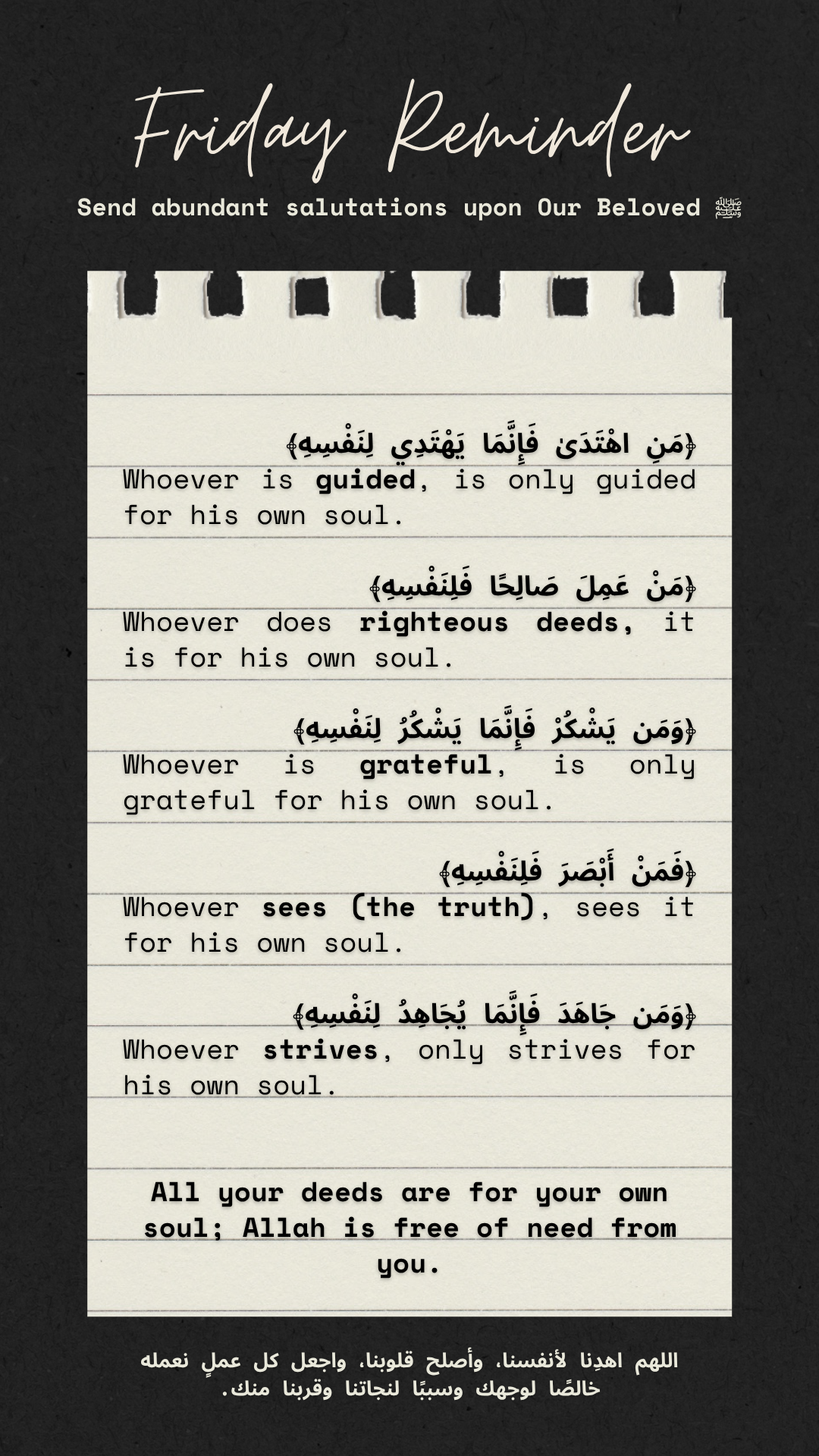
There is a powerful truth that the Qur’an reminds us of repeatedly: everything we do ultimately comes back to us. Our guidance benefits us, our good deeds benefit us, our gratitude benefits us, and even the effort we make to become better people is for our own benefit. Allah does not need anything from us. He is completely independent and free of need, while we are constantly in need of Him. When we worship Him, obey Him and strive to come closer to Him, we are not increasing His greatness. Rather, we are improving our own condition and preparing our own souls for what lies ahead.
Allah says:
مَنِ اهْتَدَىٰ فَإِنَّمَا يَهْتَدِي لِنَفْسِهِ
“Whoever is guided is only guided for his own soul.” (Surah Al Isra, 17:15).
Guidance is one of the greatest gifts a person can receive, yet the benefit of that guidance belongs to the person who accepts it. When Allah guides someone towards prayer, towards repentance, towards good character or away from sin, it is that person who benefits. Allah does not gain anything from our obedience. We are the ones whose hearts become stronger, whose lives become better and whose souls become closer to Him.
The same message appears when Allah speaks about righteous deeds:
مَنْ عَمِلَ صَالِحًا فَلِنَفْسِهِ
“Whoever does righteous deeds, it is for his own soul.” (Surah Fussilat, 41:46).
Every good deed we perform is ultimately an investment in ourselves. The prayer we make when we are tired, the charity we give when nobody knows, the kindness we show to someone who may never be able to repay us, the patience we show during a difficult moment and the sin we leave purely because we know Allah is watching are all deeds that are recorded for us. We may forget them, but Allah does not. What seems small to us may be something immense when we stand before Him.
Allah also reminds us about the importance of gratitude:
وَمَن شَكَرَ فَإِنَّمَا يَشْكُرُ لِنَفْسِهِ
“Whoever is grateful is only grateful for his own soul.” (Surah An Naml, 27:40).
When we say Alhamdulillah and genuinely recognise the blessings Allah has given us, we are not adding anything to Allah’s greatness. He already possesses everything. Our gratitude does not benefit Him in any way. Instead, gratitude benefits us. It changes the way we see our lives, teaches us to recognise blessings we often overlook and brings contentment into our hearts. The more we recognise what Allah has given us, the more we realise just how dependent we are upon Him.
Allah then says:
فَمَنْ أَبْصَرَ فَلِنَفْسِهِ
“So whoever sees, it is for his own soul.” (Surah Al An’am, 6:104).
There is a difference between seeing something with our eyes and truly seeing it with our hearts. A person may see the signs of Allah around them every day and still choose to ignore them. Another person may look at those same signs and allow them to bring them closer to their Creator. When a person recognises the truth and chooses to follow it, that clarity benefits nobody more than the person who has received it.
Allah also tells us:
وَمَن جَاهَدَ فَإِنَّمَا يُجَاهِدُ لِنَفْسِهِ
“Whoever strives, only strives for his own soul.” (Surah Al Ankabut, 29:6).
Striving is part of every believer’s journey. We struggle against our desires, our weaknesses, our habits and sometimes even our own doubts. We try to become better, we fall, we make mistakes and then we try again. At times, the effort can feel exhausting. There may be moments when we wonder whether all this struggle is worth it. Allah gives us the answer: it is. We are striving for ourselves.
Every time we choose obedience over temptation, we are helping ourselves. Every time we control our anger, forgive someone, resist a sin or remain patient through a difficulty, we are helping ourselves. Every time we return to Allah after falling into a mistake, we are helping ourselves. Allah does not need our struggle, but we need the reward, purification and closeness to Him that comes from that struggle.
This understanding can completely change the way we look at worship. Prayer is not something Allah needs from us. We need prayer. The Qur’an is not something Allah needs us to read. We need the Qur’an. Charity is not something Allah needs from us. We need the reward and purification that come through giving. Repentance is not something that benefits Allah. We are the ones who desperately need His forgiveness and mercy.
Allah makes this principle even clearer when He says:
مَنْ عَمِلَ صَالِحًا فَلِنَفْسِهِ وَمَنْ أَسَاءَ فَعَلَيْهَا وَمَا رَبُّكَ بِظَلَّامٍ لِلْعَبِيدِ
“Whoever does good, it is for his own benefit, and whoever does evil, it is against himself. And your Lord is never unjust to His servants.” (Surah Fussilat, 41:46).
Our actions have consequences, and those consequences ultimately return to us. When we do good, we are building something for ourselves. When we persist in wrongdoing, we are harming ourselves.
Perhaps this is why we should never look at worship as though we are doing Allah a favour. We should look at it as one of the greatest opportunities Allah has given us. When you wake up for Fajr, you are doing something for your own soul. When you give charity, you are doing something for your own soul. When you lower your gaze, control your anger, forgive someone or walk away from a sin, you are doing something for your own soul. When you make dua in the quiet of the night and turn to Allah with everything that is in your heart, you are doing something for your own soul.
We may sometimes feel that our efforts are unnoticed, especially when nobody around us sees the sacrifices we make. But Allah sees every one of them. He knows the struggle behind the obedience, the tears behind the repentance and the effort behind every attempt to become better. Nothing done sincerely for His sake is ever wasted.
The reality is that we need Allah far more than we realise. We need His guidance when we are lost, His mercy when we fall, His forgiveness when we make mistakes, His strength when we feel weak and His help when life becomes difficult. Allah does not need our worship, but we need the worship that brings us closer to Him. He does not need our gratitude, but we need the gratitude that brings peace and contentment into our hearts.
So the next time you find yourself struggling to do what is right, remind yourself that you are not doing it for Allah’s benefit. You are doing it for yourself. Every prayer, every sacrifice, every moment of patience, every act of gratitude, every sin you leave and every step you take towards Allah is being written for your own soul.
Allah is free of need from us, while we are completely dependent upon Him. And perhaps one of the greatest acts of understanding is to recognise that every command He has given us is ultimately for our own good. He calls us towards what will benefit us, warns us against what will harm us and continually opens the door for us to return to Him.
Everything you do for the sake of Allah is for your own soul. You may not see its benefit immediately, and you may not always understand why you are being asked to struggle, but trust that Allah knows what you need. Keep going, keep turning back to Him and keep striving. One day, you may look back and realise that every step you took towards Allah was, in reality, a step towards saving yourself.
]]>
Allah says in the Qur’an:
“So whoever hopes to meet his Lord, let him do righteous deeds and not associate anyone in the worship of his Lord.” (Surah Al-Kahf, 18:110)
This verse reminds us that the meeting is not merely a future event but a spiritual reality accessible through righteous action and pure intention. Every prayer, every act of charity, every heartfelt duʿāʾ is a moment of nearness — a private audience with the Divine.
Each form of worship is a doorway to that meeting:
Imam al-Hasan al-Basri once saw a man praying with deep concentration. When asked what made his prayer so tranquil, the man replied, “I stand before Allah as if I already see Him — for if I do not see Him, He surely sees me.” This echoes the hadith of Ihsan: “To worship Allah as though you see Him; and if you do not see Him, know that He sees you.” (Muslim)
Such awareness transforms every act into a meeting — not of form, but of presence.
The believer’s rest is not in worldly ease but in the serenity of divine connection. Every moment of sincerity is a meeting with the One who created time itself. So, as Friday arrives — a day of mercy and remembrance — let us renew our intention to seek these meetings with Allah, the Mighty and Majestic, in every breath and deed.
]]>
Every Prophet lived this truth. Every Companion embodied it. Their stories remind us that Allah does not measure you by how much you achieve, but by how truthfully you try.
When results feel slow, uncertain, or invisible, you are still moving in the sight of Allah — and He never loses sight of a heart that tries.
Imagine calling your people to Allah for nine and a half centuries. Most of us struggle to stay consistent for nine days. Yet Nūḥ عليه السلام persisted with gentleness, wisdom, and patience. Only a small group believed — but his rank with Allah is immense.
His story teaches you:
Allah honoured him not because of the outcome, but because of the heart that never stopped trying.
When Ibrāhīm left Hājar and baby Ismāʿīl in a barren desert, there was no visible outcome. No water. No people. No shelter. Just obedience.
From that moment of surrender came:
One sincere act became a river of blessings that still nourishes the Ummah today. You never know what Allah will grow from your effort.
At the Red Sea, the command was simple: strike the sea with your staff. A stick cannot split an ocean — but effort is yours, and miracles are Allah’s.
You do the small action. Allah opens the impossible path.
He went from being the most elegant youth in Makkah to wearing patched cloth for the sake of Allah. His daʿwah in Madinah transformed an entire city. Yet he died with barely enough cloth to cover his body.
The world saw little. Allah saw everything.
She embraced Islam early, raised her son Anas with love for the Prophet ﷺ, and nurtured faith in her household even when society resisted. Her effort produced one of the greatest scholars of this Ummah.
Sometimes your quiet work at home becomes a legacy for generations.
 What These Stories Teach You
Even when:
Allah never loses sight of a heart that tries.
You are not defined by outcomes — you are defined by the sincerity of your effort. The Prophets and Companions remind you that the greatest victories often begin as small, hidden acts of obedience.
So keep showing up. Keep trying. Keep planting seeds.
Your effort is your accountability. Your sincerity is your offering. Your outcome is with Allah — and He never wastes the effort of those who strive.
]]>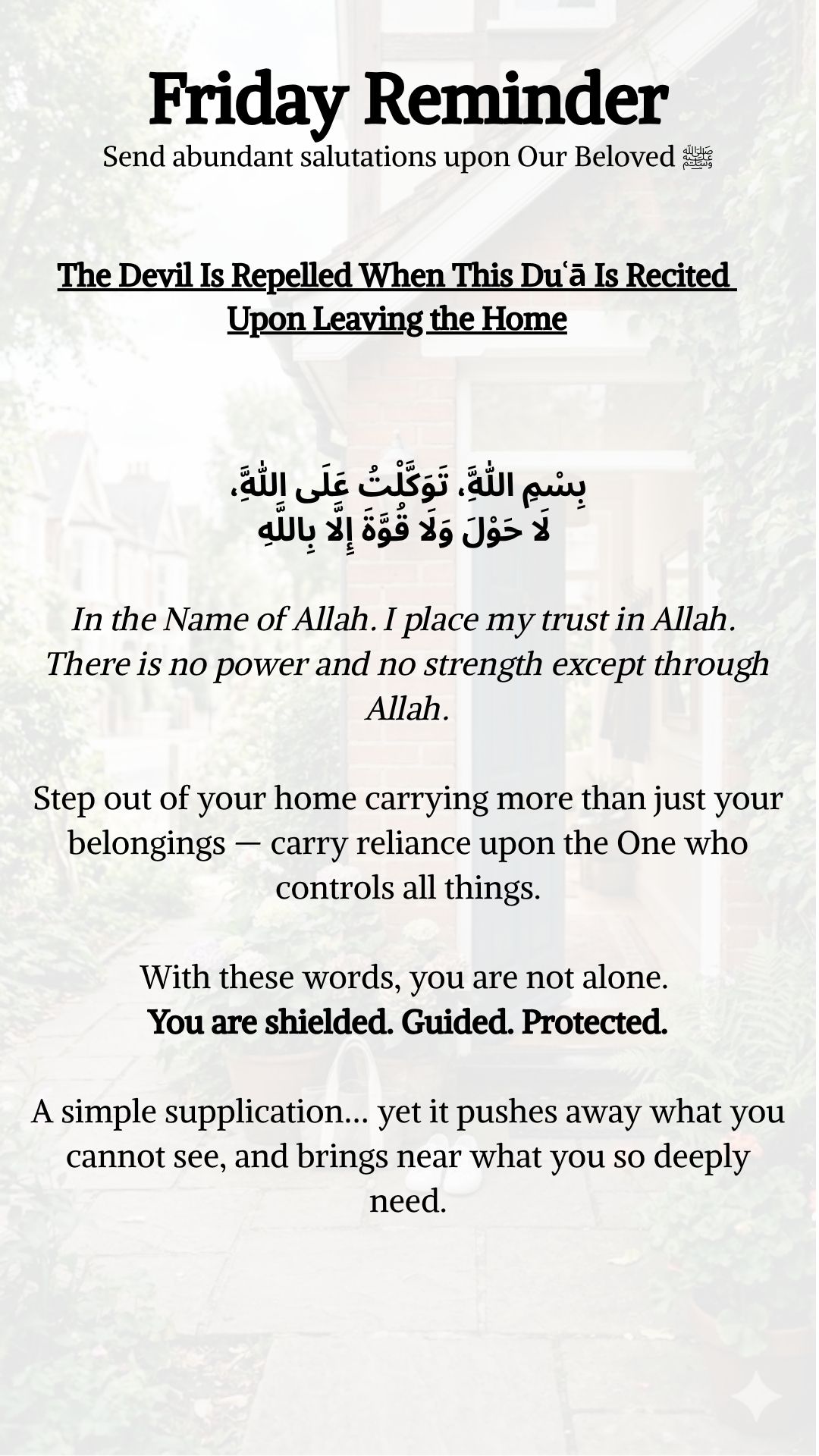
When a believer steps out into the world, they step into a place of tests — seen and unseen. Yet the Prophet ﷺ gifted us a supplication that turns an ordinary moment, like walking out of the door, into an act of protection and trust.
بِسْمِ اللَّهِ، تَوَكَّلْتُ عَلَى اللَّهِ، لَا حَوْلَ وَلَا قُوَّةَ إِلَّا بِاللَّهِ
In the Name of Allah. I place my trust in Allah. There is no power and no strength except through Allah.
The Prophet ﷺ said:
إِذَا خَرَجَ الرَّجُلُ مِنْ بَيْتِهِ فَقَالَ: بِسْمِ اللَّهِ، تَوَكَّلْتُ عَلَى اللَّهِ، لَا حَوْلَ وَلَا قُوَّةَ إِلَّا بِاللَّهِ، يُقَالُ لَهُ: هُدِيتَ، وَكُفِيتَ، وَوُقِيتَ، فَتَنَحَّى عَنْهُ الشَّيْطَانُ
“When a person leaves his home and says: ‘In the Name of Allah, I place my trust in Allah, there is no power and no strength except through Allah,’ it is said to him: ‘You are guided, protected, and sufficed,’ and the devil moves away from him.” (Sunan Abī Dāwūd, 5095)
Step out of your home carrying more than your belongings — carry reliance upon the One who controls all things. With these words, you are not stepping into uncertainty alone. You are stepping out with:
A simple supplication… yet it pushes away what you cannot see, and brings near what your heart deeply needs.
This duʿā is not long. It is not difficult. It takes seconds. But it builds a spiritual shield around your day — a reminder that your strength is not in your plans, your preparation, or your confidence, but in your tawakkul.
Let your first step outside be a step toward Allah.
]]>
There are seasons in life when you do everything with sincerity, yet the outcome feels painfully unfair. You agree to things out of goodwill, only to realise later that the agreement was never about cooperation — it was about control. You show flexibility, and it is interpreted as weakness. You offer respect, and it is met with quiet attempts to undermine you. You move with a clean heart, and still, you are misunderstood.
But Allah never misreads a heart.
Life has a way of revealing people’s intentions slowly. Sometimes you only understand the truth of a situation years later — when the dust has settled, when emotions have cooled, when the masks have slipped. You look back and realise that what was presented as principle was actually preference, what was framed as righteousness was actually ego, and what was demanded from you was never practiced by those who demanded it.
These moments are not random. They are part of the divine curriculum that shapes the believer.
إِنَّ رَبَّكَ يَقْضِي بَيْنَهُم بِحُكْمِهِ ۖ وَهُوَ الْعَزِيزُ الْعَلِيمُ
“Indeed, your Lord will judge between them by His wisdom, and He is the Mighty, the Knowing.” (Qur’an 27:78)
Allah allows certain events to unfold not to break you, but to clarify you — to show you who you are, and who others truly are.
The Prophet ﷺ taught us:
إِنَّمَا الأَعْمَالُ بِالنِّيَّاتِ
“Actions are judged by intentions.” (Bukhārī & Muslim)
This ḥadīth is not simply a principle — it is a lifeline. Because there will be times when your intention is the only thing you have left. You act with integrity, but others twist the narrative. You offer clarity, but people choose assumptions. You maintain respect, but they choose distance.
And yet, Allah sees every quiet effort you made to keep things together. He sees the patience you held when others were provoking you. He sees the dignity you maintained when others abandoned theirs.
Time has a way of exposing truth gently but unmistakably.
You may discover years later that the things people insisted on were never sacred to them. You may realise that the conditions placed on you were never about principle, but about pressure. You may see friendships dissolve not because you wronged anyone, but because they needed an excuse to justify their own discomfort.
And sometimes, the people who were misunderstood in life are honoured in their absence. A father whose intentions were questioned becomes beloved in memory. His quiet acts of goodness are remembered by hundreds. His sincerity, once overlooked, becomes a legacy.
وَاللَّهُ يُحِبُّ الْمُحْسِنِينَ
“And Allah loves the doers of excellence.” (Qur’an 3:134)
Excellence is not only in worship — it is in how you treat people, even when they do not treat you the same.
Not every separation is a loss. Sometimes Allah removes people from your life because they would have drained your peace. Sometimes He exposes intentions you were never meant to build your future upon. Sometimes He allows a friendship to fracture so that you can see the truth of someone’s heart — not to hurt you, but to protect you.
You may deal with someone in good faith, only to realise they were looking for a way out. You may offer loyalty, only to be met with avoidance. You may extend kindness, only to be repaid with pettiness.
But Allah sees. And Allah replaces.
« إِنَّكَ لَنْ تَدَعَ شَيْئًا لِلَّهِ عَزَّ وَجَلَّ إِلَّا بَدَّلَكَ اللَّهُ بِهِ مَا هُوَ خَيْرٌ لَكَ مِنْهُ »
“You never leave something for the sake of Allah except that He replaces it with something better.” (Musnad Aḥmad)
Sometimes the “better” is a person. Sometimes it is an opportunity. Sometimes it is clarity. And sometimes it is simply peace.
Sincerity protects you in ways you cannot see. It keeps your heart soft when the world tries to harden it. It prevents bitterness from taking root. It ensures that even when people misjudge you, Allah elevates you.
فَاصْبِرْ إِنَّ وَعْدَ اللَّهِ حَقٌّ
“So be patient — indeed, the promise of Allah is true.” (Qur’an 30:60)
Patience is not weakness. It is strength wrapped in silence.
اللهم اجعل نياتنا خالصة لوجهك، وأصلح لنا ما ظهر وما بطن، واجعل لنا من كل ضيقٍ مخرجًا، ومن كل همٍّ فرجًا، وارزقنا صدقًا لا تزلزله الأيام.
O Allah, make our intentions pure for Your sake, rectify for us what is outward and inward, grant us relief from every burden, and bless us with sincerity that no trial can shake.
]]>
“Whoever recites Surah al-Kahf on Friday, it will illuminate him with light between the two Fridays.” (al-Ḥākim, al-Bayhaqī — graded ḥasan)
This chapter is not just a ritual — it’s a weekly realignment of the heart.
It teaches how to survive the subtle trials that repeat through life: wealth, knowledge, power, faith, and the ultimate deception of the Dajjāl.
Each story is a mirror — reflecting how easily blessings can become tests.

وَاضْرِبْ لَهُم مَّثَلًا رَّجُلَيْنِ جَعَلْنَا لِأَحَدِهِمَا جَنَّتَيْنِ مِنْ أَعْنَابٍ وَحَفَفْنَاهُمَا بِنَخْلٍ وَجَعَلْنَا بَيْنَهُمَا زَرْعًا
“Give them the example of two men: for one We made two gardens of grapevines, surrounded them with date palms, and placed crops between them.” (18:32)
One man was blessed with abundance — fertile gardens, flowing rivers, and fruit that never failed. His companion, poorer but faithful, reminded him to thank Allah. Yet the wealthy man’s heart grew proud:
مَا أَظُنُّ أَن تَبِيدَ هَٰذِهِ أَبَدًا
“I do not think this will ever perish.” (18:35)
He forgot that permanence belongs only to Allah. His arrogance led him to say:
وَمَا أَظُنُّ السَّاعَةَ قَائِمَةً
“I do not think the Hour will ever come.” (18:36)
Then, in a single night, his gardens were destroyed — a vivid reminder that wealth can vanish faster than it grows.
Lesson:

2. Fitnah of Knowledge — Mūsā and Khidr (18:60–82)
فَوَجَدَا عَبْدًا مِّنْ عِبَادِنَا آتَيْنَاهُ رَحْمَةً مِّنْ عِندِنَا وَعَلَّمْنَاهُ مِن لَّدُنَّا عِلْمًا
“They found one of Our servants to whom We had given mercy from Us and taught knowledge from Ourself.” (18:65)
Prophet Mūsā عليه السلام, despite his immense wisdom, was told there was someone who knew what he did not. He humbly sought Khidr, asking to learn from him.
But Khidr’s actions — damaging a boat, killing a boy, repairing a wall — seemed unjust. Mūsā questioned each one, unable to see the hidden wisdom behind them.
Only later did Khidr explain:
• The boat belonged to poor men — damaging it saved them from a tyrant.
• The boy would have grown to oppress his parents — his death was mercy.
• The wall concealed treasure for orphans — repairing it preserved their future.
Lesson:

3. Fitnah of Power — Dhul-Qarnayn (18:83–98)
إِنَّا مَكَّنَّا لَهُ فِي الْأَرْضِ وَآتَيْنَاهُ مِن كُلِّ شَيْءٍ سَبَبًا
“Indeed, We established him upon the earth and gave him the means to everything.” (18:84)
Dhul-Qarnayn was a ruler of vast lands, blessed with strength and wisdom. He traveled to the ends of the earth, bringing justice wherever he went.
When he met oppressed people seeking protection from Yājūj and Mājūj, he could have exploited them — but instead, he empowered them to build a barrier with their own hands.
قَالَ هَٰذَا رَحْمَةٌ مِّن رَّبِّي
“He said, ‘This is a mercy from my Lord.’” (18:98)
He recognised that power is a trust, not a throne.
Lesson:

4. Fitnah of Faith — People of the Cave (18:9–26)
إِنَّهُمْ فِتْيَةٌ آمَنُوا بِرَبِّهِمْ وَزِدْنَاهُمْ هُدًى
“They were young men who believed in their Lord, and We increased them in guidance.” (18:13)
In a society drowning in idolatry, a group of young believers refused to bow to false gods. They fled to a cave, seeking refuge in faith.
Their test was severe — isolation, fear, and the threat of persecution. Yet Allah preserved them miraculously, causing them to sleep for centuries.
فَضَرَبْنَا عَلَىٰ آذَانِهِمْ فِي الْكَهْفِ سِنِينَ عَدَدًا
“So We sealed their ears in the cave for a number of years.” (18:11)
When they awoke, the world had changed — but their faith remained intact.
Lesson:
Your environment shapes your īmān more than you realise.
Sometimes, protecting your dīn requires distance from harmful influences.
Faith may demand solitude, but Allah’s protection fills that silence.

5. The Ultimate Fitnah — The Trial of the Dajjāl
The Prophet ﷺ said:
“Whoever memorises the first ten verses of Surah al-Kahf will be protected from the trial of the Dajjāl.” (Ṣaḥīḥ Muslim, 809)
Dajjāl represents all previous trials — wealth, power, knowledge, and faith — but at their most extreme.
He will control resources, distort truth, and claim divinity.
His deception will make الحق (truth) appear as falsehood.
مَا مِنْ فِتْنَةٍ مُنْذُ خَلْقِ آدَمَ أَعْظَمُ مِنْ فِتْنَةِ الدَّجَّالِ
“No trial since the creation of Adam is greater than the trial of the Dajjāl.” (Ṣaḥīḥ Muslim, 2946)
Deeper Lesson:
Dajjāl is not just a future event — he is a warning pattern.
Every story in Surah al-Kahf trains you to resist his deception:
• The man of the gardens → don’t be deceived by material success
• Mūsā & Khidr → don’t be deceived by what you think you understand
• Dhul-Qarnayn → don’t be deceived by power and control
• People of the Cave → hold firm when faith is under pressure
Preparation:
Reciting Surah al-Kahf weekly is spiritual training — a shield for the heart before the greatest trial arrives.
Conclusion
Surah al-Kahf is a map for survival in a world of illusions.
Its stories teach that every blessing — wealth, intellect, influence, or faith — can become a test if detached from Allah.
]]>
In the story of Prophet Yunus عليه السلام, there is a moment of profound darkness — physical, emotional, and spiritual. Swallowed by the whale, enveloped by the sea, and hidden beneath the night sky, Yunus found himself in layers of isolation. Yet from within that darkness, he called upon Allah with a voice that pierced through the heavens.
The angels said:
صوتٌ معروفٌ من مكانٍ معروف
“A known voice from a known place.”
They recognised his voice because it was not new to them. It was a voice they had heard often before — a voice of remembrance, of duʿāʾ, of devotion. Even in ease, Yunus had been calling upon his Lord. So when hardship came, his voice was already beloved and familiar in the heavens.
This narration, mentioned by Ibn Kathīr in his Tafsīr of Sūrah al-Anbiyāʾ (21:87), carries a timeless message. Many of us wait for difficulty before we turn to Allah — when the heart is heavy, when the path is unclear, when the world feels dark. But Yunus عليه السلام teaches us that the most powerful duʿāʾ in hardship is the one built upon a lifetime of duʿāʾ in ease.
When the angels heard his cry, they did not ask, “Who is this?” They said, “A known voice from a known place.” His consistency in calling upon Allah had made his voice known in the heavens.
On this blessed day of Jumuʿah, when hearts are invited to renewal and remembrance, let us take this lesson deeply. Don’t wait for hardship to find your voice. Call upon Allah in your moments of calm, in your daily routines, in your quiet reflections. Let your voice become one that the angels recognise — a voice of gratitude, of hope, of love.
So when darkness comes, your duʿāʾ will rise not as a stranger’s plea, but as a familiar call — a known voice from a known place.
لَا إِلَٰهَ إِلَّا أَنتَ سُبْحَانَكَ إِنِّي كُنتُ مِنَ الظَّالِمِينَ
]]>
There are moments in life when being fair feels almost unnatural.
Someone hurts you. They cross a line. They say something that lingers longer than it should.
And in that moment, something inside you shifts. You feel justified. Justified in being distant. Justified in being harsh. Justified in giving them exactly what they gave you. It feels right.
But then the words of Allah interrupt that feeling:
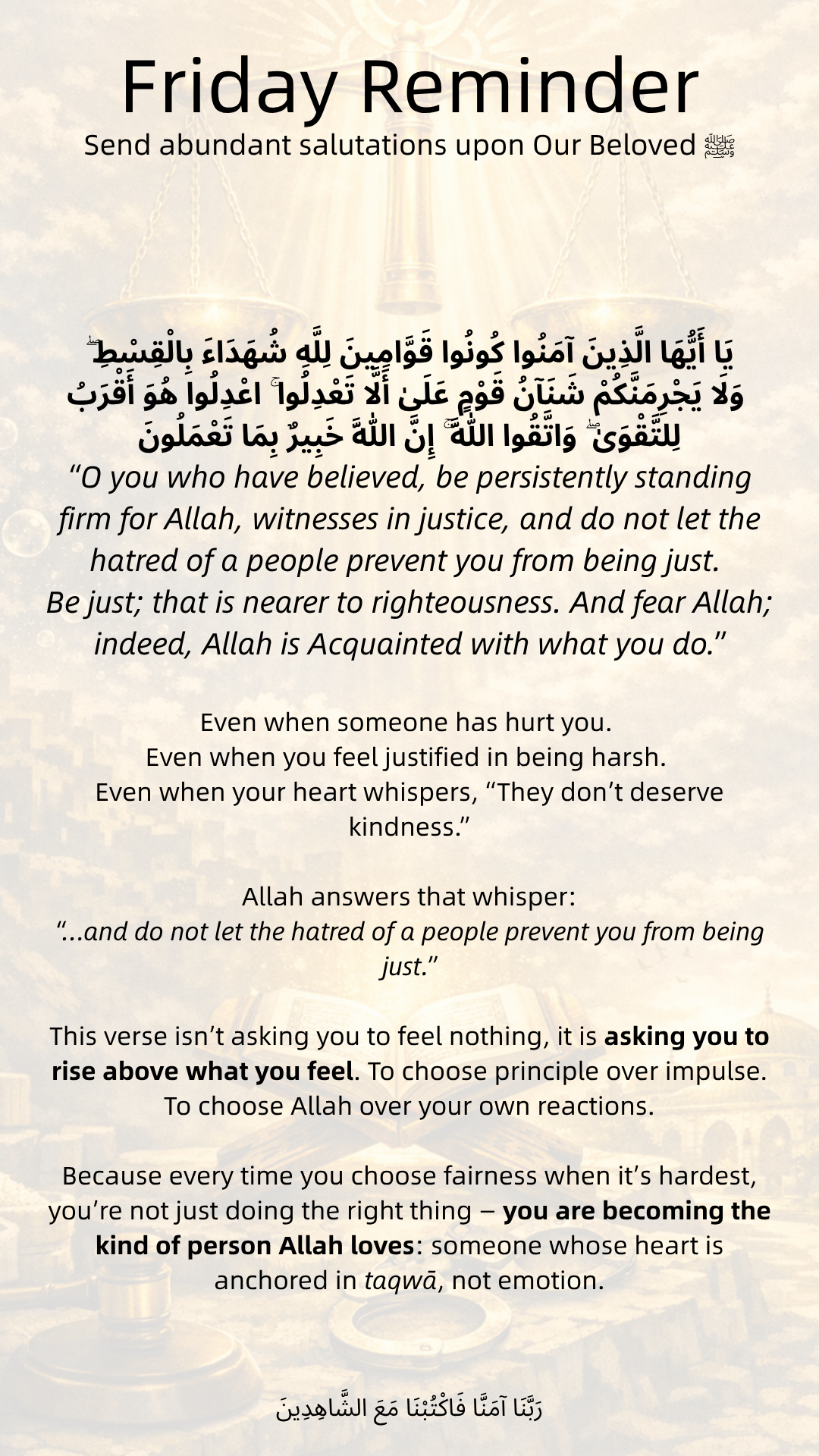
يَا أَيُّهَا الَّذِينَ آمَنُوا كُونُوا قَوَّامِينَ لِلَّهِ شُهَدَاءَ بِالْقِسْطِ
وَلَا يَجْرِمَنَّكُمْ شَنَآنُ قَوْمٍ عَلَىٰ أَلَّا تَعْدِلُوا
اعْدِلُوا هُوَ أَقْرَبُ لِلتَّقْوَىٰ ۖ وَاتَّقُوا اللَّهَ
إِنَّ اللَّهَ خَبِيرٌ بِمَا تَعْمَلُونَ
“O you who have believed, be persistently standing firm for Allah, witnesses in justice, and do not let the hatred of a people prevent you from being just. Be just; that is nearer to righteousness. And fear Allah; indeed, Allah is Acquainted with what you do.” (Surah Al-Ma’idah, 5:8)
This verse doesn’t come to you when you’re calm. It comes to you when your emotions are loud.
Islam doesn’t ask you to switch off your feelings.
You’re allowed to feel hurt. You’re allowed to feel anger.
But you’re not allowed to let those feelings decide what is right. And that’s where the real struggle begins.
Not the kind of struggle people applaud — but the kind that happens silently:
That moment — that tension — is عبادَة (worship).
The Prophet ﷺ said:
“The strong one is not the one who overcomes people by his strength, but the one who controls himself while in anger.” (Sahih al-Bukhari & Sahih Muslim)
Strength, in Islam, is redefined. It’s not dominance. It’s restraint.
What makes this verse so powerful is that it doesn’t just tell you what to do — it tells you when it matters most.
“Do not let the hatred of a people prevent you from being just.”
Not love. Not neutrality. Hatred.
Meaning: even when your heart is pushing you away from fairness — you are still commanded to return to it.
Because عدالت (justice) in Islam is not built on emotion. It’s built on principle. And principle doesn’t shift depending on who you’re dealing with.
Let’s be honest — choosing fairness when you’ve been wronged feels heavy.
Because your ego wants balance in a different way. It wants repayment. It wants recognition. It wants to win.
But Allah redirects you to something higher:
اعْدِلُوا هُوَ أَقْرَبُ لِلتَّقْوَىٰ
“Be just; that is nearer to taqwā.”
Because taqwā isn’t proven when it’s easy to be good. It’s proven when you could easily be unfair — and choose not to be.
Every time you choose fairness over reaction, something changes within you. You become less driven by impulse, and more grounded in purpose. Less controlled by people, and more conscious of Allah. And slowly, quietly, you become the kind of person this verse is describing:
قَوَّامِينَ لِلَّهِ — someone who stands for Allah, not for themselves.
We often think winning means having the last word. Or proving a point. Or making sure the other person feels what we felt. But this verse teaches a different measure.
Sometimes, winning is:
And even if no one notices…
Allah ends the verse with a reminder that settles everything:
إِنَّ اللَّهَ خَبِيرٌ بِمَا تَعْمَلُونَ
“Indeed, Allah is fully aware of what you do.”
Nothing escapes Him.
Not the anger you swallowed. Not the fairness you upheld. Not the moment you chose Him over your ego. And maybe that’s the point.
That in a moment where you had every reason to follow your feelings— you chose to stand for something higher.
رَبَّنَا آمَنَّا فَاكْتُبْنَا مَعَ الشَّاهِدِينَ
]]>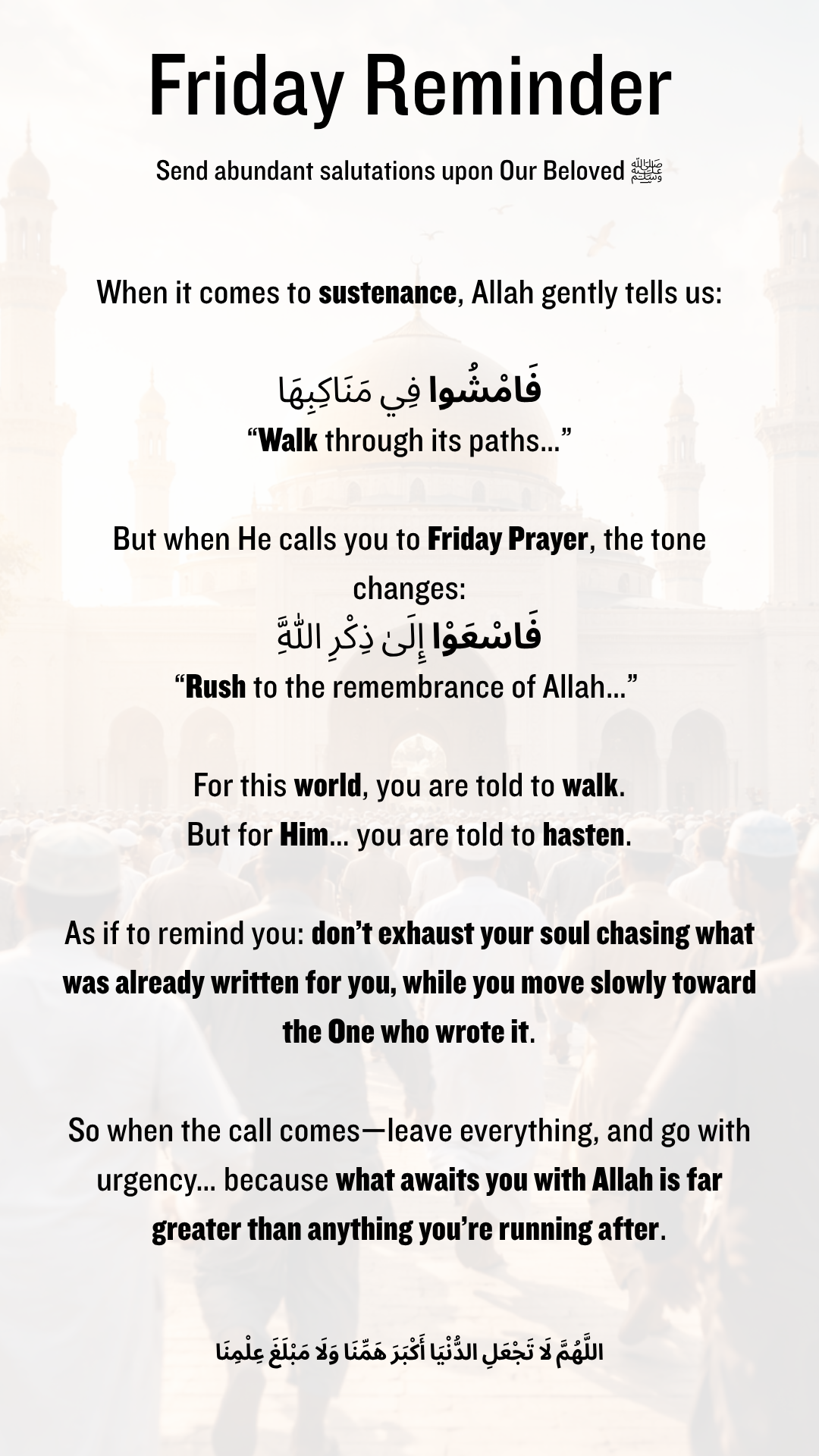
When it comes to sustenance, provision, and everything we spend our lives striving for, Allah says:
فَامْشُوا فِي مَنَاكِبِهَا وَكُلُوا مِن رِّزْقِهِ
“Walk through its paths and eat from His provision…” (Surah Al-Mulk 67:15)
The command is gentle: walk.
No urgency. No pressure. No desperation.
Because what is written for you will reach you, even if you move slowly.
The Messenger of Allah ﷺ said:
إِنَّ رُوحَ الْقُدُسِ نَفَثَ فِي رُوعِي أَنَّ نَفْسًا لَنْ تَمُوتَ حَتَّىٰ تَسْتَكْمِلَ رِزْقَهَا وَأَجَلَهَا
“The Holy Spirit has inspired in my heart that no soul will die until it has completed its provision and its lifespan…” (Ibn Ḥibbān)
Your rizq is not running away from you. It does not need to be chased with anxiety, nor seized with fear.
And yet, when Allah calls you to Jumu‘ah, the tone shifts completely:
يَا أَيُّهَا الَّذِينَ آمَنُوا إِذَا نُودِيَ لِلصَّلَاةِ مِن يَوْمِ الْجُمُعَةِ فَاسْعَوْا إِلَىٰ ذِكْرِ اللَّهِ وَذَرُوا الْبَيْعَ
“O you who believe, when the call is made for prayer on the day of Friday, then hasten to the remembrance of Allah and leave off trade… (Surah Al-Jumu‘ah 62:9)
Now the command is urgent: hasten.
Not walk. Not delay. Not “when you’re free.”
Leave your trade. Leave your transactions. Leave what you thought could not wait.
Because what you are being called to is greater than what you are being called away from.
This contrast is not accidental.
It is as if Allah is reminding us:
The Prophet ﷺ warned about this imbalance when he said:
مَن تَرَكَ ثَلَاثَ جُمَعٍ تَهَاوُنًا بِهَا طَبَعَ اللَّهُ عَلَىٰ قَلْبِهِ
“Whoever leaves three Friday prayers out of negligence, Allah will place a seal upon his heart.” (Abū Dāwūd)
This is not about a missed routine—it is about a drifting heart.
And on the other hand, the one who honors Jumu‘ah is given immense reward. The Prophet ﷺ said:
مَنِ اغْتَسَلَ يَوْمَ الْجُمُعَةِ… ثُمَّ مَشَىٰ وَلَمْ يَرْكَبْ… وَدَنَا مِنَ الْإِمَامِ… غُفِرَ لَهُ مَا بَيْنَهُ وَبَيْنَ الْجُمُعَةِ الْأُخْرَىٰ
“Whoever performs ghusl on Friday… then walks and does not ride… draws close to the Imam… will have his sins forgiven between that Friday and the next.” (Aḥmad)
Notice again: for Jumu‘ah, even your walking becomes an act of devotion when it is done with intention and presence.
So the lesson is not simply about physical movement—it is about the state of the heart.
For the dunya, Allah tells you to walk, because your provision is already written:
وَفِي السَّمَاءِ رِزْقُكُمْ وَمَا تُوعَدُونَ
“And in the heaven is your provision and that which you are promised.” (Surah Adh-Dhāriyāt 51:22)
But for Him, you are told to hasten, because your meeting with Him is what truly matters.
So when the call comes—Allāhu Akbar, Allāhu Akbar—pause and reflect:
Don’t exhaust your soul chasing what was already decreed for you,
while moving lazily toward the One who decreed it.
Leave what is in your hands, and respond with urgency.
Because whatever you think you might lose by going to Allah…
was never truly yours to begin with.
And whatever you gain with Allah…
is far greater than anything you could ever run after.
]]>
There are moments in life when the heart quietly slips into thinking that certain things are simply beyond reach. A door feels permanently closed. A prayer feels too delayed. A situation seems too tangled to ever be resolved. In those moments, the Qur’an gently redirects us to stories that remind us of who Allah is — and what He can do.
Surah Maryam opens with the intimate, trembling voice of Prophet Zakariyyah. Old in age, his hair white, his wife unable to bear children, he still turns to Allah with a whisper of hope. He doesn’t demand. He doesn’t insist. He simply asks, knowing that even the faintest prayer is heard by the One who never forgets His servants.
When the angels bring him the news of a child — Yahyā — Zakariyyah is stunned. Not doubtful, but overwhelmed. He asks again and again how such a thing could happen. His heart is witnessing a miracle that defies every law of nature he has known. Yet Allah reminds him that His power is not bound by human limits.
Then the surah shifts to Maryam, a young woman of purity and devotion. She is told of something even more incomprehensible — a child without a father. No logic, no precedent, no human explanation could make sense of it. Her heart trembles, and she seeks refuge from what she cannot understand.
But the message is the same.
What is impossible for creation is never impossible for the Creator.
Across both stories, Allah repeats a single, timeless truth:
إِذَا قَضَىٰ أَمْرًا فَإِنَّمَا يَقُولُ لَهُ كُن فَيَكُون
“When He decrees a matter, He only says to it, ‘Be,’ and it is.”
These stories are not just historical accounts. They are reminders for every believer who stands before a mountain they cannot move, a door they cannot open, or a future they cannot imagine.
If Allah could give Zakariyyah a child in old age…
If Allah could give Maryam a child without a father…
Then what burden of yours is truly beyond His power?
The same Lord who granted them the unimaginable is the same Lord who watches over you now.
So when your heart feels overwhelmed, whisper the duʿāʾ the Prophet ﷺ taught:
اللَّهُمَّ لَا سَهْلَ إِلَّا مَا جَعَلْتَهُ سَهْلًا، وَأَنْتَ تَجْعَلُ الْحَزْنَ إِذَا شِئْتَ سَهْلًا
O Allah, nothing is easy except what You make easy, and You can make hardship easy whenever You will.
]]>
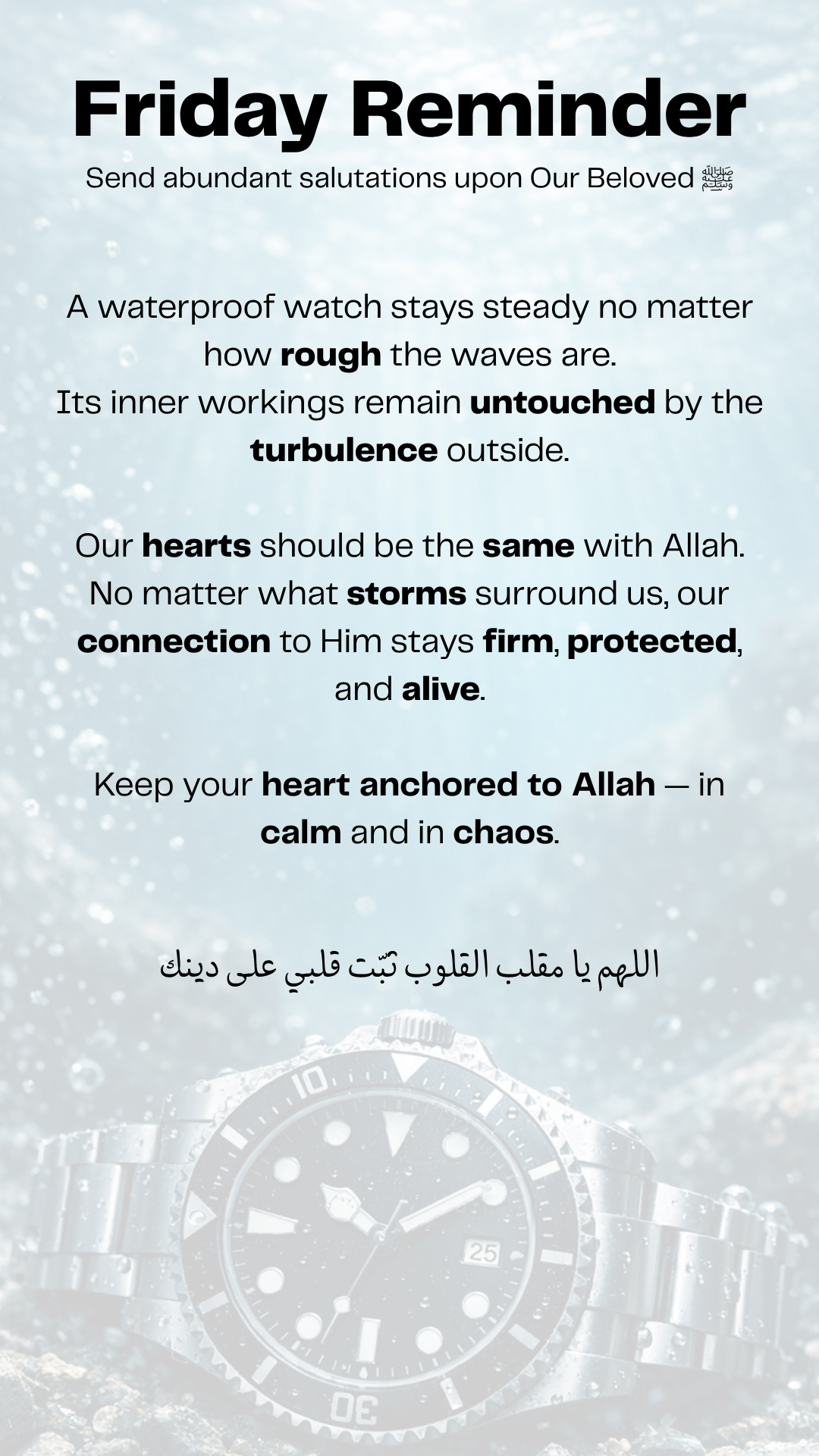
In a world filled with constant change, trials, and uncertainty, the believer is reminded to remain firm and grounded. Just as a waterproof watch remains unaffected by the waves that crash against it, the heart of a المؤمن (believer) should remain steady—anchored to Allah—regardless of the storms surrounding it.
Allah reminds us in the Qur’an:
“Indeed, in the remembrance of Allah do hearts find rest.”
(Sūrah Ar-Ra‘d 13:28)
True stability is not found in a life free of hardship, but in a heart that remains connected to its Creator through every hardship. When the الدنيا becomes turbulent, it is dhikr (remembrance), du‘ā, and reliance upon Allah that protect the inner state of a believer.
The Prophet ﷺ emphasised the importance of a firm heart, frequently making the du‘ā:
“O Turner of the hearts, keep my heart firm upon Your religion.”
(Jāmi‘ at-Tirmidhī)
This powerful supplication reflects a profound truth: hearts are constantly changing, and without Allah’s guidance, they can easily drift.
Life will inevitably bring moments of chaos, uncertainty, and difficulty. Yet the believer strives to remain inwardly calm—not because the storm is weak, but because their connection to Allah is strong.
Anchoring the heart to Allah means:
Turning to Him in ease and hardship
Trusting His decree with contentment
Remembering Him consistently
Seeking forgiveness and guidance often
When the heart is firmly attached to Allah, it remains alive, protected, and at peace—even when everything else feels unstable.
]]>
The Messenger of Allah ﷺ said:
“A true Muslim is one from whose tongue and hands others are safe, and a true believer is one who safeguards the lives and wealth of others.” (Nasāʾī)
In this profound hadith, the Prophet ﷺ defines faith not through rituals alone, but through the impact a believer has on the people around them. True Islam is not merely something we carry in our hearts or express in private devotion—it is something others feel through our character, our speech, and our behaviour.
The Prophet ﷺ teaches that a genuine Muslim is someone from whom no harm comes—neither through harsh words nor harmful actions. Their presence brings reassurance, not fear; comfort, not anxiety. They are careful with their tongue, knowing that a single word can wound more deeply than a weapon. They are mindful with their hands, ensuring they never violate the rights, dignity, or property of another.
A true believer, the Prophet ﷺ continues, is one who safeguards the lives and wealth of others. This is a powerful shift in perspective: faith is not only about avoiding harm, but actively protecting others. The believer becomes a guardian of trust, a person others feel safe around, someone who strengthens the fabric of their community through honesty, compassion, and responsibility.
This hadith reminds us that Islam is not a solitary journey. Our worship refines us, but our character reveals us. The measure of our faith is reflected in how we treat people—family, neighbours, colleagues, and even strangers. Every interaction becomes an opportunity to embody mercy, restraint, and integrity.
In a world where harm often spreads faster than healing, the Prophet ﷺ calls us to be sources of safety, kindness, and protection.
اللهم اجعلنا ممن سلم المسلمون من لسانه ويده، واملأ قلوبنا رحمةً وصدقا، واجعلنا مفاتيح للخير مغاليق للشر
O Allah, make us among those from whose tongue and hands others are safe. Fill our hearts with mercy and sincerity, and make us keys to goodness and locks against harm.
]]>
The story of ʿAmr ibn al‑ʿĀṣ is one of the most striking examples of how noble character can soften even the firmest opposition. Known for his sharp intellect, political skill, and military strength, ʿAmr initially stood among those who resisted the rise of Islam. Yet the very qualities he admired in leadership—integrity, consistency, and moral courage—were the qualities he witnessed most clearly in the Prophet Muhammad ﷺ.
ʿAmr ibn al‑ʿĀṣ later described the turning point that led him to embrace Islam. His words reveal not just admiration, but a deep recognition of prophetic truth:
“What convinced me of the truthfulness of this unlettered Prophet was that he never commands any good without being the first to act upon it, nor does he forbid any evil without being the first to abstain from it. When he is victorious, he remains humble, and when he faces defeat, he does not resort to abuse. He is true to his word and fulfills his promises. I bear witness that he is indeed a Prophet.”
This testimony captures the essence of the Prophet’s leadership. His message was not merely spoken—it was lived. His ethics were not theoretical—they were embodied. His victories never inflated him, and his challenges never compromised his principles.
ʿAmr’s reflection highlights several qualities that define prophetic character:
These qualities were not occasional; they were consistent. And it was this consistency—this unwavering alignment between word and action—that convinced a seasoned statesman like ʿAmr that Muhammad ﷺ was truly sent by God.
The story invites reflection on how character influences hearts more deeply than argument. People may debate ideas, but they cannot deny integrity when they see it lived. The most powerful daʿwah is not in speech alone, but in the quiet, steady truth of one’s actions.
اللهم ارزقنا صدق الاتباع، وحسن الاقتداء بنبيك، وثبّت قلوبنا على الحق قولًا وعملاً
O Allah, grant us true adherence and beautiful imitation of Your Prophet, and keep our hearts firm upon truth in word and deed.
]]>
Allah says:
وَإِذَا قُلْتُمْ فَاعْدِلُوا وَلَوْ كَانَ ذَا قُرْبَىٰ
“Whenever you speak, maintain justice—even regarding a close relative.”
This brief yet powerful command reminds us that integrity in speech is a core part of faith. Our words carry weight, and Allah calls us to use them with fairness, honesty, and balance—regardless of who is involved.
It is easy to be just when dealing with strangers. The real test appears when the truth affects someone close to us: a family member, a friend, someone we feel protective over. In those moments, personal loyalty can blur moral clarity. Yet the Qur’an insists that truth and justice must rise above emotion, habit, and social pressure.
To speak justly is to honour Allah before honouring people. It is to let principles guide the tongue, not personal ties. It is to recognise that fairness is an act of worship, and that every word is recorded.
May Allah grant us the strength to uphold truth in all circumstances.
اَللّٰهُمَّ أَسْأَلُكَ كَلِمَةَ الْحَقِّ فِي الرِّضَا وَالْغَضَبِ
O Allah, I ask You for a word of truth in times of calm and in times of anger
]]>
One of the most profound reminders given to us in the Qur’an is the certainty of death. It is a truth that every human being, regardless of status, wealth, or strength, will inevitably face.
A Qur’anic Reminder
Allah says:
كُلُّ نَفْسٍ ذَائِقَةُ الْمَوْتِ
“Every soul shall taste death.” (Sūrah Āli‑‘Imrān 3:185)
This short yet powerful verse is enough to awaken the heart. It reminds us that life is temporary, fragile, and fleeting. What remains eternal are our deeds and the state in which we meet our Lord.
The Prophet’s ﷺ Practice at the Grave
Death was not something the Prophet ﷺ ignored or avoided. Rather, he used it as a means to soften hearts and encourage reflection. It is narrated that:
Whenever the Prophet ﷺ finished the burial of the dead, he would stand over the grave and say:
“استغفروا لأخيكم وسلوا له التثبيت فإنه الآن يُسأل”
“Ask forgiveness for your brother, then ask that he may be strengthened, for he is now being questioned.” (Sunan Abī Dāwūd)
This moment at the graveside was not simply a ritual. It was a reminder that the journey of the deceased had entered a new phase — one in which only their deeds could accompany them.
Living with Purpose and Consciousness
Remembering death is not meant to create fear without direction. Instead, it is meant to inspire purposeful living. When we recognise that every breath is a gift and every action is recorded, our priorities naturally shift.
We begin to:
• Choose actions that draw us closer to Allah, rather than those that distract us.
• Model our character on the Sunnah of the Prophet ﷺ, striving for kindness, honesty, humility, and patience.
• Repent frequently, knowing that our hearts are in constant need of cleansing.
• Value time, understanding that it is one of the greatest blessings we will be questioned about.
Preparing for the Inevitable
The believer does not fear death in a hopeless way. Instead, they prepare for it with hope, effort, and trust in Allah’s mercy. By living with awareness, we aim to meet that final moment with:
• A firm heart, grounded in faith.
• A peaceful soul, content with Allah’s decree.
• A record of deeds, filled with sincerity and striving.
A Final Reflection
Death is not the end; it is the beginning of the true life. The wise person is the one who prepares for what is certain. Let this reminder soften our hearts, refine our actions, and draw us closer to the One who created us.
رَبَّنَا اغْفِرْ لَنَا وَلِإِخْوَانِنَا الَّذِيْنَ سَبَقُوْنَا بِالْإِيْمَانِ وَلَا تَجْعَلْ فِيْ قُلُوْبِنَا غِلًّا لِّلَّذِيْنَ اٰمَنُوْا رَبَّنَآ إِنَّكَ رَءُوْفٌ رَّحِيْمٌ
]]>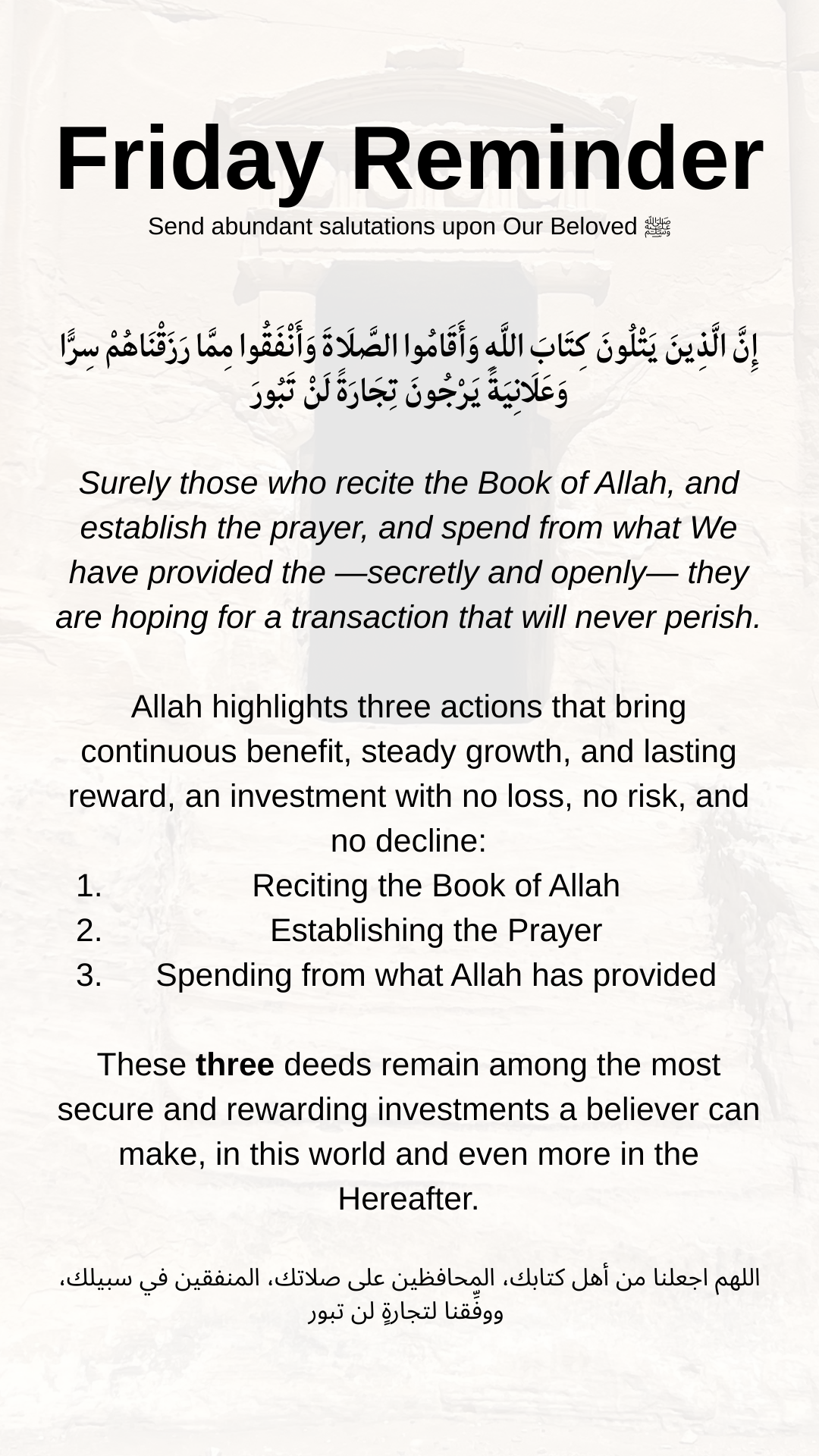
Allah says:
إِنَّ الَّذِينَ يَتْلُونَ كِتَابَ اللَّهِ وَأَقَامُوا الصَّلَاةَ وَأَنْفَقُوا مِمَّا رَزَقْنَاهُمْ سِرًّا وَعَلَانِيَةً يَرْجُونَ تِجَارَةً لَنْ تَبُورَ
“Surely those who recite the Book of Allah, establish the prayer, and spend from what We have provided them—secretly and openly—are hoping for a transaction that will never perish.”
This verse highlights three timeless actions that form the most secure spiritual investment a believer can make—an investment with no risk, no loss, and no decline.
Engaging with the Qur’an nourishes the heart and illuminates the path. Every recitation strengthens faith, deepens understanding, and brings reward that continues to grow.
Prayer is the believer’s daily anchor. It brings discipline, peace, and a constant return to purpose. When performed with consistency and devotion, it becomes a source of stability and spiritual profit.
Giving—whether quietly or openly—purifies wealth and uplifts others. It transforms temporary possessions into lasting reward and builds a legacy that continues long after one departs this world.
Together, these three deeds form a portfolio of actions that never depreciate. They enrich the soul, strengthen community, and secure reward in the Hereafter. In a world full of uncertainty, Allah offers a promise of absolute stability: a trade that will never fail.
اللهم اجعلنا من أهل كتابك، المحافظين على صلاتك، المنفقين في سبيلك، ووفِّقنا لتجارةٍ لن تبور
O Allah, make us among the people of Your Book, those who uphold the prayer, give in Your path, and grant us a transaction that will never perish.
]]>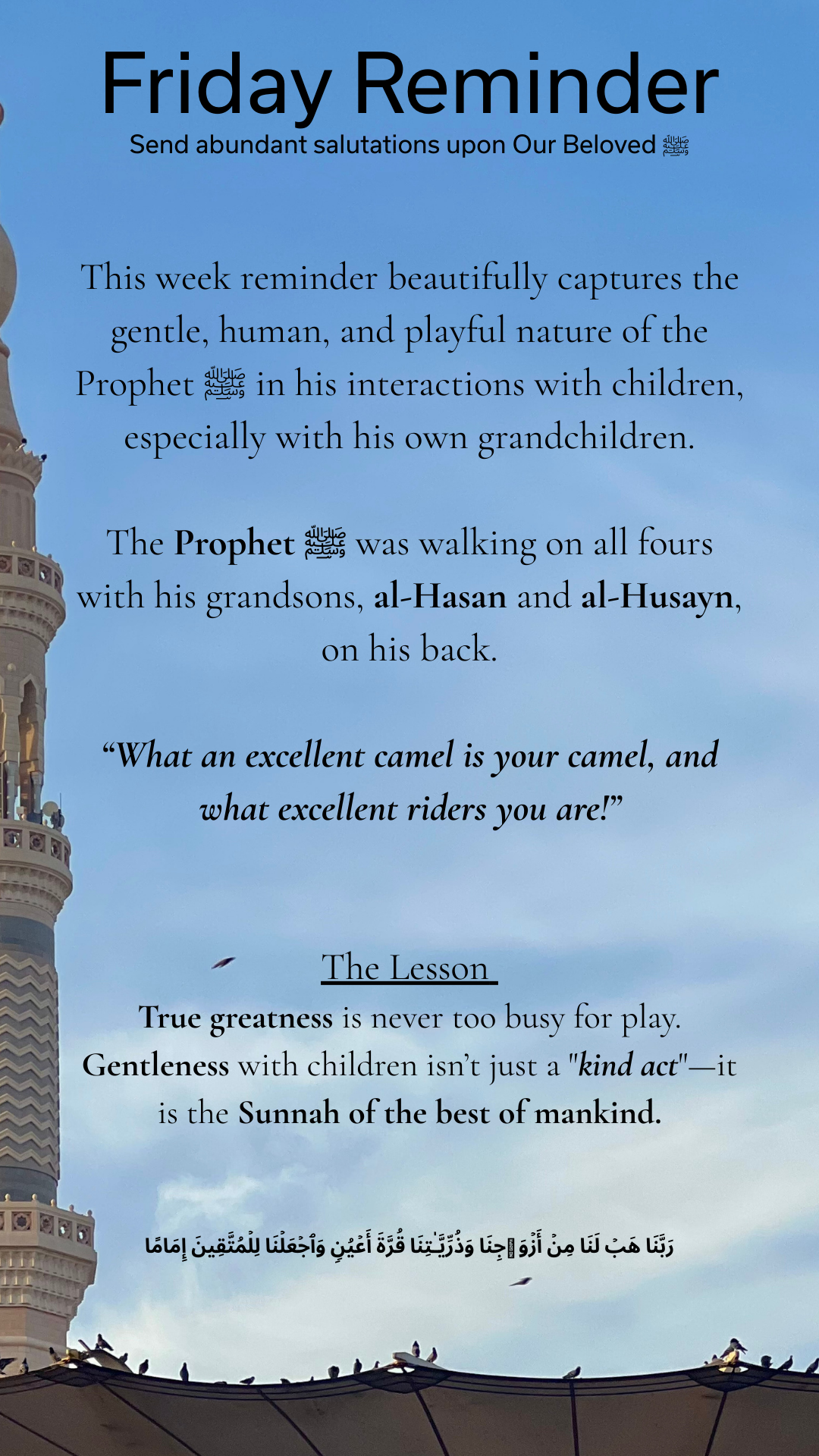
In our modern, fast-paced world, we often measure “greatness” by productivity, titles, and the weight of our responsibilities. We wear our busyness like a badge of honour, often at the expense of the little eyes watching us from below. However, a beautiful narration from the life of the Prophet Muhammad ﷺ reminds us that true stature is found in the ability to stoop down to a child’s level.
Imagine the scene: The man chosen to lead an entire Ummah, the Final Messenger ﷺ, is found on his hands and knees. On his back sit his beloved grandsons, al-Hasan and al-Husayn. He isn’t just supervising them; he is active in their joy, acting as their “camel” in a moment of pure, unscripted play.
When an onlooker witnessed this scene, Prophet ﷺ said, “What an excellent camel is your camel!” the Prophet ﷺ didn’t feel embarrassed or reassert his authority. Instead, the moment was completed with a compliment to the children: “And what excellent riders you are!”
Greatness is Never Too Busy: If the man carrying the weight of Revelation could find time to crawl on the floor for a child, none of us are “too busy” to put down our phones and engage.
The Sunnah of Gentleness: Compassion toward children isn’t a secondary trait; it is a core prophetic practice. Gentleness (Rifq) validates a child’s worth and builds a foundation of security and love.
Play as Worship: This interaction shows that nurturing the hearts of the next generation through joy is, in itself, an act of spiritual excellence.
As we strive to embody this prophetic gentleness, we turn to the beautiful supplication from the Qur’an:
رَبَّنَا هَبۡ لَنَا مِنۡ أَزۡوَ ٰجِنَا وَذُرِّیَّـٰتِنَا قُرَّةَ أَعۡیُنࣲ وَٱجۡعَلۡنَا لِلۡمُتَّقِینَ إِمَامًا
“Our Lord, grant us from among our spouses and offspring comfort to our eyes and make us an example for the righteous.” (Surah Al-Furqan, 25:74)
Let us remember that to be an “example for the righteous” often starts on the living room floor, playing with those who call us home.
]]>
Prophet ﷺ said:
وَالصَّبْرُ ضِيَاءٌ
“Patience is a radiant light.”
When the Prophet ﷺ described patience as ضياء, he was showing us that:
1. Patience is not passive — it is an active form of worship.
2. Patience burns away confusion.
3. Patience has heat—meaning it involves struggle.
4. Patience gives spiritual vision.

Dua
اَللّٰهُمَّ لَا سَهْلَ إِلَّا مَا جَعَلْتَهُ سَهْلًا، وَأَنْتَ تَجْعَلُ الْحَزْنَ إِذَا شِئْتَ سَهْلًا
Allāhumma lā sahla illā mā jaʿaltahū sahlā, wa anta tajʿalu-l-ḥazna idhā shi’ta sahlā.
O Allah, there is no ease except what You make easy, and You make hardship easy when You will.
— Reported from Anas b. Mālik (raḍiyallāhu ʿanhu)
(Ibn Ḥibbān 6737, Ibn al-Sunnī 351)

Life is often described in the Qur’an as a journey of testing. These trials are not signs of Allah’s displeasure; rather, they are often a hallmark of His love. As the Prophet Muhammad ﷺ said, “The people most severely tested are the Prophets, then the next best, then the next best.”
When we face hardships, our perspective often narrows to our own pain. By looking at the lives of those who came before us, we shift our focus from “Why is this happening?” to “How can I grow through this?”
1. The Trial of Loneliness and Family Conflict
Often, our deepest wounds come from those closest to us, or from a profound sense of being “the only one.”
• Adam (ʿalayhi as-salām) | Loneliness: Imagine being the first of your kind, navigating an entire world without a peer. When you feel misunderstood or solitary in your faith, remember that the father of humanity began his journey in total reliance on Allah alone.
• Ibrāhīm (ʿalayhi as-salām) | Parental Rejection: For many, the greatest heartache is a parent who doesn’t understand or support their path. Ibrāhīm (AS) faced a father who threatened him for his beliefs. He responded with grace and a prayer for his father’s forgiveness, teaching us that our duty to Allah stands above all, even when it costs us familial comfort.
• Yūsuf (ʿalayhi as-salām) | Betrayal by Peers: Betrayal by siblings or friends can lead to deep cynicism. Yūsuf (AS) was thrown into a well by those who should have protected him. His story reminds us that human betrayal cannot thwart Divine decree; what was meant to destroy him actually positioned him for greatness.
2. The Trial of Reputation and Social Pressure
In an age of social media and “cancel culture,” the fear of being mocked or slandered is pervasive.
• Prophet Muhammad ﷺ | Social Hardship: He was called a sorcerer, a liar, and was pelted with stones. He lost his wealth, his status, and his beloved wife Khadijah (RA) during the most difficult years. His life is a testament to the fact that perseverance (Sabr) is the key to ultimate victory.
• ʿĀʾishah (may Allah be pleased with her) | Slander: The “Incident of the Slander” (Ifk) is a profound lesson for anyone whose character has been questioned. She remained patient while the entire city whispered about her, until Allah Himself cleared her name in the Qur’an. She teaches us that Allah is the ultimate defender of the innocent.
3. The Trial of Physical and Internal Limitations
Our bodies and our abilities are also a terrain for spiritual growth.
• Ayūb (ʿalayhi as-salām) | Chronic Illness: After losing his wealth, his children, and his health, Ayūb (AS) never complained against Allah. He showed us that patience is not just waiting; it is keeping a good attitude while waiting.
• Mūsā (ʿalayhi as-salām) | Physical Impediment: Mūsā (AS) had a speech impediment and felt inadequate to face Pharaoh. Yet, Allah chose him to lead an entire nation. His story teaches us that Allah does not call the qualified; He qualifies the called. Our “weaknesses” are often the very things that make our reliance on Him more sincere.
4. The Trial of the Unknown and Being “Trapped”
Sometimes, we feel stuck in situations where we see no logical exit, or we are asked to work toward a goal we don’t fully understand.
• Yūnus (ʿalayhi as-salām) | Feeling Trapped: In the darkness of the whale’s belly, at the bottom of the ocean, there was no physical way out. Yūnus (AS) turned inward and called upon Allah with his famous prayer: “There is no deity except You; exalted are You. Indeed, I have been of the wrongdoers.” He proves that no matter how deep the “whale” you are in, Allah can hear your whisper.
• Nūḥ (ʿalayhi as-salām) | Trusting the Process: Building an ark in the middle of a desert made no sense to the onlookers. Nūḥ (AS) endured centuries of mockery because he trusted the Divine command over his own logic. He teaches us that obedience to Allah provides safety, even when the “storm” hasn’t arrived yet.
Moving Forward
The next time a difficulty arises, don’t just ask “Why?” Instead, ask, “Whose path am I walking on right now?” Whether it is the loneliness of Adam or the patience of Ayūb, you are in the company of the greatest humans to ever live.
]]>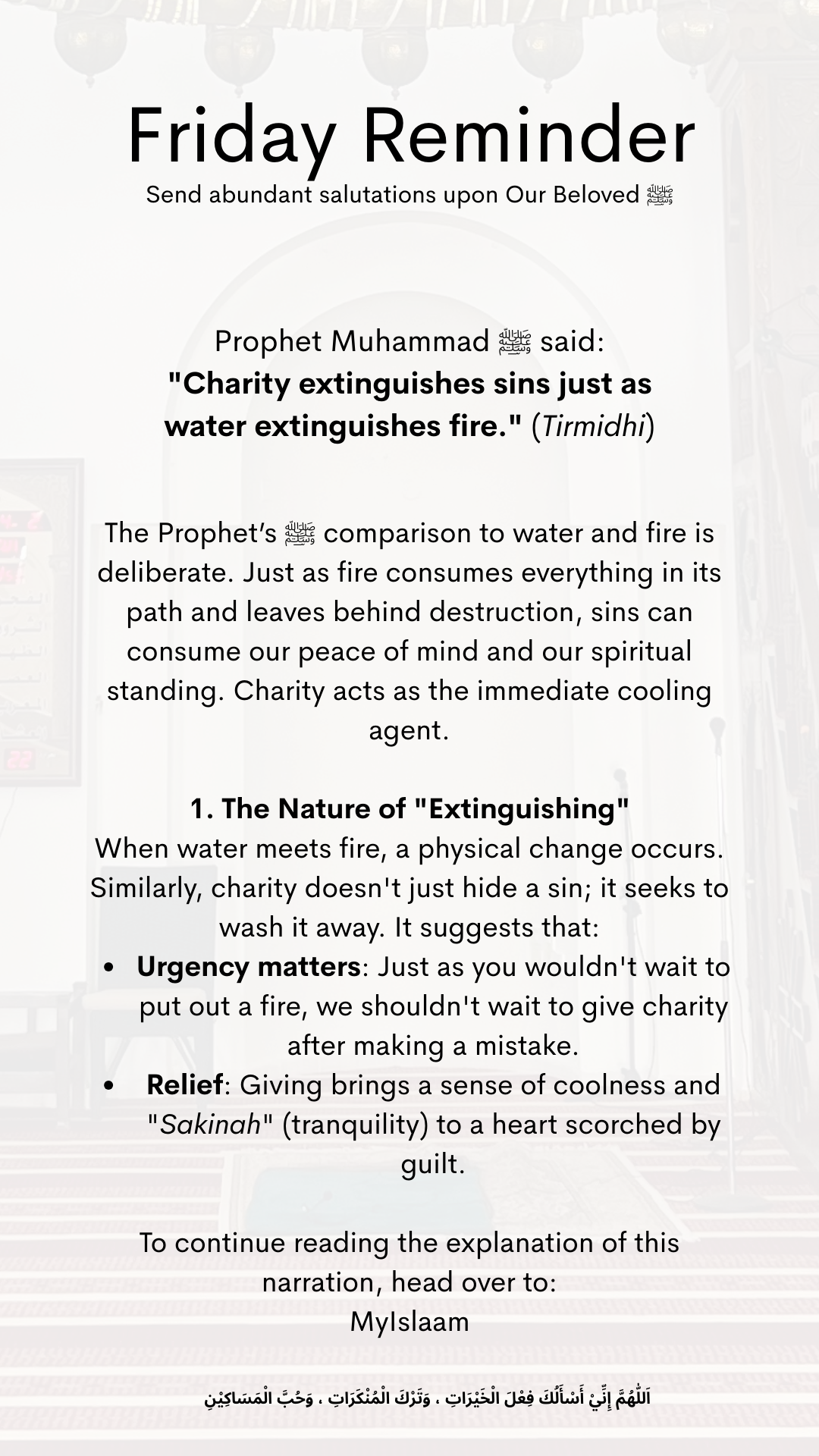
Prophet Muhammad ﷺ said: “Charity extinguishes sins just as water extinguishes fire.” (Tirmidhī)
The Prophet’s ﷺ comparison to water and fire is deliberate. Just as fire consumes everything in its path and leaves behind destruction, sins can consume our peace of mind and our spiritual standing. Charity acts as the immediate cooling agent.
1. The Nature of “Extinguishing”
When water meets fire, a physical change occurs. Similarly, charity doesn’t just hide a sin; it seeks to wash it away. It suggests that:
2. Sincerity Over Quantity
The “water” of charity can be a massive flood or a single drop. In Islamic tradition, the value is in the intent (Niyyah).
3. The “Fire” of the Hereafter
Scholars also note that this “fire” refers to the consequences in the afterlife. Charity acts as a shield or a barrier, cooling the heat of the Day of Judgment for the believer.
Key Takeaway: Charity is a spiritual reset button. No matter how “burnt” we feel by our own shortcomings, a sincere act of kindness provides the water needed to start fresh.
]]>
The Arabic term Niyyah (نِيَّة) literally means ‘intention,’ ‘purpose,’ or ‘determination.’ In Islamic jurisprudence and spirituality, it carries a very precise and critical meaning.
The centrality of Niyyah is established by a famous Ḥadīth:
“Actions are but by intention, and every man shall have but that which he intended…” (Bukhārī & Muslim)
The Hadith you provided beautifully illustrates how intention governs the recording of both good and bad deeds.
The moment a person makes a sincere intention to perform a good deed, they are immediately rewarded. This means the Niyyah itself is a deed of the heart.
Example: A person resolves: “Tomorrow, I will give $10 to charity.”
Scenario 1 (Reward): If they fall ill and cannot leave the house, the Niyyah alone is recorded as a complete good deed.
Scenario 2 (Multiplied Reward): If they follow through, the original Niyyah is rewarded (1 point), and the Action is multiplied (10x to 700x).
In the case of avoiding sin, the Niyyah acts as a spiritual defense system:
Scenario: A person intends to lie to gain an advantage but then remembers Allah and thinks: “I will not lie, because I fear Allah.”
The Intention to sin is not recorded.
The subsequent Niyyah to abandon the sin for Allah’s sake is rewarded as a full good deed (1 Point).
The ultimate practical lesson of the Niyyah is to constantly purify the heart. Before starting any action—whether praying, studying, working, or resting—one should ask: “Why am I doing this? Is my purpose to please Allah?” This internal check ensures that even simple, daily activities can become a source of multiplied rewards.
]]>
Winter often brings with it cold mornings, early sunsets, heavy clouds, and long stretches of darkness. For many, this season feels heavy — a time of low energy, shorter days, and grey moods. But for the believer, winter holds a quiet secret: it is the easiest doorway to one of the greatest acts of worship.
A man once asked al-Ḥasan al-Baṣrī:
“O Abū Saʿīd, what is the best deed by which a servant draws near to Allah?”
He replied:
“I do not know of anything by which those who draw near to Allah come closer than when a person rises in the depths of the night to perform prayer.”
These words carry even more weight when winter arrives.
The nights stretch long, the world slows down, and silence deepens. Where others might see darkness, the righteous saw opportunity. They used to say:
“Winter is the believer’s spring.”
Because its long nights make standing before Allah easier, softer, more attainable than at any other time of year.
There is a unique sweetness in waking when the world sleeps — to whisper duʿā’, to bow in gratitude, to feel your forehead touch the ground in the quiet hours before dawn. This is a closeness that daytime worship does not replicate.
The Prophet ﷺ said:
“Hold tight to the night prayer. It was the practice of the righteous before you. It brings you closer to your Lord, wipes away sins, and prevents wrongdoing.” (Tirmidhī)
Even if it is just ten minutes before Fajr, even if it is two simple rakaʿāt — those moments carry a weight that transforms the heart.
The early Muslims would say that the delight they found in night prayer was greater than the delight others found in entertainment. Some nights, their hearts would almost leap from joy simply remembering Allah, to the point they would say:
“If the people of Paradise experience anything like this, how blissful must their lives be!”
Winter offers what no other season does: nights long enough to rest and rise. The cold air, the stillness, the quiet hours — they all make qiyām easier, gentler, more inviting.
Instead of letting this season pass as a time of gloom or heaviness, turn it into a season of nearness. Let the long nights become moments of whispered duʿā’, renewed resolve, and sincere connection.
Start small. Wake a few minutes early. Pray two rakaʿāt. Ask Allah for what weighs on your heart. Build slowly, consistently, lovingly.
Because qiyām isn’t only an act of worship — it is a gift.
رَبَّنَا هَبْ لَنَا مِن لَّدُنكَ رَحْمَةً
“Our Lord, grant us mercy from Yourself.”

أَمَّن يُجِيبُ ٱلْمُضْطَرَّ إِذَا دَعَاهُ وَيَكْشِفُ ٱلسُّوٓءَ وَيَجْعَلُكُمْ خُلَفَآءَ ٱلْأَرْضِ ۗ أَءِلَـٰهٌۭ مَّعَ ٱللَّهِ ۚ قَلِيْلاً مَّا تَذَكَّرُونَ
“Who responds to the desperate one when he calls upon Him, removes hardship, and makes you successors on the earth? Is there any god besides Allah? Little do you reflect.”
This verse teaches us three important lessons about Allah and our purpose in life.
First, Allah alone responds to those in distress. Ibn Kathīr explains that when a person is truly in need, there is no one to turn to except Allah, and only He can remove their hardship. One narration from a man of the Hujaymī tribe records the Prophet ﷺ saying, “I call to Allah alone, who, if harm touches you and you call Him, He removes it.” (Aḥmad) This reminds us to place our trust in Allah in times of difficulty.
Second, Allah grants humans the role of stewards on the earth. Ibn Kathīr writes that He appoints each generation to succeed the previous one, spreading humanity across time and space with wisdom. This teaches us that while we rely on Allah for help, we also have a responsibility to care for the world and the people around us.
Finally, the verse reminds us to reflect on the uniqueness of Allah. There is no god beside Him. He alone has the power to respond to our calls, remove hardships, and shape the destiny of humankind. This encourages mindfulness and gratitude in every aspect of our lives.
In essence, this verse invites us to turn to Allah in our struggles, trust in His wisdom, and embrace our responsibility as caretakers of the earth.
]]>
The Islamic tradition offers timeless guidance to shape a believer’s heart, behaviour, and relationships. The following principles come from the Qur’an and the Sunnah. Each one carries a reference from the Islamic sources.
1. أحسنوا الظن بالله — Think Well of Allah
A believer maintains hope and trust in Allah at all times, especially in moments of difficulty. Having good expectations of Allah is an act of worship and a sign of a heart filled with faith.
The Prophet ﷺ said: “None of you should die except while assuming the best about Allah.” (Ṣaḥīḥ Muslim)
2. سل الله العفو والعافية — Ask Allah for Pardon and Well-Being
Well-being in body, soul, and life is among the greatest gifts a person can receive. The Prophet ﷺ encouraged the believers to frequently ask Allah for pardon and well-being.
The Prophet ﷺ said: “Ask Allah for pardon and well-being, for no one is given anything better after certainty in faith than well-being.” (Sunan at-Tirmidhī)
3. استوصوا بالنساء خيرا — Treat Women with Kindness
The Prophet ﷺ honoured women and emphasised their rights and dignity. He reminded the ummah repeatedly to be gentle, fair, and kind toward women.
The Prophet ﷺ said: “Treat women kindly.” (Ṣaḥīḥ al-Bukhārī & Muslim)
4. اتق الله حيثما كنت — Fear Allah Wherever You Are
Taqwā is a constant state of awareness. The believer carries it in private and in public, in ease and in hardship, wherever they may be.
The Prophet ﷺ said: “Fear Allah wherever you are.” (Sunan at-Tirmidhī)
5. الكلمة الطيبة صدقة — A Kind Word Is Charity
Charity is not limited to giving money. A sincere and gentle word that uplifts another person is also counted as charity.
The Prophet ﷺ said: “A good word is charity.” (Ṣaḥīḥ al-Bukhārī & Muslim)
6. أقيموا الصلاة — Establish Prayer
Prayer is the foundation of spiritual life. Establishing prayer means performing it regularly, properly, and with presence of heart.
Allah says: “Establish the prayer.” (Qurʾān 2:43)
7. ارحموا الناس — Be Merciful to Others
Mercy is at the heart of the Prophet’s message. Showing mercy to people invites the mercy of Allah upon oneself.
The Prophet ﷺ said: “Be merciful to those on earth and the One above the heavens will be merciful to you.” (Sunan at-Tirmidhī)
8. أخلصوا النية — Purify Your Intention
The sincerity of intention gives value to every action. Every good deed begins with a pure and clear intention.
The Prophet ﷺ said: “Actions are only by intentions.” (Ṣaḥīḥ al-Bukhārī & Muslim)
9. أدّوا الأمانة — Keep Trust
Trustworthiness is one of the strongest signs of true faith. A believer returns what they are entrusted with, whether it is property, responsibility, or a promise.
The Prophet ﷺ said: “Render the trust to the one who entrusted you.” (Sunan Abī Dāwūd)
These principles guide the believer toward sincerity, mercy, trust, and devotion. When a person lives by them, their heart becomes purified and their character becomes a source of goodness for others. Through these teachings, the light of the Qur’an and the Sunnah shines in both private and public life.
اللَّهُمَّ اهْدِنِي لِأَحْسَنِ الأَخْلَاقِ، لا يَهْدِي لِأَحْسَنِهَا إِلَّا أَنْتَ، وَاصْرِفْ عَنِّي سَيِّئَهَا، لا يَصْرِفُ عَنِّي سَيِّئَهَا إِلَّا أَنْتَ
“O Allah, guide me to the best of character, for none can guide to its best except You, and turn me away from bad character, for none can turn it away except You.”

Always make duʿā, even for the simplest matters, the ones you feel perfectly capable of handling on your own. Even when life feels calm, steady, and free of hardship, make duʿā.
Why? Because the one who turns to Allah in moments of ease will find their heart instinctively drawn to Him in moments of difficulty. The soul that is trained to rely upon its Lord in peace will not panic when tested by the storm.
The Prophet ﷺ said:
“Remember Allah in times of ease and He will remember you in times of hardship.” (Tirmidhī)
He ﷺ also said:
“Let each one of you ask his Lord for all his needs, even for a lace of his sandal when it breaks.” (Tirmidhī)
These words remind us that duʿā is not only for moments of desperation. It is an act of love and recognition, a declaration that every blessing, big or small, comes only by the will of Allah. When you ask Allah for the tiniest of things, for guidance in a decision, for patience in your day, even for something as small as a missing shoelace, you are acknowledging His constant presence in your life.
Making duʿā in times of ease is a form of gratitude. It softens the heart, nurtures humility, and keeps the soul aware of its need for its Creator. It prevents the illusion of self-sufficiency, the silent belief that we can manage without Him.
And when hardship eventually arrives, as it always does in the journey of life, the heart that has been in constant conversation with Allah will not need to search for words or direction. It will instinctively turn back to Him, finding comfort in familiar nearness.
So keep making duʿā in every season, through every emotion, and for every need.
Because when you remember Allah in your ease, He will remember you in your hardship.
And in those moments of difficulty, you will not just be calling out to Him — you will find that He has already turned His mercy toward you.

Your Lord never forgets.
وَمَا كَانَ رَبُّكَ نَسِيًّا
“And your Lord is never forgetful.” [Maryam 19:64]
There is a verse that should strike like an arrow into the heart of every oppressor and bring deep, abiding comfort to every oppressed soul.
When life feels unfair, when wrongs seem unanswered, when prayers go unanswered for years, this verse quietly echoes through the corridors of the heart. It reminds us that while human memory fades, divine memory never does. Allah overlooks when He wills, forgives whom He wills, turns sins into good deeds, and raises the most hopeless hearts to the highest ranks of mercy, but He never forgets.
Every tear, every injustice, every hidden act of goodness is preserved with Him. Nothing slips past His awareness. This is not the forgetfulness of delay, it is the patience of divine wisdom.
To trust in that is to find peace amid the storm. To remember that is to know that justice is not always loud, but it is always certain.
In moments when you feel unseen or forgotten, turn to the duʿāʾ of the Prophet ﷺ:
اللهم لا تجعلني في نفسي، ولا تكلني إلى نفسي طرفة عين
“O Allah, do not leave me to myself, nor entrust me to my own soul even for the blink of an eye.” (Abū Dāwūd)
For the One who never forgets you will never abandon you.
Let that resonate, not as a mere verse, but as a lifeline.
]]>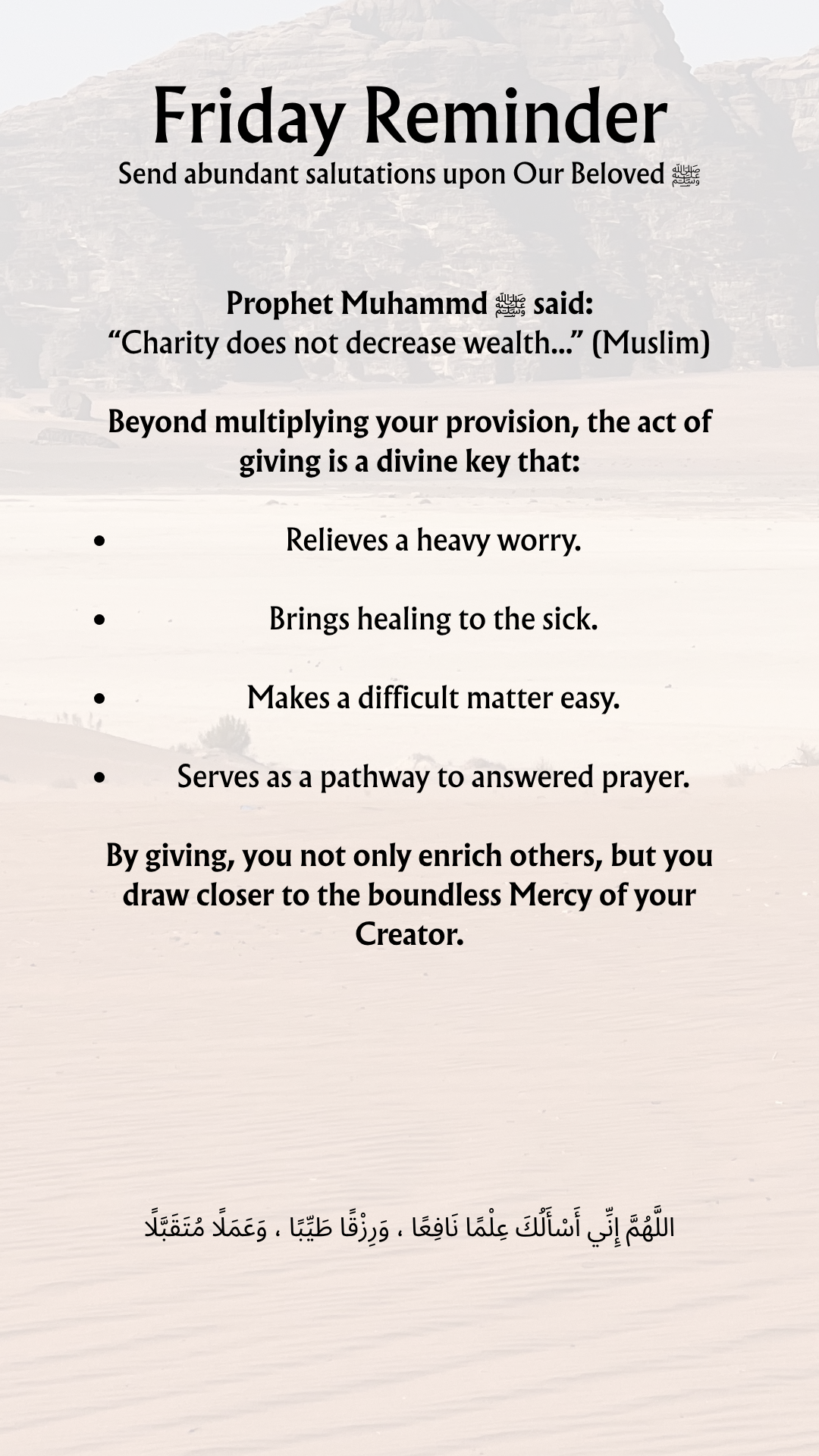
The Prophet Muhammad ﷺ said:
“Charity does not decrease wealth.”(Ṣaḥīḥ Muslim)
At first glance, this statement seems to defy logic. How can giving away what we own not reduce it? Yet, this timeless truth unveils one of the most profound spiritual laws in Islam: what is given for the sake of Allah is never lost.
In the unseen economy of the Divine, charity (ṣadaqah) multiplies wealth rather than diminishes it. The hand that gives is the one most deserving of increase. The one who shares what they love for Allah’s sake finds that blessings flow to them in ways beyond material calculation, through ease, contentment, and unexpected openings.
The effects of charity extend far beyond financial blessing. The act of giving is a divine key that unlocks multiple doors of goodness.
It relieves a heavy worry. When you give, you invite divine comfort into your own life. Many have experienced that a burden lifts after helping someone else carry theirs.
It brings healing to the sick. The Prophet ﷺ taught, “Treat your sick with charity.” (al-Ṭabarānī)
Giving opens the heart to mercy, and mercy invites healing both physical and spiritual.
It makes a difficult matter easy. Sometimes what stands between us and relief is an act of generosity. Charity brings barakah, divine increase, to one’s time, efforts, and affairs.
It serves as a pathway to answered prayers. The one who gives sincerely for Allah’s sake finds their supplications traveling swiftly toward acceptance.
In giving, you are not merely transferring wealth; you are investing in eternity. You are declaring that your trust lies not in possessions but in the Sustainer of all provision, Ar-Razzāq. Each coin given and each kindness offered becomes a seed planted in the fertile soil of faith, destined to blossom in this world and the next.
So the next time you give, do so with certainty, knowing that every act of generosity draws you nearer to the boundless Mercy of your Creator. For in truth, it is not wealth that grows less when we give, but hearts that grow richer.
]]>
Allah ﷻ says in Sūrah al-Balad:
أَلَمْ نَجْعَل لَّهُ عَيْنَيْنِ، وَلِسَانًا وَشَفَتَيْنِ، وَهَدَيْنَاهُ النَّجْدَيْنِ
“Have We not made for him two eyes, and a tongue, and two lips, and shown him the two paths?” (Qurʾān 90:8–10)
This short passage is both a reminder and a reckoning. It draws our attention to the blessings that we often take for granted. Eyes to see, a tongue to speak, and guidance to distinguish right from wrong. All of these are signs from Allah, pointing to both His generosity and His expectation that we use these gifts with purpose.
One night, the righteous scholar Al-Fuḍayl ibn ‘Iyāḍ (رحمه الله) recited these verses and began to weep. When asked why, he said:
“Have you ever spent a night thanking Allah for granting you two eyes with which you see?
Have you ever spent a night thanking Allah for granting you a tongue with which you speak?”
Then he continued listing the endless blessings that surround us, the ones so constant that they fade into the background of our lives.
His words echo the Qur’anic truth:
وَإِن تَعُدُّوا نِعْمَتَ اللَّهِ لَا تُحْصُوهَا
“And if you were to count the favour’s of Allah, you could not enumerate them.” (Qurʾān 16:18)
Our eyes, tongue, hands, and time are among the greatest trusts (amānāh) Allah has placed in our care. Yet they are often the very blessings we use carelessly. The Prophet ﷺ said:
“نِعْمَتَانِ مَغْبُونٌ فِيهِمَا كَثِيرٌ مِنَ النَّاسِ: الصِّحَّةُ وَالْفَرَاغُ”
“There are two blessings that many people are deceived concerning: health and free time.”(Ṣaḥīḥ al-Bukhārī, 6412)
Health and time are the two things most wasted yet most missed once they are gone. The eyes that see Qurʾān today may one day dim. The tongue that recites dhikr may one day fall silent. Gratitude is not just an emotion; it is a state of mindful use.
The Prophet ﷺ advised us with timeless wisdom:
“اغْتَنِمْ خَمْسًا قَبْلَ خَمْسٍ: شَبَابَكَ قَبْلَ هَرَمِكَ، وَصِحَّتَكَ قَبْلَ سَقَمِكَ، وَغِنَاكَ قَبْلَ فَقْرِكَ، وَفَرَاغَكَ قَبْلَ شُغْلِكَ، وَحَيَاتَكَ قَبْلَ مَوْتِكَ”
“Take advantage of five before five: your youth before your old age, your health before your sickness, your wealth before your poverty, your free time before your busyness, and your life before your death.” (Reported by al-Ḥākim and al-Bayhaqī)
This ḥadīth is not only a call to action but a reminder of accountability. Each of these five is a temporary gift. They fade, they shift, and when they are gone, the only thing that remains is how we used them.
When we reflect on Al-Fuḍayl’s tears, we are reminded that gratitude (shukr) is not limited to words like “alḥamdulillāh.” True gratitude is to use Allah’s blessings in obedience to Him, to let the eyes look at what is pure, to let the tongue speak truth, and to let time be filled with remembrance.
Allah ﷻ promises:
لَئِن شَكَرْتُمْ لَأَزِيدَنَّكُمْ
“If you are grateful, I will surely increase you [in favour].” (Qur’an 14:7)
Imagine, as Al-Fuḍayl asked, spending one night simply thanking Allah, not for wealth or success, but for sight, for speech, for guidance. How often do we reflect that our ability to see a sunrise, to whisper a du‘ā’, or to recite the Qurʾān is itself an ocean of mercy?
Gratitude purifies the heart, softens the soul, and turns routine blessings into acts of worship. As one of the early scholars said:
“The one who truly knows Allah is the one who never tires of thanking Him.”
رَبِّ اجْعَلْنِيْ لَكَ شَكَّارًا ، لَكَ ذَكَّارًا ، لَكَ رَهَّابًا ، لَكَ مِطْوَاعًا ، لَكَ مُخْبِتًا ، إِلَيْكَ أَوَّاهًا مُّنِيْبًا
]]>

The truest measure of a believer is not found in public, where eyes are watching, but in private — when only Allah sees us. Our hidden deeds shape our hearts, our lives, and ultimately our destiny.
Allah tells us in the Qur’an:
إِنَّ الَّذِينَ يَخْشَوْنَ رَبَّهُم بِالْغَيْبِ لَهُم مَّغْفِرَةٌ وَأَجْرٌ كَبِيرٌ
“Indeed, those who fear their Lord unseen will have forgiveness and a great reward.” (Sūrah Al-Mulk, 67:12)
When the servant remembers Allah in solitude, the soul is purified, the heart is calmed, and a light radiates on the face that no cosmetic can imitate. Private acts of worship (a secret charity, a hidden du‘ā, or resisting sin when no one is watching) draw us nearer to Allah in ways the world may never notice.
The Prophet ﷺ said:
“Seven will be shaded by Allah on the Day when there will be no shade but His… [among them is] a person who remembers Allah in solitude, and his eyes overflow with tears.” (Saḥīḥ al-Bukhārī)
But just as secret worship brings light, hidden disobedience brings darkness. The Prophet ﷺ warned:
“I certainly know people from my Ummah who will come on the Day of Resurrection with good deeds like the mountains of Tihamah, but Allah will make them scattered dust.”They are people, he explained, “who, when they are alone with the prohibitions of Allah, they violate them.” (Sunan Ibn Mājah)
This is why life sometimes feels heavy: the heart restless, the face darkened, the spirit constricted. These are often the unseen effects of private sins that erode our souls from within.
Our unseen moments are a trust. If we are faithful to Allah in private, He will honour us in public, grant us ease in the grave, and raise us with light on the Day of Judgment.
يَوْمَ تُبْلَى السَّرَائِرُ
“The Day when secrets will be put on trial.” (Sūrah Aṭ-Ṭāriq, 86:9)
So let us guard our private lives with as much care as we guard our reputations. Fill solitude with Qur’an, remembrance, and sincere repentance. And when we falter — as all humans do — let us rush back to Allah’s vast mercy.
اَللّٰهُمَّ اغْفِرْ لِيْ ذَنْبِيْ كُلَّهُ ، دِقَّهُ وَجِلَّهُ ، وَأَوَّلَهُ وَآخِرَهُ ، وَعَلَانِيَتَهُ وَسِرَّهُ.
O Allah, forgive for me all of my sins: the minor and major, the first and the last, the public and the private.
]]>
Alhamdulillah… for the way life unfolds, often in ways we cannot grasp at first. There are moments when events feel heavy, confusing, or even painful. In those moments, it is hard to believe that good could possibly emerge. Yet, Allah’s wisdom is always greater than our vision.
Consider the story of the mother of Musa (peace be upon him). In what must have been the most heartbreaking moment, she placed her beloved baby in a basket and set him afloat upon the river. To her, it must have felt like loss—an unbearable separation. But in reality, that very act was the beginning of Allah’s mercy and protection.
Allah tells us in the Qur’an:
فَرَدَدْنَاهُ إِلَىٰ أُمِّهِ كَيْ تَقَرَّ عَيْنُهَا وَلَا تَحْزَنَ
“So We restored him to his mother, that she might be comforted and not grieve…”
What seemed like the end was actually the opening of a greater story. What seemed like a separation was, in truth, the means of safety.
This is a reminder for every heart that struggles in uncertainty: Allah is arranging what you cannot yet see. What you perceive as delay, hardship, or loss may be the very path toward His mercy. Trust Him. His plan is always gentle, always precise, always rooted in wisdom.
Alhamdulillah, always.
اللَّهُمَّ لَكَ أَسْلَمْتُ وَعَلَيْكَ تَوَكَّلْتُ وَبِكَ آمَنْتُ ، وَإِلَيْكَ أَنَبْتُ ، وَبِكَ خَاصَمْتُ ، وَإِلَيْكَ حَاكَمْتُ.
]]>
Messenger of Allah ﷺ says:

]]>

For a few years now, a Friday reminder has been shared with the hope that it has been beneficial. For this week’s reminder, we turn to a truly beautiful supplication that was encouraged by someone dear to me. It’s a prayer so profound that it’s now read at least five times a day, and I’m forever grateful for it. Just read the meaning; it perfectly captures the ultimate goal for a Muslim in this life: to attain the love of Allah.
The Prophet Muhammad ﷺ said, “It used to be from the supplication of Dawud that he would say:
اللَّهُمَّ إِنِّي أَسْأَلُكَ حُبَّكَ وَحُبَّ مَنْ يُحِبُّكَ وَالْعَمَلَ الَّذِي يُبَلِّغُنِي حُبَّكَ اللَّهُمَّ اجْعَلْ حُبَّكَ أَحَبَّ إِلَىَّ مِنْ نَفْسِي وَأَهْلِي وَمِنَ الْمَاءِ الْبَارِدِ
The meaning of this powerful prayer is:
“O Allah, indeed, I ask You for Your love and the love of those who love You, and for the action that will cause me to attain Your love, O Allah, make Your love more beloved to me than myself, my family and cold water.”
The Prophet ﷺ would also add that Dawud was “the best in worship out of all men.” This beautiful du’a highlights a core principle of faith: our deepest desire should be to draw closer to the Creator. It asks for three things: Allah’s direct love, the love of those who love Him, and the actions that will lead us to His love.
By placing His love above ourselves, our families, and even something as essential as cold water on a scorching day, we affirm the true purpose of our existence. This prayer is a beautiful way to redirect our focus from the transient things of this world to what is eternal. It is a powerful reminder that the love of Allah is the most valuable of all treasures and the true source of all peace.
]]>
Life often feels like a carefully crafted plan: a series of goals to be met, challenges to be overcome, and outcomes to be controlled. We pour our energy into our efforts, striving to shape our reality. But what happens when our plans unravel, our efforts fall short, and the future becomes a cloud of uncertainty?
In these moments, a heavy weight can settle over us, the feeling that we’ve lost control. We may be tempted to double down, to try and force a different outcome, to wrestle with a reality that simply won’t cooperate. But there’s a different path, one that offers a deeper and more lasting peace.
This path is found in surrender. This isn’t the surrender of defeat or giving up. Instead, it’s an act of profound trust—a recognition that some things are beyond our control. It’s a powerful acknowledgment that true peace isn’t found in a perfect outcome, but in placing our trust in the One who holds all affairs.
The Quran captures this spirit of reliance in a simple yet profound verse, a timeless reminder whispered by a believer:
“وَأُفَوِّضُ أَمْرِي إِلَى اللَّهِ”
“I entrust my affair to Allah.”
This statement is a quiet revolution. It’s a choice to release our grip on what we cannot control and place our faith in the One who sees the full picture. It shifts our focus from the anxiety of what might go wrong to the peace of knowing that our affairs are in the best of hands.
When we feel overwhelmed, this beautiful act of surrender allows us to find comfort. It transforms a moment of potential despair into an opportunity for spiritual growth, reminding us that even in our darkest moments, we are not alone. It is a reminder that true peace comes not from controlling every outcome, but from a profound and trusting surrender to the Divine.
]]>
In the vast collection of ḥadīth, moments where the Prophet ﷺ openly expresses personal love for a companion are rare and deeply moving. One such occasion was with the great companion, Muʿādh ibn Jabal (May Allah be pleased with him).
The Prophet ﷺ said to him:
يَا مُعَاذُ، وَاللَّهِ إِنِّي لَأُحِبُّكَ، فَلَا تَدَعْ أَنْ تَقُولَ فِي دُبُرِ كُلِّ صَلَاةٍ
O Muʿādh, by Allah, I love you. So do not forget to say after every prayer:
اللَّهُمَّ أَعِنِّي عَلَى ذِكْرِكَ، وَشُكْرِكَ، وَحُسْنِ عِبَادَتِكَ
O Allah, help me to remember You, to thank You, and to worship You in the best way. (Abū Dāwūd)
Imagine being in Muʿādh’s place when hearing the Messenger of Allah ﷺ swear by Allah that he loves you. It was not only a declaration of affection but a bond of spiritual brotherhood. And in that same moment of love, the Prophet ﷺ gifted him a timeless duʿā, a key to deepening one’s connection with Allah in every prayer.
Muʿādh was known for his knowledge, wisdom, and sincerity. This personal expression of love was a unique honour, but it also carried a lesson for the Ummah: true love for the sake of Allah is tied to guiding one another towards remembrance, gratitude, and excellence in worship.
]]>
When we’re in the midst of a trial, it can feel like we are drowning in chaos. Our vision is blurred by confusion, our hearts are heavy with uncertainty, and our minds spiral with questions: Why is this happening? When will it end?
Yet, even in these moments of despair, the Divine Plan is already unfolding, even if we cannot see it.
Imagine how Prophet Yūsuf (peace be upon him) felt when he was thrown into a well — not by strangers, but by his own brothers. They sought to remove him from their father’s affection:
قَالُوا لَيُوسُفُ وَأَخُوهُ أَحَبُّ إِلَىٰ أَبِينَا مِنَّا… اقْتُلُوا يُوسُفَ أَوِ اطْرَحُوهُ أَرْضًا
“They said, ‘Surely Yūsuf and his brother are more beloved to our father than we are… Kill Yūsuf or cast him into a land…'” (Sūrah Yūsuf, 12:8-9)
But their plan didn’t remove love from their father’s heart, it only intensified it. And more importantly, they could not interfere with the plan of Allah.
Allah was already unfolding a greater story. Yūsuf (عليه السلام) was rescued, raised in nobility, and eventually became a ruler over Egypt:
وَكَذَٰلِكَ مَكَّنَّا لِيُوسُفَ فِي الْأَرْضِ…
“Thus We established Yūsuf in the land…” (Surah Yūsuf, 12:21)
By the end of his journey, he said with peace and certainty:
إِنَّ رَبِّي لَطِيفٌ لِمَا يَشَاءُ
“Indeed, my Lord is subtle in what He wills.” (Sūrah Yūsuf, 12:100)
Just because you can’t see Allah’s plan doesn’t mean it isn’t already in motion. The well, the betrayal, the prison, all of these were all stepping stones to something greater. This is true in our lives too. We may feel lost in the darkness of our personal “well,” but the light is already on its way.
The Prophet Muhammad ﷺ reminds us:
وَاعْلَمْ أَنَّ النَّصْرَ مَعَ الصَّبْرِ، وَأَنَّ الْفَرَجَ مَعَ الْكَرْبِ، وَأَنَّ مَعَ الْعُسْرِ يُسْرًا
“Know that victory comes with patience, relief with affliction, and ease with hardship.”
And Allah promises:
فَإِنَّ مَعَ الْعُسْرِ يُسْرًا. إِنَّ مَعَ الْعُسْرِ يُسْرًا
“Indeed, with hardship comes ease. Indeed, with hardship comes ease.” (Sūrah Al-Inshirāḥ, 94:5-6)
If you are facing a storm, remember: storms are temporary. Allah’s plan is always in motion, even when it’s invisible to you. He is Al-Laṭīf – the Subtle, the Gentle, the One who arranges matters with delicate precision.
So hold on, even when the well is deep and dark. Because just like Yūsuf (عليه السلام), your story isn’t over — and your rise may be nearer than you think.
]]>
The Messenger of Allah ﷺ said:
“لَيْسَ الغِنَى عَنْ كَثْرَةِ العَرَضِ، وَلَكِنَّ الغِنَى غِنَى النَّفْسِ”
“Wealth is not in having many possessions, but true wealth is the richness of the soul.” (Muslim)
In a world obsessed with accumulation—more money, more status, more things—this profound ḥadīth invites us to pause and reassess. True richness, the Prophet ﷺ teaches us, does not lie in outward abundance but in inward contentment.
A person may own little, yet walk with a heart full of gratitude and peace. Another may possess fortunes, but live restless, always chasing more. The difference lies not in what is in their hands, but in what is in their hearts.
“وَمَن يُوقَ شُحَّ نَفْسِهِ فَأُوْلَٰئِكَ هُمُ ٱلْمُفْلِحُونَ”
“And whoever is protected from the greed of his soul – it is they who will be successful.” (Qur’ān 59:9)
This verse echoes the same truth: inner greed is what impoverishes, and freedom from it is true success.
Richness of the soul is rooted in gratitude, contentment, trust in Allah, and a deep awareness that what He gives is always enough. It’s not about denying the material, but mastering it, so it never masters us.
Let this ḥadīth be our anchor in uncertain times: seek wealth not in your hands, but in your heart.
اَللّٰهُمَّ أَغْنِنِيْ بِفَضْلِكَ عَمَّنْ سِوَاكَ
]]>
Prophet ﷺ said:
مَنْ كَانَتِ الآخِرَةُ نِيَّتَهُ جَمَعَ اللَّهُ لَهُ أَمْرَهُ وَجَعَلَ غِنَاهُ فِي قَلْبِهِ وَأَتَتْهُ الدُّنْيَا وَهِيَ رَاغِمَةٌ
“Whoever is focused on the Hereafter, Allah will settle his affairs for him and make him feel content with his lot, and his provision and worldly gains will undoubtedly come to him.” (Sunan Ibn Mājah)
This hadith reminds us of a beautiful reality: when your heart is fixed on the Hereafter, your life finds clarity and purpose. Allah organises your scattered concerns, places contentment in your heart, and even the dunya comes to you, humbled, not the other way around.
Contrast this with those who chase the dunya as their primary goal:
مَن كَانَ يُرِيدُ الْعَاجِلَةَ عَجَّلْنَا لَهُ فِيهَا مَا نَشَاءُ لِمَن نُّرِيدُ ثُمَّ جَعَلْنَا لَهُ جَهَنَّمَ يَصْلَاهَا مَذْمُومًا مَّدْحُورًا
“Whoever desires this world alone, We hasten for them what We will… then We appoint for them Hell…”(Qurʾān 17:18)
But for those who strive for the Hereafter:
وَمَنْ أَرَادَ الْآخِرَةَ وَسَعَىٰ لَهَا سَعْيَهَا وَهُوَ مُؤْمِنٌ فَأُولَٰئِكَ كَانَ سَعْيُهُم مَّشْكُورًا
“But whoever desires the Hereafter and strives for it as it should be strived for, and is a believer—those, their effort will be appreciated.” (Qurʾān 17:19)
And Allah promises:
وَمَن يَتَّقِ اللَّهَ يَجْعَل لَّهُ مَخْرَجًا وَيَرْزُقْهُ مِنْ حَيْثُ لَا يَحْتَسِبُ وَمَن يَتَوَكَّلْ عَلَى اللَّهِ فَهُوَ حَسْبُهُ
“Whoever fears Allah—He will make for him a way out. And provide for him from where he does not expect. And whoever relies upon Allah—then He is sufficient for him.”(Qurʾān 65:2–3)
Before starting your day, ask yourself: Is my goal today the pleasure of Allah? If you orient your heart toward the Akhirah, the chaos of this world quiets, your heart feels full, and your path becomes easier than you thought.
Let the Hereafter lead your choices and watch how the dunya follows.
]]>
Allah says:
وَرَحْمَتِي وَسِعَتْ كُلَّ شَيْءٍ
“My mercy encompasses all things.” (Qurʾān 7:156)
There are moments when life feels unbearably heavy, when words fail, and the heart quietly carries what the tongue cannot say. But even in that silence, you are seen. You are not forgotten.
This verse is a divine reminder: Allah’s mercy isn’t measured by our strength, our perfection, or how well we appear to be coping. His mercy covers every corner of existence: the seen and unseen, the spoken and unspoken. It embraces the tired soul, the uncertain heart, and the one who’s simply trying to hold on.
So when you feel like you’re falling behind or falling apart, remember: you are falling into His mercy.
Don’t rush the healing. Don’t lose hope. Keep walking, even if slowly. You are being carried by the One whose mercy never runs out, Ar-Rahman, Ar-Raheem – the Most Merciful, the Most Compassionate.
Relief will come, and until it does, know that you are held.
اَللّٰهُمَّ رَحْمٰنَ الدُّنْيَا وَالْآخِرَةِ وَرَحِيْمَهُمَا ، تُعْطِيْهِمَا مَنْ تَشَاءُ ، وَتَمْنَعُ مِنْهُمَا مَنْ تَشَاءُ ، اِرْحَمْنِيْ رَحْمَةً تُغْنِيْنِيْ بِهَا عَنْ رَّحْمَةِ مَنْ سِوَاكَ
]]>
In a beautiful and profound narration, the Prophet Muhammad ﷺ once posed a question to his companions: “There is a tree among the trees that is as blessed as a Muslim. Do you know what it is?” After their attempts, he revealed the answer: “It is the date-palm tree.”
Why did the Prophet ﷺ draw this parallel to the humble date palm? The reasons are as rich and abundant as the tree itself. The date palm is a symbol of unwavering generosity. It constantly gives, providing essential fruit, comforting shade, and vital nourishment. Its utility doesn’t end even when it appears to dry out; every single part of the date palm serves a purpose, from its strong trunk to its versatile leaf.
This remarkable characteristic of continuous benefit and enduring usefulness mirrors the essence of a true believer. Just as the date palm provides for all who come into contact with it, a Muslim is encouraged to be a source of good in the world. They are individuals who are always benefiting others, consistently spreading kindness, and striving to leave behind a positive, lasting impact through their good deeds.
The beauty of this comparison extends beyond one’s lifetime. The charity a believer gives, the knowledge they impart, and the kindness they sow continue to benefit the world long after they have passed away. Their legacy, much like the enduring utility of the date palm, continues to bear fruit.
So, let this timeless wisdom be a reminder to us all. Let’s strive to embody the qualities of the date palm: to be strong in our faith, abundant in our giving, and overflowing with goodness in every aspect of our lives.
]]>
The Prophet ﷺ said, “Allah surely loves the servant who is taqī (pious), ghanī (content and self-sufficient), and khafī (humble and discreet).” (Ṣaḥīḥ Muslim)
This beautiful ḥadīth highlights three noble qualities that draw a person closer to the love of Allah: taqwā (piety), ghinā (contentment and self-sufficiency), and khafāʾ (humility and discretion).
A pious person (taqī) is someone who strives to obey Allah’s commandments, avoids what He has forbidden, and is conscious of Him in both public and private. Taqwa is the foundation of a sincere relationship with Allah, keeping the heart soft and the soul alert to what pleases the Creator.
A content person (ghanī) is not necessarily someone who has much, but someone who feels no need for more than what Allah has provided. This kind of spiritual richness frees the heart from greed, jealousy, and dependency on others. It reflects deep trust in Allah’s decree and brings peace to the soul.
A humble and discreet person (khafī) avoids seeking attention or praise, preferring instead to keep their deeds sincere and hidden, known only to Allah. Such humility is a sign of inner strength and sincerity. Recognising one’s limitations and staying grounded prevents arrogance and pride from taking root.
By cultivating these virtues, we not only earn the love of Allah but also shape our character in a way that brings peace, balance, and meaning to our lives. In a world driven by noise, ambition, and constant display, the quiet sincerity of a humble, God-conscious soul is truly beloved to Allah.
]]>
The Prophet Muhammad ﷺ said to Ibn ʿAbbās (may Allah be pleased with him):
“يَا غُلَامُ، إِنِّي أُعَلِّمُكَ كَلِمَاتٍ: احْفَظِ اللَّهَ يَحْفَظْكَ، احْفَظِ اللَّهَ تَجِدْهُ تُجَاهَكَ، إِذَا سَأَلْتَ فَاسْأَلِ اللَّهَ، وَإِذَا اسْتَعَنْتَ فَاسْتَعِنْ بِاللَّهِ، وَاعْلَمْ أَنَّ الْأُمَّةَ لَوِ اجْتَمَعُوا عَلَى أَنْ يَنْفَعُوكَ بِشَيْءٍ، لَمْ يَنْفَعُوكَ إِلَّا بِشَيْءٍ قَدْ كَتَبَهُ اللَّهُ لَكَ، وَإِنِ اجْتَمَعُوا عَلَى أَنْ يَضُرُّوكَ بِشَيْءٍ، لَمْ يَضُرُّوكَ إِلَّا بِشَيْءٍ قَدْ كَتَبَهُ اللَّهُ عَلَيْكَ، رُفِعَتِ الْأَقْلَامُ، وَجَفَّتِ الصُّحُفُ.”
“O young man, I shall teach you some words: Be mindful of Allah, and He will protect you. Be mindful of Allah, and you will find Him before you. If you ask, ask of Allah; and if you seek help, seek help from Allah. Know that if the entire nation were to gather to benefit you with something, they would not benefit you except with what Allah has already written for you. And if they were to gather to harm you with something, they would not harm you except with what Allah has already written against you. The pens have been lifted and the pages have dried.” (At-Tirmidhī)
This Hadith taught by the Prophet ﷺ to a young companion, Ibn ʿAbbās, is not just a lesson in faith. It is a complete framework for how to live with trust, dignity, and connection to the Divine.
To ‘be mindful of Allah’ means to guard His commandments, remember Him constantly, and live in awareness of His presence. In return, Allah promises His protection, not just physically, but spiritually and emotionally. When your heart is anchored to Him, the storms of life may rage, but you remain steady.
When each part of you is turned toward Him, you’ll find peace in your steps, clarity in your thoughts, and light in your path.
This Hadith reminds us that all power ultimately lies with Allah. No one can grant or withhold benefit without His permission. This is not meant to isolate us from people, but to lift our hearts from dependency on creation and place our full trust in the Creator.
]]>
“Surely your Lord is Most Kind, Most Merciful”
فَإِنَّ رَبَّكُمْ لَرَءُوفٌ رَّحِيمٌۭ
(Qur’an – Surah An-Nahl, 16:7)
There are moments in life when we carry burdens no one else can see such as private battles, fears we can’t voice, and wounds we hide behind polite smiles. In these quiet moments of struggle, this verse arrives like a soft whisper from the Divine:
“Surely your Lord is Most Kind, Most Merciful.”
Allah is Ra’ūf — رَءُوف — intensely gentle, the One whose compassion is never harsh, never rushed. And He is Raḥīm — رَحِيم — constantly merciful, never withholding His mercy from those who seek it, even in their weakest state.
He Knows What Is Hidden
Allah sees what no one else sees. He knows not just your actions, but your thoughts, your intentions, your silent tears.
وَيَعْلَمُ مَا فِي ٱلصُّدُورِ
“And He knows what is within the hearts.” (Surah Al-Taghābun, 64:4)
When the world does not understand you.. He does. When you can’t explain your pain.. He already knows it.
قَدْ نَعْلَمُ إِنَّهُۥ لَيَحْزُنُكَ ٱلَّذِى يَقُولُونَ ۖ فَإِنَّهُمْ لَا يُكَذِّبُونَكَ وَلَٰكِنَّ ٱلظَّـٰلِمِينَ بِـَٔايَـٰتِ ٱللَّهِ يَجْحَدُونَ
“We certainly know that what they say grieves you. But it is not you they reject — it is the signs of Allah that the wrongdoers deny.” (Surah Al-An‘ām, 6:33)
Even the Prophet ﷺ felt sorrow and this verse comforted him. It reminds us that feeling pain does not mean a lack of faith; rather, it is an opportunity to turn more deeply to the One who heals all wounds.
He Is Closer Than You Think
You do not need perfect words to reach Allah. A broken heart is not a barrier but it is a bridge.
وَنَحْنُ أَقْرَبُ إِلَيْهِ مِنْ حَبْلِ ٱلْوَرِيدِ
“And We are closer to him than [his] jugular vein.” (Surah Qāf, 50:16)
The Prophet ﷺ said:
“إنَّ اللَّهَ يقولُ: أنا عندَ ظنِّ عبدي بي، وأنا معه إذا ذكرني…”
“Allah says: I am as My servant thinks of Me, and I am with him when he remembers Me…” (Saḥīḥ al-Bukhārī & Muslim)
So think well of Allah, not just in moments of ease, but especially in hardship. He is not far. He is near, nearer than your breath, nearer than your grief. And His Mercy Exceeds All Things
No sin is too great. No sorrow is too deep. The doors of mercy are always open.
وَرَحْمَتِى وَسِعَتْ كُلَّ شَىْءٍۢ
“And My mercy encompasses all things.” (Surah Al-A‘rāf, 7:156)
In another ḥadīth, the Prophet ﷺ said:
“لله أرحم بعباده من هذه بولدها”
“Allah is more merciful to His servants than this mother is to her child.” (Saḥīḥ al-Bukhārī & Muslim, upon seeing a mother anxiously searching for her baby)
This is the mercy of your Lord. If a mother can be so protective, loving, and forgiving — imagine the One who created that mother’s heart.
Whatever you’re going through — heartbreak, failure, anxiety, loss — you are not abandoned. You are not unseen. Even when no one else notices your effort, your patience, your prayers — He does.
إِنَّ مَعَ ٱلْعُسْرِ يُسْرًا إِنَّ مَعَ ٱلْعُسْرِ يُسْرًا
“Indeed, with hardship comes ease. Indeed, with hardship comes ease.” (Sūrah Ash-Sharḥ, 94:6-7)
And so, speak to Him in sujūd, in your quiet drive home, or in the stillness of the night. Even if all you can offer are tears, remember:
فَإِنَّ رَبَّكُمْ لَرَءُوفٌ رَّحِيمٌۭ
“Surely your Lord is Most Kind, Most Merciful.”
Let this verse be the light that anchors your soul — a reminder that you are never alone, and you are always held by the Most Gentle, the Most Merciful.
]]>
In times of difficulty, patience can feel heavy, almost impossible. But when we look to the life of the Prophet Muhammad ﷺ, we find a deeply moving reminder that patience is not weakness. It is strength.
The Prophet ﷺ lived a life marked by pain, loss, and struggle, yet his heart remained steady, and his hope in Allah never wavered.
He lost his father before he was even born.
At the tender age of six, he lost his mother.
Just two years later, his grandfather, who had cared for him, also passed away.
He knew what it meant to be an orphan and to feel alone.
As he grew older, he worked hard to support himself and his loved ones. He buried his beloved wife Khadījah, his daughters, his sons, his uncles, and many of his closest companions. He was mocked, beaten, boycotted, and exiled from his home. He faced assassination attempts, and near the end of his life, he was even poisoned.
Yet through all this, the Prophet ﷺ never complained. He did not allow hardship to harden his heart. Instead, he leaned on his Lord, showing his ummah — all of us — what it truly means to be patient.
He taught that patience is not just about enduring. It is about enduring with grace. It is about continuing to trust, continuing to pray, and continuing to love, even when your world feels like it is falling apart.
“And be patient, for indeed, Allah does not allow the reward of the doers of good to be lost.”
وَٱصْبِرْ فَإِنَّ ٱللَّهَ لَا يُضِيعُ أَجْرَ ٱلْمُحْسِنِينَ
(Surah Hūd, 11:115)
The Prophet’s life is a powerful reminder. Patience is not the absence of pain. It is the refusal to let pain define you. It is turning to Allah when everything else is gone and still saying, “I trust You.”
So whatever trial you face — loss, loneliness, grief, or fear — know that your Prophet walked that path before you. And he showed us how to walk it with strength, dignity, and full trust in Allah.
May Allah grant us the strength to be patient, the heart to remain hopeful, and the wisdom to remember that every difficulty carries the seeds of reward if we hold firm.
]]>
The essence of tawakkul is complete reliance on Allah. It is not just a belief held in the mind, but a deep state of the heart. It is a way of living where every step forward is taken with confidence in Allah’s plan, even when the path is unknown. Few lives illustrate this better than the life of Prophet Ibrāhīm (peace be upon him), the father of prophets and a symbol of unwavering trust.
Thrown Into the Fire
One of the earliest and most profound displays of tawakkul in Ibrāhīm’s life was when he stood up against the idol worship of his people. He broke the idols they worshipped and boldly called them to the worship of Allah alone. In response, his people, led by their tyrannical king, threw him into a massive fire.
In that moment, when no human could save him, he placed his trust solely in Allah. As he was thrown into the flames, the angels came asking if he needed help. His answer was calm: “Allah is sufficient for me, and He is the best disposer of affairs.”
Allah responded to this trust by commanding the fire:
“O fire, be cool and safe for Ibrāhīm.” (Surah Al-Anbiyā’, 21:69)
The fire, meant to destroy him, became a place of peace. This is the power of tawakkul. It turns fear into peace and trials into miracles.
Leaving His Family in the Desert
Later, Allah tested Ibrāhīm with another command. He was told to leave his wife Hājar and their infant son Ismāʿīl in the barren valley of Makkah. There was no vegetation, no water, and no people. When Hājar asked if this was a command from Allah, Ibrāhīm silently nodded. Her response reflected the same deep trust:
“Then Allah will not abandon us.”
Ibrāhīm walked away, and as his eyes welled with tears, he made duʿā’:
“O our Lord, I have settled some of my descendants in a barren valley near Your Sacred House… so make the hearts of some people incline toward them and provide for them…” (Surah Ibrāhīm, 14:37)
This incredible trust led to a miraculous response. Baby Ismāʿīl cried from thirst, and Hājar ran between the hills of Ṣafā and Marwah searching for help. Her effort was not in vain. Allah caused water to gush forth from beneath Ismāʿīl’s feet. This became the well of Zamzam, which flows to this day.
The Ultimate Sacrifice
Years later, Ibrāhīm was tested again with the command to sacrifice his beloved son Ismāʿīl. He informed his son, who responded with submission:
“O my father, do as you are commanded. You will find me, if Allah wills, among the patient.” (Surah As-Sāffāt, 37:102)
As Ibrāhīm placed the knife on his son’s neck, Allah intervened. It was only a test, and instead of taking his son, Allah sent a ram to be sacrificed. This moment of obedience and surrender became the foundation for the ritual sacrifice (qurbānī) performed during Hajj.
Living Tawakkul During Hajj
The journey of Hajj is a reenactment of these stories. When pilgrims walk between Ṣafā and Marwah, they remember Hājar’s desperate search and her trust in Allah’s mercy. When they offer the sacrifice, they reflect on Ibrāhīm and Ismāʿīl’s willingness to give everything for Allah’s sake.
Each ritual teaches us a single truth. Tawakkul is not passive. It is an active journey of faith, effort, and surrender. It is striving with your hands while trusting with your heart.
The Legacy of Ibrāhīm Lives On
The story of Prophet Ibrāhīm is not a tale from the past. It is a living example for every believer. In times of fear, in moments of uncertainty, and in the face of sacrifice, we are reminded:
Place your trust in Allah. Make duʿā’ sincerely. Take the step forward. He will never abandon you.
“And whoever relies upon Allah — then He is sufficient for him.”
(Surah At-Talāq, 65:3)

In a world full of distractions and shifting values, staying firm on the truth is one of the greatest blessings a believer can ask for. The duʿā’:
رَبَّنَا لَا تُزِغْ قُلُوْبَنَا بَعْدَ إِذْ هَدَيْتَنَا وَهَبْ لَنَا مِنْ لَّدُنْكَ رَحْمَةً ۚ إِنَّكَ أَنتَ الْوَهَّابُ
“Our Lord, do not let our hearts swerve from the truth after You have guided us, and bestow upon us mercy from Yourself. Surely, You, and You Alone are the Great Bestower.” (Āli ʿImrān 3:8)
This duʿā’ teaches us a powerful lesson: guidance is not guaranteed. It’s a gift from Allah, and just as it’s given, it can be taken away. That’s why the Prophet ﷺ often made duʿā’ for a heart that remains firm on the truth.
By regularly reciting this verse, we humble ourselves before Allah, acknowledging that our hearts are in His hands, and without His mercy, we cannot stay the course. In asking for steadfastness, we’re also asking for the strength to live with sincerity, clarity, and unwavering faith.
Make this duʿā’ part of your daily routine — because nothing is more precious than a heart that remains guided.
]]>
The next time you find yourself restless at night or wake up in the middle of the night, see it as an opportunity to turn to Allah, ask for His guidance, and make duʿāʾ. It could be the perfect moment for your prayers to be answered.
The following narration is from Bukhārī where the Prophet ﷺ says: “Whoever gets up at night and says:
لاَ إِلَهَ إِلاَّ اللَّهُ وَحْدَهُ لاَ شَرِيكَ لَهُ، لَهُ الْمُلْكُ، وَلَهُ الْحَمْدُ، وَهُوَ عَلَى كُلِّ شَىْءٍ قَدِيرٌ. الْحَمْدُ لِلَّهِ، وَسُبْحَانَ اللَّهِ، وَلاَ إِلَهَ إِلاَّ اللَّهُ، وَاللَّهُ أَكْبَرُ، وَلاَ حَوْلَ وَلاَ قُوَّةَ إِلاَّ بِاللَّهِ
None has the right to be worshipped but Allah. He is the Only One and has no partners . For Him is the Kingdom and all the praises are due for Him. He is Omnipotent. All the praises are for Allah. All the glories are for Allah. And none has the right to be worshipped but Allah, And Allah is Great And there is neither Might nor Power Except with Allah.
And then says:
اللَّهُمَّ اغْفِرْ لِي
O Allah! Forgive me
Or invokes (Allah), he will be responded to and if he performs ablution (and prays), his prayer will be accepted.”
]]>
Allah says in the Qur’an:
قَدْ أَفْلَحَ مَن تَزَكَّىٰ
“Indeed, successful is the one who purifies himself.” (Sūrah Al-Aʿla, 87:14)
This verse points to a central goal in every believer’s life: Tazkiyah an-Nafs (the purification of the soul). The word tazkiyah comes from the Arabic root meaning both purification and growth. Thus, Tazkiyah an-Nafs is not only about removing sins and spiritual diseases but also about nurturing sincerity, humility, and love for Allah.
It is this purification that determines our true success, as Allah says elsewhere:
قَدْ أَفْلَحَ مَن زَكَّاهَا وَقَدْ خَابَ مَن دَسَّاهَا
“He has succeeded who purifies it [the soul], and he has failed who corrupts it.” (Sūrah Ash-Shams, 91:9–10)
This is not a side goal, but it is the essence of our journey in life.
The Prophet Muhammad ﷺ taught us:
“When a servant commits a sin, a black spot appears on his heart. If he repents and seeks forgiveness, his heart is polished. But if he continues, it increases until it covers his heart.” (Sunan Ibn Mājah)
Sins are not harmless. Each one leaves a mark on the heart. Over time, they accumulate, dulling our spiritual senses. We begin to feel distant from Allah, unaffected by worship, and numb to reminders. This is why tazkiyah is so important as it polishes the heart and revives our connection with our Creator.
Breaking the Cycle of Habitual Sin
Many people feel trapped in sins they commit repeatedly. But no matter how deep we fall, the path to purification is always open. Some practical steps include:
The Inner Diseases of the Heart
While external sins are dangerous, the internal traits can be even more destructive:
These are diseases of the soul that require real effort, self-reflection, and sincere duʿā to remove. Without addressing them, our worship remains incomplete. The Prophet ﷺ said:
“Indeed, in the body is a piece of flesh. If it is sound, the whole body is sound; and if it is corrupt, the whole body is corrupt. It is the heart.” (Bukhari & Muslim)
The Need for Mentorship and Guidance
No one walks this path alone. Just as we seek doctors for physical illness, we need spiritual mentors, people who remind us of Allah, correct us with gentleness, and care for our akhirah (hereafter) more than our comfort.
A man came to the Prophet ﷺ and said, “Advise me.” The Prophet ﷺ replied, “Do not get angry.” (Bukhārī)
He repeated it several times, showing the weight of this simple yet profound advice. Anger opens the door to many sins. Controlling it is part of purifying the soul.
Other pieces of advice the Prophet ﷺ gave include:
These aren’t just sayings, they are prescriptions for tazkiyah.
The Prophet ﷺ used to make this powerful supplication:
اللَّهُمَّ آتِ نَفْسِي تَقْوَاهَا ، وَزَكِّهَا أَنْتَ خَيْرُ مَنْ زَكَّاهَا ، أَنْتَ وَلِيُّهَا وَمَوْلَاهَا
“O Allah, grant my soul taqwā (piety) and purify it, for You are the Best of those who can purify it. You are its Protector and Master.” (Muslim)
This duʿā is the essence of Tazkiyah an-Nafs, it acknowledges that real purification doesn’t come from willpower alone, but from divine help. We strive, but it is Allah who purifies.
In Conclusion
Tazkiyah an-Nafs is the path to success in both worlds. It is not just a spiritual luxury rather it is a necessity. Every sin, every ill trait, and every moment of heedlessness takes us away from Allah. But every effort to purify our hearts brings us closer to Him.
Let us commit to this journey, seek Allah’s help, surround ourselves with righteous company, and constantly return to Him with humility and hope.
قَدْ أَفْلَحَ مَن تَزَكَّىٰ
“Indeed, successful is the one who purifies himself.” (87:14)
May we be among them. Āmīn.
]]>
ما يَفْتَحِ ٱللَّهُ لِلنَّاسِ مِن رَّحْمَةٍۢ فَلَا مُمْسِكَ لَهَا ۖ وَمَا يُمْسِكْ فَلَا مُرْسِلَ لَهُۥ مِنۢ بَعْدِهِۦ ۚ وَهُوَ ٱلْعَزِيزُ ٱلْحَكِيمُ
“Whatever mercy Allah opens up for people, none can withhold it; and whatever He withholds, none can release it thereafter. And He is the Almighty, All-Wise.” (Surah Fāṭir, 35:2)
This powerful verse reminds us of a deeply grounding truth: every blessing, every relief, and every moment of comfort is in the hands of Allah alone. He is the source of mercy, the controller of outcomes, and the planner of every moment in our lives. When Allah decides to bestow a blessing, nobody can shut you down, lock you out, or block you from what Allah has decreed for you.
In a world where we often feel pressured to chase opportunities, force outcomes, or control every variable, this verse calls us to surrender, not in defeat, but in faith. Because He opens doors that no one can close, and if He chooses to withhold, no one else can give in His place. His mercy reaches whom He wills, and His wisdom guides all decisions, even when they don’t align with our immediate desires.
So what do we do in times of waiting, uncertainty, or hardship?
We turn to Him.
We remember that our desires for ease, healing, or clarity begin with sincere du‘ā and trust in His timing. The heart finds peace not in the illusion of control, but in knowing that the One in control is All-Wise and All-Merciful.
Sometimes, life leads us where we least expect. Opportunities vanish, plans fall through, or we find ourselves in places that feel unfamiliar or even uncomfortable. But always have faith that you’re exactly where you are meant to be. There is no randomness in your story. Trust Allah’s plan. What seems like a delay or detour might be the very path leading you to what is better, even if you cannot yet see it.
In moments of disappointment or confusion, you must convince your heart that whatever Allah has decreed is most appropriate and most beneficial for you. This isn’t passive optimism, it is active īmān (faith). It’s a reminder to strengthen your relationship with Allah, for it is through Him that all things find their rightful place.
Let your heart rest in this truth: what is meant for you will never miss you, and what misses you was never meant for you. And above all, know that Allah’s mercy, once it comes to you, is unstoppable.
Whatever situation you’re in right now—whether it’s ease or hardship, clarity or confusion—pause and remember: He is Al-‘Azīz (The Almighty) and Al-Ḥakīm (The All-Wise). Trust Him. Rely on Him. And walk forward with certainty that you’re in the care of the One who never makes mistakes.
]]>
Coming across an Islamic reminder earlier this week inspired Friday reflection:
“Pick one good deed to do every day. Stick to it. Allah loves deeds that are done consistently, even if they are small.”
This simple yet powerful advice speaks to something many of us struggle with: consistency. In our desire to do more, we sometimes overcommit, but to only burn out or fall short. But Islam teaches us that what truly matters is steadiness over time, not size or show.
The Prophet Muhammad ﷺ said:
أَحَبُّ الأَعْمَالِ إِلَى اللَّهِ أَدْوَمُهَا وَإِنْ قَلَّ
“The most beloved deeds to Allah are those done consist ently, even if they are few.” (Bukhārī)
So how can we apply this? It begins with picking something manageable, something that feels doable even on busy or difficult days. Here are a few simple examples:
These are small habits, but over weeks and months, they grow roots, shaping who we are and strengthening our bond with Allah.
And this brings us to a beautiful narration reported by Imām Muslim from Abū Hurayrah:
“My beloved friend (the Prophet ﷺ) advised me to do three things, and I will never leave them until I die:
Each of these acts is simple and sustainable — yet packed with spiritual value:
You don’t need to do everything at once. Choose one deed that fits into your life, and stick to it. Let it grow into something beloved, not just to you, but to Allah. Because sometimes, the smallest habits leave the deepest impact. And in the eyes of Allah, it’s the consistency of the heart that counts most.
اَللّٰهُمَّ إِنِّيْ أَسْأَلُكَ عَمَلًا مُّتَقَبَّلًا
]]>
Allah says in the Holy Qur’an:
كُنتُمْ خَيْرَ أُمَّةٍ أُخْرِجَتْ لِلنَّاسِ تَأْمُرُونَ بِالْمَعْرُوفِ وَتَنْهَوْنَ عَنِ الْمُنكَرِ وَتُؤْمِنُونَ بِاللَّهِ
“You are the best nation produced [as an example] for mankind. You enjoin what is right and forbid what is wrong and believe in Allah.” (Surah Āli ‘Imrān, 3:110)
This verse is not just a title of honour — it’s a divine responsibility. It declares that the Muslim Ummah has been raised to serve, guide, and care for humanity through justice, goodness, and faith.
Allah has given us a mission: to stand for what is right, oppose what is wrong, and live with unshakable belief in Him. This isn’t passive, it requires effort, courage, and compassion.
And the Prophet ﷺ explained this responsibility clearly when he said:
“Whoever among you sees something wrong, let him change it with his hand. If he cannot, then with his tongue. And if he cannot, then with his heart — and that is the weakest level of faith.” (Ṣaḥīḥ Muslim)
This hadith teaches us that our faith is not complete without action. If we see harm, injustice, or wrongdoing, we are called to stop it with our ability, speak against it with truth, or at the very least, feel disturbed by it in our hearts.
Islam is not just about personal rituals — it’s about being people of integrity, compassion, and courage in society. We follow a Prophet who was a mercy to the worlds ﷺ, and we’re meant to continue that legacy. To care. To speak. To serve. To uplift.
Take a moment to reflect:
May Allah guide us to uphold truth with wisdom, to be voices of mercy and justice, and to be people who rise to the responsibility of this beautiful verse. Āmīn.
]]>
In this life, friendships can feel like one of the sweetest gifts — a source of laughter, comfort, and support. But the company we keep is more than just companionship; it can be the difference between salvation and regret.
Allah says in the Qur’ān:
الْأَخِلَّاءُ يَوْمَئِذٍ بَعْضُهُمْ لِبَعْضٍ عَدُوٌّ إِلَّا الْمُتَّقِينَ
“Close friends on that Day will be enemies to each other, except for the righteous.”
(Surah Az-Zukhruf, 43:67)
This verse gives us a sobering glimpse of the Day of Judgment, a day when even the closest of friends will turn against each other. Their loyalty, their shared moments, and their years of friendship will vanish, replaced by blame and regret. Why? Because their friendship was built on fleeting pleasures rather than eternal values. The only exception, Allah tells us, will be “al-muttaqīn” – those who had taqwa, those whose bond was rooted in righteousness.
A true friend is not just someone who stands by you in hardship or laughs with you in joy. A true friend is one who reminds you of Allah when you forget, who holds your hand when you’re tempted to fall, and who pushes you to be better, not just for your own sake, but for the sake of your Hereafter.
They are the friend who says, “I won’t do this with you, because I fear for your soul as much as I fear for mine.”
They are the friend who cares more about your eternal home than a temporary thrill.
They are the one who would rather lose a moment of fun than risk writing sin into your record.
We should actively seek friends who fear Allah, not just in solitude, but even within the warmth of friendship. The kind of friends who are fun and sincere, yet never cross a line. Who will enjoy halal moments with you, and gently pull you back if you begin to wander. Who pray with you, who fast with you, and who remind you of Jannah when the world becomes distracting.
Being around righteous friends doesn’t mean living without joy, it means your joy has a purpose. Your conversations have depth. Your laughter is clean. Your hearts are connected by something far stronger than mere interests: they’re connected by faith.
The Prophet ﷺ said: “A person is upon the religion of his close friend, so let one of you look at whom he befriends.” (Tirmidhi)
Your friends will either polish your soul or stain it. They will either be a shield for you on the Day of Judgment or a source of regret. So choose those who will drag you toward the prayer mat, not toward heedlessness. Choose those who make you feel guilty for sin, not comfortable in it.
We all want friends who understand us, who care for us, who support us. But more than anything, we need friends who will stand with us on the Day when everyone else becomes an enemy except those who loved us for the sake of Allah.
Because in the end, true friendship is not measured by how long it lasts in this world, but by whether it helps you reach the next.
]]>
In the intricate fabric of faith, patience is not a mere virtue — it is a divine thread, carefully and purposefully woven into every test and trial. It binds the hearts of believers to their Lord, reminding them that what seems like delay is often divine design.
Throughout history, the Prophets — the most beloved to Allah — were tested in ways that echo through the ages. Their stories are not relics of the past, but guiding lights for every soul navigating the storms of life.
1. Prophet Yūsuf (Joseph) – Peace be upon him:
Yūsuf was the beloved son of Prophet Ya‘qūb (Jacob), but his brothers, jealous of his father’s affection, plotted against him. They threw him into a well and abandoned him, believing he would die there. However, he was rescued and sold into slavery in Egypt. Over time, he faced further trials, including being wrongfully imprisoned. Despite the hardships, Yūsuf maintained his faith and patience. Eventually, he was appointed as a high-ranking official in Egypt, and through his wisdom, he reunited with his family. His story teaches the value of trusting Allah’s plan even when the path seems unclear.
2. Prophet Ibrāhīm (Abraham) – Peace be upon him:
Ibrāhīm’s life was filled with tests that showcased his unwavering faith. His people rejected his message, and he was ultimately thrown into a blazing fire by the king, Nimrod, who sought to kill him. However, Ibrāhīm’s trust in Allah’s protection saved him, as the fire became cool and harmless. He also endured the test of being asked to sacrifice his beloved son, Ismā‘īl (Ishmael), in obedience to Allah. Just before the sacrifice, Allah provided a ram in his place. Prophet Ibrāhīm’s story emphasises the importance of complete submission to Allah’s will, no matter how difficult the test may be.
3. Prophet Ayyūb (Job) – Peace be upon him:
Ayyūb was a man blessed with health, wealth, and a large family, but he was tested with the loss of all of these blessings. He became severely ill, his wealth was taken, and even his friends turned against him. Despite these trials, Ayyūb remained patient and never lost faith in Allah. He continuously prayed and sought relief, saying, “Indeed, adversity has touched me, and You are the most merciful of the merciful.” In the end, Allah granted him healing, restored his wealth, and blessed him with a new family. Ayyūb’s story teaches the importance of patience in the face of prolonged suffering and the reward that comes with steadfastness.
4. Prophet Yūnus (Jonah) – Peace be upon him:
Prophet Yūnus was sent to his people to call them to worship Allah, but they rejected him. In frustration, he left them, only to find himself swallowed by a great fish (or whale) after being caught in a storm at sea. Inside the darkness of the fish’s belly, Yūnus turned to Allah in repentance, saying, “There is no deity except You; exalted are You. Indeed, I have been of the wrongdoers.” Allah, in His mercy, answered his prayer, and Yūnus was released. His story is a powerful reminder of the importance of repentance, humility, and trust in Allah’s mercy, even when surrounded by darkness and uncertainty.
In each of these sacred narratives, there is a pattern: hardship, patience, and divine deliverance. And within that pattern lies a message for us — that patience is not passive waiting, but active trust. It is faith in motion. It is knowing that what you endure is not unseen, and that relief is never out of reach.
So if you find yourself waiting — for clarity, for healing, for resolution — know this: you are not alone. You walk a path walked by the Prophets themselves. You are in the company of the patient, and the hopeful. And just as dawn breaks after the longest night, your relief will come, by the will of the Most Merciful.
For in every moment of patience lies a hidden mercy, and in every test, a chance to draw nearer to the One who never forgets.
]]>
Gratitude is one of the most powerful expressions of faith and humility. It nurtures relationships, increases blessings, and strengthens our connection with Allah. The Prophet Muhammad ﷺ emphasised its importance when he said:
“One who fails to express gratitude to others fails to express gratitude to God.” (Tirmidhī)
This ḥadīth highlights that gratitude is not only a moral virtue but also a fundamental part of faith. When we appreciate the kindness of others, we are ultimately acknowledging the One who made it possible—Allah.
Allah repeatedly reminds us in the Qurʾān that gratitude leads to increased blessings:
وَإِذْ تَأَذَّنَ رَبُّكُمْ لَئِن شَكَرْتُمْ لَأَزِيدَنَّكُمْ وَلَئِن كَفَرْتُمْ إِنَّ عَذَابِى لَشَدِيدٌ
“And [remember] when your Lord proclaimed, ‘If you are grateful, I will surely increase you [in favour]; but if you deny, indeed, My punishment is severe.'” (Surah Ibrāhim 14:7)
This verse serves as a divine promise—when we acknowledge and appreciate the blessings we have, Allah increases them. However, ingratitude leads to loss and hardship.
Expressing gratitude is like a warm hug for the soul. It not only strengthens our relationship with Allah but also deepens our bonds with family, friends, and the people around us. When we say “thank you” to someone, we recognise their effort, making them feel valued and appreciated.
The Prophet ﷺ was the best example of this. He would always show appreciation, whether it was for a small act of kindness or a great favour.
In a hadith, He ﷺ said:
“Whoever does you a favour, return it. And if you cannot find anything to give in return, then pray for him until you think you have repaid him.” (Abū Dāwūd)
This teaches us that gratitude is not just about words—it’s also about reciprocation, kindness, and making dua for those who help us.
The highest form of gratitude is acknowledging Allah’s blessings and remembering Him throughout our day. The Qurʾān reminds us:
فَٱذْكُرُونِىٓ أَذْكُرْكُمْ وَٱشْكُرُوا۟ لِى وَلَا تَكْفُرُونِ
“So remember Me; I will remember you. And be grateful to Me and do not deny Me.” (Surah Al-Baqarah 2:152)
Gratitude isn’t just about words—it’s also about actions. We can express thankfulness to Allah by:
Gratitude is a small act that carries immense rewards. It softens hearts, strengthens relationships, and brings divine blessings into our lives. When we make it a habit to appreciate both Allah’s favours and the kindness of people, we cultivate a life of peace and contentment.
]]>
Four Practices for Increased Blessings and Sustenance
Every person seeks blessings (barakah) and sustenance (rizq) in life, whether in wealth, health, time, or peace of mind. Ibn Qayyim al-Jawziyyah (May Allah have mercy on him) mentioned four powerful practices that can open the doors of blessings and increase sustenance:
By incorporating these practices into our daily routine, we invite divine blessings, contentment, and prosperity into our lives.
1. Night Prayer (Qiyām al-Layl)
Praying in the stillness of the night is one of the greatest ways to attain closeness to Allah and seek His blessings. The Prophet ﷺ said:
“The best prayer after the obligatory prayers is the night prayer.” (Muslim)
Allah describes the righteous believers:
وَبِٱلْأَسْحَارِ هُمْ يَسْتَغْفِرُونَ
“And in the hours before dawn, they seek forgiveness.” (Sūrah Adh-Dhāriyat 51:18)
Night prayer strengthens the soul, purifies the heart, and is a means of sustenance, both spiritual and material. It is a secret between the servant and his Lord, one that brings barakah into all aspects of life.
The Prophet ﷺ encouraged us:
“Hold fast to the night prayer, for it is the practice of the righteous before you. It brings you closer to your Lord, expiates sins, prevents wrongdoing, and drives away illness from the body.” (Tirmidhī)
2. Frequent Supplication at Dawn (Istighfār in the early morning hours)
Seeking forgiveness from Allah, especially before dawn, is a practice of the pious. Allah praises those who do so:
وَبِٱلْأَسْحَارِ هُمْ يَسْتَغْفِرُونَ
“And they seek forgiveness before dawn.” (Surah Adh-Dhāriyat 51:18)
The Prophet ﷺ also taught:
“Whoever seeks forgiveness abundantly, Allah will grant him relief from every worry, a way out of every difficulty, and will provide for him from sources he never expected.” (Abu Dāwūd, Ibn Mājah)
When we sincerely turn to Allah at dawn, we acknowledge our dependence on Him. This humility and sincerity invite blessings into our lives in ways we cannot imagine.
3. Consistent Charity (Sadaqah)
Giving charity regularly is a means of purification and an avenue for increasing sustenance. Allah promises:
مَّثَلُ ٱلَّذِينَ یُنفِقُونَ أَمْوَٰلَهُمْ فِی سَبِیلِ ٱللَّهِ كَمَثَلِ حَبَّةٍ أَنۢبَتَتْ سَبْعَ سَنَابِلَ فِی كُلِّ سُنبُلَةٍۢ مِّا۟ئَةُ حَبَّةٍۢ ۗ وَٱللَّهُ یُضَٰعِفُ لِمَن یَشَآءُ ۚ وَٱللَّهُ وَٰسِعٌ عَلِیمٌ
“The example of those who spend their wealth in the way of Allah is like a seed of grain that sprouts seven ears; in each ear is a hundred grains. And Allah multiplies [reward] for whom He wills. And Allah is All-Encompassing and Knowing.” (Surah Al-Baqarah 2:261)
The Prophet ﷺ reassured us:
“Charity does not decrease wealth.” (Muslim)
When we give for the sake of Allah, we are actually increasing our wealth, not diminishing it. Allah replaces what is given with something even better.
4. Remembrance of Allah (Dhikr in the Morning and Evening)
Regular remembrance of Allah brings peace, contentment, and barakah in life. Allah tells us:
ٱلَّذِينَ ءَامَنُوا۟ وَتَطْمَىٕنُّ قُلُوبُهُم بِذِكْرِ ٱللَّهِ ۗ أَلَا بِذِكْرِ ٱللَّهِ تَطْمَىٕنُّ ٱلْقُلُوبُ
“Those who believe and whose hearts find tranquility in the remembrance of Allah. Indeed, in the remembrance of Allah do hearts find rest.” (Surah Ar-Raʿd 13:28)
The Prophet ﷺ said:
“The one who remembers his Lord and the one who does not are like the living and the dead.” (Bukhārī & Muslim)
By engaging in morning and evening dhikr, we protect ourselves from harm, attract divine mercy, and increase our provisions. The Prophet ﷺ taught us various supplications to recite at these times, ensuring that we remain connected to Allah throughout the day.
By consistently practicing these four actions—praying at night, seeking forgiveness at dawn, giving charity, and remembering Allah—we open the doors to barakah in all aspects of our lives.
These are not just rituals; they are powerful means of drawing closer to Allah and ensuring both spiritual and worldly success.
]]>
In a world filled with distractions, worries, and fleeting pleasures, people search for peace in different ways—some in wealth, others in status or relationships. Yet, true tranquility, the kind that settles the heart and brings lasting contentment, is found only in the continuous remembrance of Allah.
Dhū an-Nūn (May Allah have mercy on him) beautifully expressed this truth:
ما طابت الدنيا إلا بذكره
“The world is only sweet with His remembrance.”
ولا طابت الآخرة إلا بعفوه
“And the next life is only sweet with His forgiveness.”
ولا طابت الجنة إلا برؤيته
“And Jannah is only sweet with seeing Him.”
The Qur’an on Finding Peace in Allah’s Remembrance
Allah Himself tells us in the Qur’an that the key to inner peace is His remembrance:
ٱلَّذِينَ ءَامَنُوا۟ وَتَطْمَىٕنُّ قُلُوبُهُم بِذِكْرِ ٱللَّهِ ۗ أَلَا بِذِكْرِ ٱللَّهِ تَطْمَىٕنُّ ٱلْقُلُوبُ
“Those who believe and whose hearts find tranquility in the remembrance of Allah. Verily, in the remembrance of Allah do hearts find rest.” (Surah Ar-Ra’d 13:28)
This verse reminds us that nothing in this world can truly bring peace except the constant remembrance of Allah. While material comforts may provide temporary happiness, they cannot fill the void within the heart. Only when we engage in dhikr (remembrance) and connect with our Creator do we experience true tranquility.
The Prophet ﷺ on the Power of Dhikr
The Prophet Muhammad ﷺ repeatedly emphasised the importance of remembering Allah. He said:
“The example of the one who remembers his Lord and the one who does not is like that of the living and the dead.”(Bukhari & Muslim)
Just as the body cannot survive without food and water, the heart cannot thrive without dhikr. The more we remember Allah, the more alive our hearts become, filled with faith and serenity.
How to Attain Tranquility Through Remembrance
Here are some ways to bring continuous remembrance into our daily lives:
The Ultimate Reward: Seeing Allah in Jannah
Dhū an-Nūn’s final statement reminds us of the greatest joy of all:
ولا طابت الجنة إلا برؤيته
“And Jannah is only sweet with seeing Him.”
The highest level of happiness for a believer is not only entering Jannah but gazing upon Allah Himself. Allah says in the Qur’an:
وُجُوهٌۭ يَوْمَىٕذٍۢ نَّاضِرَةٌ إِلَىٰ رَبِّهَا نَاظِرَةٌ
“On that Day, faces will be radiant, looking at their Lord.” (Surah Al-Qiyāmah 75:22-23)
The Prophet ﷺ also confirmed:
“Indeed, you will see your Lord just as you see the full moon.” (Bukhārī & Muslim)
This is the ultimate tranquility—the moment when every difficulty, every hardship, and every sacrifice will be forgotten, and all that remains is the overwhelming joy of seeing Allah Himself.
Conclusion: Living in Remembrance
If we want peace in this life, let us increase in the remembrance of Allah. If we want peace in the next life, let us seek His forgiveness. And if we long for the highest joy in Jannah, let us strive to be among those blessed to see His glorious face.
]]>
Life is full of ups and downs—times of ease and times of hardship. As believers, we often seek control over our circumstances, but true peace comes when we learn to accept Allah’s decree with contentment.
Shaykh Adam (may Allah have mercy on him) once instilled this powerful supplication in his students during their final year of study:
اللهم أرضني بقضائك
“O Allah, make me happy with Your decree.”
He encouraged them to internalise this mindset:
“O Allah, whatever situation You place me in, grant me the contentment to accept Your decree, for it is You who have ordained it.”
This is a profound lesson in faith: instead of resisting what life brings, we surrender our hearts to the wisdom of Allah’s plan.
Turning to Allah in Every Situation
No matter what happens—joy or sorrow, gain or loss—the first response of a believer should be to turn to Allah. This was a core teaching of the Prophet Muhammad ﷺ: to praise and thank Allah in all situations.
The Prophet ﷺ said:
“How amazing is the affair of a believer! All his affairs are good for him, and this applies only to a believer. If something good happens to him, he is grateful, and that is good for him. If something bad happens to him, he is patient, and that is good for him.” (Muslim)
This mindset of gratitude and patience brings a sense of calm, knowing that every moment—whether ease or hardship—is an opportunity to grow closer to Allah.
Qur’anic Guidance on Acceptance
Allah reminds us that everything happens according to His perfect plan:
مَاۤ أَصَابَ مِن مُّصِیبَةٍ إِلَّا بِإِذْنِ ٱللَّهِ ۗ وَمَن یُؤۡمِنۢ بِٱللَّهِ یَهۡدِ قَلۡبَهُۥ ۚ وَٱللَّهُ بِكُلِّ شَیۡءٍ عَلِیمٌ
“No calamity befalls except by the permission of Allah. And whoever believes in Allah, He will guide his heart. And Allah is Knowing of all things.” (Surah At-Taghabun 64:11)
This verse teaches us that belief in Allah allows our hearts to be guided toward contentment. When we trust in His wisdom, we no longer see trials as punishments but as part of a greater plan that is always for our ultimate benefit.
Dua and Acceptance – The Path to Inner Peace
Making dua for acceptance is one of the most powerful ways to develop inner peace. The Prophet ﷺ himself would often turn to Allah, asking for a heart that is content with His decree.
One of his well-known supplications is:
اللهم إني أسألك الرضا بعد القضاء
“O Allah, I ask You for contentment after Your decree.” (Ahmad)
This dua reminds us that true peace is not found in controlling our circumstances but in surrendering to Allah’s wisdom with trust and gratitude.
Conclusion: Choosing Contentment
Life will always bring challenges, but the difference between despair and peace lies in how we respond. Instead of resisting what Allah has decreed, we can choose to embrace it with trust, knowing that He is the Best of Planners.
]]>
The Prophet ﷺ gave us a profound piece of wisdom:
تعرَّف إلى الله في الرخاء يَعْرِفْك في الشدة
“Know Allah in times of ease, and He will know you in times of hardship.”
These words remind us of a deep truth: our relationship with Allah should not be based on urgency alone. Too often, we turn to Him only when we are in pain, desperate for relief. But what about when life is smooth and comfortable? Are we still seeking Him with the same devotion?
What Does It Mean to “Know” Allah?
The word “know” in this hadith is crucial. It does not simply mean knowing about Allah—it means recognising Him in our daily lives, remembering Him in moments of ease, and building a bond with Him before trials come. Allah says in the Qur’an:
وَإِذَا مَسَّ ٱلْإِنسَٰنَ ٱلضُّرُّ دَعَانَا ثُمَّ إِذَا خَوَّلْنَٰهُ نِعْمَةًۭ مِّنَّا قَالَ إِنَّمَآ أُوتِيتُهُۥ عَلَىٰ عِلْمٍۢ ۚ بَلْ هِىَ فِتْنَةٌۭ وَلَٰكِنَّ أَكْثَرَهُمْ لَا يَعْلَمُونَ
“And when adversity touches man, he calls upon his Lord, turning to Him. Then when We bestow upon him a favour from Us, he says, ‘I have only been given it because of (my) knowledge.’ Rather, it is a trial, but most of them do not know.” (Surah Az-Zumar 39:8)
This is human nature—we seek Allah fervently in distress but often become heedless in ease. The question is: how do we break this cycle?
Nurturing Our Connection with Allah in Ease
Rather than waiting for hardship to push us toward Allah, we should actively seek Him during times of ease. Here’s how:
مَن سَرَّهُ أنْ يَسْتَجِيبَ اللَّهُ له عندَ الشَّدائِدِ وَالْكُرَبِ ، فَلْيُكْثِرِ الدُّعَاءَ في الرَّخاءِ
“Whoever wishes that Allah should respond to him during hardship, let him increase in supplication during times of ease.” (Tirmidhi)
تَتَجَافَىٰ جُنُوبُهُمْ عَنِ ٱلْمَضَاجِعِ يَدْعُونَ رَبَّهُمْ خَوْفًۭا وَطَمَعًۭا وَمِمَّا رَزَقْنَٰهُمْ يُنفِقُونَ
“They arise from their beds; they supplicate their Lord in fear and aspiration, and they spend (in His cause) out of what We have provided them.” (Surah As-Sajdah 32:16)
وَإِذْ تَأَذَّنَ رَبُّكُمْ لَئِن شَكَرْتُمْ لَأَزِيدَنَّكُمْ وَلَئِن كَفَرْتُمْ إِنَّ عَذَابِى لَشَدِيدٌۭ
“And (remember) when your Lord proclaimed, ‘If you are grateful, I will surely increase you (in favour); but if you deny, indeed, My punishment is severe.’”(Surah Ibrahim 14:7)
أَحَبُّ الأَعْمَالِ إِلَى اللَّهِ أَدْوَمُهَا وَإِنْ قَلَّ
“The most beloved deeds to Allah are those that are consistent, even if they are small.” (Bukhari & Muslim)
Why Wait for Hardship?
Hardships have a way of breaking our pride, making us realise how much we need Allah. But why wait for pain to reach that level of sincerity? If we cultivate a strong relationship with Allah when life is easy, we won’t need trials to remind us of Him. Instead, we will already be close, already connected—so when hardships come, we will face them with faith and certainty in His help.
]]>
One of the most powerful Sunnahs before sleeping is reciting Ayah al-Kursī. The Prophet ﷺ said:
“Before you sleep, recite Ayah al-Kursī from beginning to end. Allah will appoint a guardian angel to protect you throughout the night. No devil will be able to come near you until you wake up.”
This simple yet profound act serves as a shield of divine protection. Ayah al-Kursī (Sūrah Al-Baqarah, 2:255) is a verse that describes the greatness of Allah—His sovereignty, perfect knowledge, and absolute power over all creation.
Why Recite Ayah al-Kursī?
1. Divine Protection – Reciting this verse before sleeping ensures Allah’s protection throughout the night. No harm or evil influence can approach the one who recites it with sincerity.
2. A Guardian Appointed by Allah – An angel is assigned to watch over the believer until they wake up, offering safety and peace.
3. Barrier Against Shaytan – The Prophet ﷺ emphasised that no devil can come near the one who recites Ayah al-Kursī, safeguarding them from nightmares and disturbances.
4. A Reminder of Allah’s Majesty – Reflecting on this verse strengthens faith, reminding us that Allah is the Ever-Living, the All-Sustaining, who never tires or sleeps.
Making It a Daily Habit
Incorporating this Sunnah into your nightly routine is easy yet immensely rewarding. Before lying down, take a moment to recite Ayah al-Kursī with focus and sincerity, seeking Allah’s protection and mercy.
اَللّٰهُ لَآ إِلٰهَ إِلَّا هُوَ الْحَىُّ الْقَيُّوْمُ ، لَا تَأْخُذُهُۥ سِنَةٌ وَّلَا نَوْمٌ ،لَهُۥ مَا فِى السَّمٰـوٰتِ وَمَا فِى الْأَرْضِ ، مَنْ ذَا الَّذِىْ يَشْفَعُ عِنْدَهُۥ إِلَّا بِإِذْنِهِۦ ، يَعْلَمُ مَا بَيْنَ أَيْدِيْهِمْ وَمَا خَلْفَهُمْ ، وَلَا يُحِيْطُوْنَ بِشَىْءٍ مِّنْ عِلْمِهِٓ إِلَّا بِمَا شَآءَ ، وَسِعَ كُرْسِيُّهُ السَّمٰـوٰتِ وَالْأَرْضَ، وَلَا يَئُوْدُهُۥ حِفْظُهُمَا ، وَهُوَ الْعَلِىُّ الْعَظِيْمُ.
]]>
وَأَحْسِنُوا إِنَّ اللَّهَ يُحِبُّ الْمُحْسِنِينَ
“Do good, for indeed, Allah loves the doers of good.” (Qur’an 2:195)
Islam places immense emphasis on the virtue of doing good. Acts of kindness, charity, and compassion are not merely recommended; they are among the most beloved deeds in the sight of Allah. The beauty of goodness lies not only in the action itself but in knowing that every small effort, every moment of generosity, and every act of mercy is seen and cherished by the Most Merciful.
Allah’s Love for the Doers of Good
Allah specifically mentions in the Qur’an that He loves those who do good. This divine love is the greatest reward one can attain. Imagine the honour of being among those whom Allah holds dear! Each time you choose to help someone in need, forgive a wrong, or offer a kind word, you are walking the path of the muḥsinīn—those who embody excellence in their deeds.
The Prophet Muhammad ﷺ beautifully emphasised this in his words:
إِنَّ اللَّهَ يُحِبُّ إِذَا عَمِلَ أَحَدُكُمْ عَمَلًا أَنْ يُتْقِنَهُ
“Allah loves that when one of you does something, he does it with excellence.” (Sunan al-Bayhaqī)
Excellence in good deeds means doing them sincerely for Allah, without seeking recognition or praise. Even the smallest act of goodness, done with a pure heart, carries immense weight in the sight of Allah.
Even the Smallest Deeds Matter
One of the most encouraging aspects of Islam is that even the smallest good deeds are acknowledged and rewarded by Allah. The Prophet ﷺ said:
لَا تَحْقِرَنَّ مِنَ الْمَعْرُوفِ شَيْئًا وَلَوْ أَنْ تَلْقَىٰ أَخَاكَ بِوَجْهِ طَلِيقٍ
“Do not belittle any good deed, even if it is meeting your brother with a cheerful face.” (Saḥīḥ Muslim)
A smile, a kind word, or simply easing someone’s burden can be a means of earning Allah’s pleasure. Even actions that seem insignificant to us may be the reason for immense rewards in the Hereafter.
The Ripple Effect of Goodness
Doing good not only benefits the recipient but also spreads kindness in society. When you give charity, you help those in need; when you forgive, you promote peace; when you speak kindly, you soften hearts. The Prophet ﷺ reminded us of the lasting impact of good deeds:
أحب الناس إلى الله أنفعهم لِعِبَادِهِ
“The most beloved people to Allah are those who are most beneficial to others.” (Al-Muʿjam al-Awsaṭ)
The more we engage in acts of goodness, the more we inspire others to do the same, creating a chain of kindness that continues beyond our own actions.
Doing Good in Times of Hardship
Goodness is especially valuable when it is done despite difficulty. Giving charity when one has little, showing patience in adversity, or being kind when faced with rudeness—these acts are highly rewarded. The Prophet ﷺ said:
أفضل الصدقة ما تكون عن ظهر غنى
“The best charity is that given when one is in need.” (Sunan Abī Dāwūd)
This teaches us that our circumstances should never be an excuse to withhold goodness. Even when faced with challenges, striving to do good strengthens our connection with Allah and brings His divine support.
Seeking Allah’s Love Through Goodness
Every good deed is a step toward Allah’s love. The key is sincerity—doing good for His sake alone. The reward for such deeds is beyond measure, as Allah promises in the Qur’an:
مَن يَعْمَلْ مِثْقَالَ ذَرَّةٍ خَيْرًا يَرَهُ
“Whoever does an atom’s weight of good will see it.” (Qur’an 99:7)
So, let us strive to be among those whom Allah loves. Let us do good—not for recognition or praise, but because our hearts long for His pleasure. Whether through charity, forgiveness, or simple acts of kindness, every effort counts.
May we be among the muḥsinīn, the doers of good whom Allah cherishes. Āmīn.
]]>
Life is a journey filled with challenges, successes, and occasional missteps. We all make mistakes, but the beauty of faith is that it offers a way to correct them. The Quran provides reassurance:
إِنَّ الْحَسَنَاتِ يُذْهِبْنَ السَّيِّئَاتِ
“Indeed, good deeds do away with misdeeds.” (Qur’an 11:114)
This verse reminds us that good actions—acts of kindness, charity, and sincere repentance—have the power to cleanse the heart and remove the negative effects of past mistakes. Rather than dwelling on guilt and despair, Islam encourages us to take proactive steps toward self-improvement.
The Prophet Muhammad (ﷺ) also reassured us of Allah’s mercy:
“The five daily prayers, and from one Friday prayer to the next, serve as an expiation for the sins committed in between, as long as major sins are avoided.” (Muslim)
Whenever you fall into sin, remind yourself:
خَسِرْتُ مَعْرَكَةً وَلَنْ أَخْسَرَ الحِرْبَ
“I lost a battle, but I will not lose the war.”
Every mistake is an opportunity to grow. Just as one failure does not define a person, a sin does not define a believer. The key is to keep turning back to Allah, seeking His guidance and mercy. His doors are always open to those who repent sincerely.
I once came across a quote that beautifully summarises this concept:
“Your deeds today are the bricks of your home tomorrow. Build your eternal home wisely.”
Let setbacks become stepping stones. Seek support from Allah through prayer, reflection, and good deeds. No matter how many times you stumble, never stop striving for a better version of yourself.
اَللّٰهُمَّ بَاعِدْ بَيْنِـيْ وَبَيْنَ خَطَايَاىَ كَمَا بَاعَدْتَ بَيْنَ الْمَشْرِقِ وَالْمَغْرِبِ ،
اَللّٰهُمَّ نَقِّنِيْ مِنَ الْخَطَايَا كَمَا يُنَقَّى الثَّوْبُ الْأَبْيَضُ مِنَ الدَّنَسِ،
اَللّٰهُمَّ اغْسِلْ خَطَايَاىَ بِالْمَاءِ وَالثَّلْجِ وَالْبَرَدِ.
]]>
In life, relationships change. People come and go, circumstances shift, and even the strongest bonds can fade. But there is one relationship that never wavers, one bond that remains constant and unbreakable—the bond between you and Allah.
Allah’s love is unlike any other. It doesn’t depend on conditions, nor does it fluctuate with time. He loves those who turn to Him, and His love is pure, deep, and unwavering.
یُحِبهُمْ وَیُحِبُّونَهُ
A people He will love and who will love Him. (Qur’an 5:54)
No matter how far you feel, Allah is always near. The moment you take even the smallest step toward Him, He responds with love beyond measure. The Prophet Muhammad ﷺ described this closeness in a ḥadīth:
Narrated Anas: The Prophet (ﷺ) said, “My Lord says, ‘If My slave comes nearer to Me for a span, I go nearer to him for a cubit; and if he comes nearer to Me for a cubit, I go nearer to him for the span of outstretched arms; and if he comes to Me walking, I go to him running.’ ” (Bukhārī)
Imagine that—Allah, the Most Merciful, running toward you! No matter how many mistakes you’ve made, how many times you’ve stumbled, His door is always open. His mercy knows no limits. Every whispered prayer, every tear shed in the quiet of the night—He hears them all.
When you call upon Him, He never turns away. He may not always give you what you want, but He will always give you what you need. His wisdom is far greater than ours, and His plan is always for the best.
So cherish this bond. Strengthen it with heartfelt and sincere prayers, and with remembrance. Seek His love above all else, for He is the One who will never leave you, the One who loves you beyond what words can express.
اللهم إني أسألك حبك
O Allah, I ask You for Your love.

Life is full of surprises—some pleasant, others challenging. As Muslims, we are taught that true peace comes not from controlling every outcome but from focusing on how we respond to what Allah decrees. Trying to control everything is a recipe for frustration, while trust in Allah’s plan brings contentment.
Allah reminds us in the Quran:
وَعَسَىٰ أَن تَكْرَهُوا شَيْئًا وَهُوَ خَيْرٌ لَّكُمْ ۖ وَعَسَىٰ أَن تُحِبُّوا شَيْئًا وَهُوَ شَرٌّ لَّكُمْ
“Perhaps you dislike something while it is good for you, and perhaps you love something while it is bad for you. Allah knows, while you do not know.” (Surah Al-Baqarah 2:216)
This verse teaches us that what we perceive as setbacks or hardships may, in reality, be part of a greater wisdom. We often stress over things beyond our control—whether it’s an unexpected change in life, the loss of a loved one, or a difficult trial. But rather than resisting these events, we should shift our focus to how we respond.
The Prophet ﷺ said:
عَجَبًا لأَمْرِ الْمُؤْمِنِ إِنَّ أَمْرَهُ كُلَّهُ خَيْرٌ وَلَيْسَ ذَاكَ لأَحَدٍ إِلاَّ لِلْمُؤْمِنِ إِنْ أَصَابَتْهُ سَرَّاءُ شَكَرَ فَكَانَ خَيْرًا لَهُ وَإِنْ أَصَابَتْهُ ضَرَّاءُ صَبَرَ فَكَانَ خَيْرًا لَهُ
“How wonderful is the affair of the believer! Indeed, all his affairs are good. If something pleasing happens to him, he is grateful, and that is good for him. If hardship befalls him, he is patient, and that is good for him.” (Muslim)
This ḥadīth highlights the key to a stress-free life: gratitude in ease and patience in hardship. If we’ve done our best, there is no need to dwell on things beyond our control. Instead of becoming angry at fate or dwelling on regrets, we should focus on maintaining a response that aligns with our faith.
Imagine waking up tomorrow to heartbreaking news—the passing of a loved one. This is something none of us can control, but what we can control is our response. Do we become bitter and question Allah’s wisdom, or do we submit to His decree and seek solace in prayer and patience?
Allah reassures us:
وَلَا تَزِرُ وَازِرَةٌ وِزْرَ أُخْرَىٰ
“No soul will bear the burden of another.” (Surah Al-Anʿām 6:164)
لَا يُكَلِّفُ اللَّهُ نَفْسًا إِلَّا وُسْعَهَا
Allah does not charge a soul except [with that within] its capacity. (Surah al-Baqarah 2:286)
فَإِنَّ مَعَ الْعُسْرِ يُسْرًا
“With hardship comes ease.” (Surah Ash-Sharḥ 94:6)
By accepting what we cannot change, we open the door to peace and contentment. Rather than dwelling on the why, we should focus on the how—how we react, how we seek comfort in Allah, and how we move forward with faith.
Life will always be unpredictable, but Islam teaches us to trust Allah and focus on what we can control—our response. When we let go of the need to control everything and instead place our trust in Him, we free ourselves from unnecessary stress and anxiety.
May Allah grant us patience in hardship, gratitude in ease, and unwavering trust in His wisdom. Āmīn.
اَللّٰهُمَّ إِنِّي أَسْأَلُكَ الرِّضَا بَعْدَ الْقَضَاءِ
]]>

The Quran, as the divine word of Allah, is a precious gift for humanity. It’s more than just a book; it’s a source of guidance, comfort, and countless blessings. Every moment spent with the Quran brings us closer to Allah, filling our hearts with peace and our lives with purpose.
Imām Ibn Aṣ-Ṣalāḥ described this beautifully: “Reciting the Quran is a special gift from Allah. It’s a privilege that even the angels envy. They long to hear humans recite the words of Allah.”
Imagine that—the angels, pure and noble, yearning to hear us as we recite these divine words. What an honour it is to hold the Quran in our hands and let its verses flow from our lips.
The Prophet Muhammad ﷺ also spoke about the incredible blessings of gathering to remember Allah: “When people gather to remember Allah, they are surrounded by angels, covered in His mercy, and tranquility descends upon them. Allah Himself mentions them with favour to those closest to Him.” (Muslim)
Picture this: as you recite or listen to the Quran, angels gather around you, mercy envelops you, and your soul feels a deep sense of calm. It’s a moment of pure connection with your Creator.
Every letter of the Quran carries immense reward. The Prophet ﷺ assured us: “Whoever recites even a single letter from the Quran will receive a reward for it, and a reward ten times greater. I don’t mean that ‘Alif Lam Mim’ is a single letter, but rather that each letter – Alif, Lam, and Mim – is rewarded individually.” (Tirmidhī)
Isn’t that incredible? Even the smallest effort to recite the Quran is multiplied many times over. It’s as if Allah is encouraging us at every step to turn to His words.
But the blessings don’t stop at recitation. The Prophet ﷺ said: “The best of you are those who learn Quran and teach it.” (Bukhārī)
Imagine being among the best in the eyes of Allah—simply by learning the Quran and helping others connect with it. Teaching the Quran is like planting seeds of goodness that grow and benefit generations.
And for those who dedicate themselves to the Quran, the rewards continue into the Hereafter. The Prophet ﷺ said: “One who was devoted to the Quran will be told to recite it in the Hereafter. They should recite carefully, just as they did in this world. For their final resting place in Paradise will be determined by the last verse they recite.” (Abū Dāwūd)
Imagine standing in Paradise, reciting the Quran, each verse elevating you to greater heights—a reward beyond anything we can fathom.
The Quran is not just a book; it’s a living miracle, a light in the darkest moments, and a source of strength when we feel weak. It’s a companion that never leaves us, guiding us in this world and leading us to eternal joy in the next. Let’s cherish this gift, recite it with love, teach it with passion, and live by its guidance. May the Quran be our light in this world and our intercessor in the Hereafter.
اَللّٰهُمَّ إِنِّيْ أَسْأَلُكَ أَنْ تَجْعَلَ الْقُرْآنَ رَبِيْعَ قَلْبِيْ ، وَنُوْرَ صَدْرِيْ ، وَجَلَاءَ حُزْنِيْ ، وَذَهَابَ هَمِّيْ
]]>
The companions of the Prophet Muhammad ﷺ were not merely followers; they were embodiments of unwavering love and devotion. Their lives were a testament to the depth of their affection for their beloved Prophet. The moving statement of the woman who lost her husband, father, and brother in the Battle of Uhud, “Every calamity is bearable except the loss of you,” speaks volumes about the profound impact the Prophet Muhammad ﷺ had on their lives.
The companions’ love transcended mere words. It manifested in countless acts of sacrifice. They willingly relinquished their wealth, their comfort, and even their lives for the sake of Islam and their beloved Prophet. Their unwavering support and unwavering dedication during the most challenging times solidified their love with an indelible mark of sacrifice.
Following the Prophet’s Example: The Essence of Love
While imitating the Prophet’s outward appearance can be a form of respect, true love for the Prophet ﷺ lies in emulating his teachings and following his Sunnah. It is about embodying his values of compassion, justice, and piety in our daily lives. Obeying his commands, doing what is lawful (halal), and abstaining from what is forbidden (haram) are the cornerstones of demonstrating our love for him.
Our love for the Prophet ﷺ should translate into a commitment to living a life that reflects his teachings. It means striving to become better Muslims, striving for excellence in our character, and striving to build a just and equitable society. It means spreading the message of Islam with kindness and wisdom, and striving to be a positive influence in the world.
In Conclusion
The companions’ love for the Prophet Muhammad ﷺ serves as a powerful example for all Muslims. Their unwavering devotion and selfless sacrifices are a testament to the profound impact the Prophet had on their lives. True love for the Prophet ﷺ lies in following his Sunnah, living according to his teachings, and striving to embody his values in our daily lives. By doing so, we can truly honour his legacy and earn his intercession on the Day of Judgment.
]]>
Why Prayers Might Seem Unanswered (and Why That’s Okay)
Have you ever wondered why sometimes your prayers feel unanswered, even when you’re facing a difficult situation?
It’s a common experience that can leave us feeling confused or discouraged. But in reality, what seems like an “unanswered” prayer is often a profound sign of Allah’s wisdom and care for us. When Allah delays or withholds what we ask for, it’s not because He hasn’t heard us. Rather, it’s part of a divine plan that is ultimately in our best interest, even if we don’t see it right away.
Sometimes, Allah tests our faith by delaying what we ask for.
When a believer faces a hardship and prays sincerely, they may expect an immediate response. However, Allah may choose to delay answering, not as a punishment, but as a test. How do we react in such moments? Do we remain hopeful, trusting in Allah’s wisdom, or do we give in to despair?
This period of waiting is an opportunity for growth. It strengthens our reliance on Allah, refines our character, and helps us detach from worldly expectations. True faith shines brightest when it persists in the face of uncertainty and difficulty.
Why does Allah do this?
A Reflection from the Quran
Allah acknowledges the human tendency to feel doubt in difficult times. In the Quran, He recounts the cry of the believers:
مَتَىٰ نَصۡرُ ٱللَّهِۗ
“When will the help of Allah come?” (Quran 2:214)
This question arose from desperation during immense trials, but it was not a rejection of Allah’s promise—it was a heartfelt plea. The verse concludes with reassurance:
أَلَاۤ إِنَّ نَصۡرَ ٱللَّهِ قَرِیب
“Unquestionably, the help of Allah is near.”
This moment serves as a reminder that Allah’s support is always closer than we think, even when it feels delayed.
The Story of Prophet Yaʿqūb (peace be upon him)
One of the most beautiful examples of patience and trust in Allah is found in the story of Prophet Yaʿqūb (peace be upon him). Despite losing his beloved son, Yusuf (peace be upon him), and enduring years of separation, Yaʿqūb never gave up hope. His words, as recorded in the Quran, reflect his unwavering faith:
قَالَ إِنَّمَاۤ أَشۡكُوا۟ بَثِّی وَحُزۡنِیۤ إِلَى ٱللَّهِ وَأَعۡلَمُ مِنَ ٱللَّهِ مَا لَا تَعۡلَمُونَ – یَـٰبَنِیَّ ٱذۡهَبُوا۟ فَتَحَسَّسُوا۟ مِن یُوسُفَ وَأَخِیهِ وَلَا تَا۟یۡـَٔسُوا۟ مِن رَّوۡحِ ٱللَّهِۖ إِنَّهُۥ لَا یَا۟یۡـَٔسُ مِن رَّوۡحِ ٱللَّهِ إِلَّا ٱلۡقَوۡمُ ٱلۡكَـٰفِرُونَ
“Indeed, I only complain of my suffering and my grief to Allah, and I know from Allah that which you do not know. O my sons, go and search for Yusuf and his brother, and do not despair of relief from Allah. Indeed, no one despairs of relief from Allah except the disbelieving people.” (Quran 12:86-87)
This faith eventually led to the joyful reunion of Yaʿqūb with his sons, a moment that underscores the power of trusting Allah even when the odds seem impossible.
A Reminder for Us
When our prayers feel unanswered, it doesn’t mean Allah is distant or unresponsive. It means He is teaching us, strengthening us, and preparing something better than we could imagine. Sometimes, what we ask for isn’t what we need—or it may come at a time we’re not yet ready to receive it.
Allah’s delay is never a denial. He knows what is best for us, and His timing is always perfect. In the meantime, continue to pray, remain hopeful, and trust in His infinite wisdom.
وَوَجَدَكَ ضَاۤلّا فَهَدَىٰ
“And He found you lost and guided you.” (Quran 93:7)
]]>
The Qurʾān and the ḥadīth repeatedly remind us about the fleeting nature of this world and caution believers against being deceived by its temporary allure. Consider the following verses and teachings that emphasise the need to stay focused on our ultimate purpose: attaining the pleasure of Allah and the eternal life of the Hereafter.
Verse 1:
فَلَا تَغُرَّنَّكُمُ الْحَيَاةُ الدُّنْيَا
“So let not the worldly life delude you” (Qurʾān 31:33).
This verse highlights the distractions of worldly life. Its pleasures, though appealing, are designed to test us and can divert us from the remembrance of Allah. When a person tastes a worldly delight, their desire often grows insatiable, craving more. The Prophet ﷺ beautifully described this nature of human greed:
“If the son of Adam were to possess a valley full of gold, he would desire a second one, for nothing can satisfy his craving except the dust of the grave. Yet, Allah forgives those who sincerely turn to Him in repentance.” (Bukhārī)
زُيِّنَ لِلنَّاسِ حُبُّ الشَّهَوَاتِ مِنَ النِّسَاءِ وَالْبَنِينَ وَالْقَنَاطِيرِ الْمُقَنطَرَةِ مِنَ الذَّهَبِ وَالْفِضَّةِ وَالْخَيْلِ الْمُسَوَّمَةِ وَالْأَنْعَامِ وَالْحَرْثِ ۗ ذَٰلِكَ مَتَاعُ الْحَيَاةِ الدُّنْيَا ۖ وَاللَّهُ عِندَهُ حُسْنُ الْمَآبِ
“Beautified for people is the love of that which they desire—of women and sons, heaped-up sums of gold and silver, fine branded horses, and cattle and tilled land. That is the enjoyment of worldly life, but Allah has with Him the best return.”(Qurʾān 3:14)
This verse lists examples of worldly attractions that captivate human hearts. While these blessings—such as wealth, family, and possessions—are not inherently negative, an excessive focus on acquiring them can lead to heedlessness. These pursuits can distract us from our ultimate goal if we are not mindful. Islam teaches us to enjoy these blessings responsibly while keeping Allah at the centre of our lives.
Verse 2:
وَمَا هَٰذِهِ الْحَيَاةُ الدُّنْيَا إِلَّا لَهْوٌ وَلَعِبٌ ۚ وَإِنَّ الدَّارَ الْآخِرَةَ لَهِيَ الْحَيَوَانُ ۚ لَوْ كَانُوا يَعْلَمُونَ
“And this worldly life is not but diversion and amusement. And indeed, the home of the Hereafter—that is the [eternal] life, if only they knew.” (Qurʾān 29:64)
This verse reminds us that the life of this world is ultimately a temporary play and distraction. The eternal and true life lies in the Hereafter. Those who understand this reality will prioritise their actions accordingly, focusing on deeds that earn Allah’s pleasure and secure their place in the eternal abode.
The Perspective of Time in the Hereafter
Allah further describes the insignificance of worldly life when compared to the Hereafter:
قَالَ كَمْ لَبِثْتُمْ فِي الْأَرْضِ عَدَدَ سِنِينَ – قَالُوا لَبِثْنَا يَوْمًا أَوْ بَعْضَ يَوْمٍ فَاسْأَلِ الْعَادِّينَ – قَالَ إِن لَّبِثْتُمْ إِلَّا قَلِيلًا ۖ لَّوْ أَنَّكُمْ كُنتُمْ تَعْلَمُونَ
“He will say, ‘How long did you remain on earth in number of years?’ They will say, ‘We remained a day or part of a day; ask those who enumerate.’ He will say, ‘You stayed not but a little—if only you had known.'” (Qurʾān 23:112-115)
Imagine your entire life being regarded as only a part of a day. This perspective underscores how trivial our worldly life is when measured against the eternal Hereafter.
Prophetic Guidance on Living in This World
The Prophet Muhammad ﷺ beautifully summarised how a believer should approach this life. ʿAbdullāh ibn ʿUmar reported:
“The Messenger of Allah ﷺ took hold of my shoulder and said, ‘Be in this world as if you were a stranger or a traveler. Ibn ʿUmar would say: ‘If you survive until the evening, do not expect to live until the morning, and if you survive until the morning, do not expect to live until the evening. Take from your health for your sickness and from your life for your death.’” (Bukhārī)
This advice urges us to treat this world as a temporary stop on our journey to the Hereafter. By remaining mindful of death and preparing for it, we can ensure that our lives are purposeful and aligned with Allah’s commands.
These verses and prophetic teachings offer a profound reminder of the transient nature of this world and the ultimate reality of the Hereafter. While worldly attractions may seem appealing, they are fleeting and insignificant compared to the eternal bliss of the Hereafter. As believers, we are called to balance the blessings of this world with our responsibility to Allah, ensuring that our hearts remain attached to Him and our actions reflect our hope for His eternal reward.
اَللّٰهُمَّ لَا تَجْعَلِ الدُّنْيَا أَكْبَرَ هَمِّنَا
]]>
The following beautiful ḥadīth offers profound insight into the humility and dedication of the Prophet Muhammad ﷺ toward his family.
When asked about his daily life, ʿĀʾishah (may Allah be pleased with her) shared that the Prophet actively participated in household chores. (Bukhārī)
This simple yet powerful act reflects his humility and his commitment to serving his family, setting an example for all Muslims.
The Prophet’s actions teach us that even the greatest of men, with immense responsibilities, valued family life and contributed to its well-being. His example reminds us, regardless of our social status or position, to prioritise our family responsibilities and ensure the smooth functioning of our homes.
ʿĀʾishah (may Allah be pleased with her) also reported that the Prophet ﷺ said:
“The best of you is the best to his family, and I am the best of you to my family.” (Sunan Ibn Mājah)
This ḥadīth highlights that true nobility lies in one’s character and treatment of their family. Despite his role as a prophet and leader, the Prophet Muhammad ﷺ demonstrated exemplary dedication to his household, illustrating the importance of kindness, fairness, and compassion within the family unit.
Key Lessons from the Prophet’s Example:
By following his example, we can cultivate stronger family bonds rooted in love, respect, and mutual support. His life serves as a timeless guide for balancing personal, familial, and societal responsibilities with grace and devotion.
اَللّٰهُمَّ إنِّيْ أَسْأَلُكَ أنْ تُصْلِحَ أَمْرِيْ
]]>
“Behave well in your private life and Allah will make your public life excellent. Take care of what is between you and Allah, and he will take care of what is between you and the people. Work for your Hereafter and Allah will suffice your affairs in this world. Sell your worldly life for your Hereafter and you will profit in them both together, and do not sell your Hereafter for your worldly life or you will lose them both together.” (Ḥilyat al-Awliyā’)
Explanation of the Advice:
Imam Sufyan’s advice is a roadmap for spiritual and worldly success, urging believers to prioritise Allah’s pleasure, maintain sincerity, and balance their focus between this life and the next. It encapsulates the essence of Islamic teachings: that ultimate success lies in aligning one’s heart, actions, and priorities with the eternal.
اَللّٰهُمَّ اهْدِنِيْ لِأَحْسَنِ الْأَخْلَاقِ لَا يَهْدِيْ لِأَحْسَنِهَا إِلَّا أَنْتَ ، وَاصْرِفْ عَنِّيْ سَيِّئَهَا لَا يَصْرِفُ عَنِّيْ سَيِّئَهَا إِلَّا أَنْتَ
]]>
Muslims are reminded to live a balanced life, walking the fine line between hope and fear. Fear of Allah’s punishment motivates us to avoid sin and strive for righteousness, while hope in His mercy inspires perseverance in challenges and seeking forgiveness for our shortcomings. By maintaining this delicate balance, we can lead lives that are both spiritually fulfilling and morally upright.
A ḥadīth from the Prophet ﷺ beautifully highlights the rewards for those who sacrifice and restrain their desires to attain ultimate salvation and protection from Hellfire:
The Prophet ﷺ said:
“The Hellfire is forbidden for the eye that weeps from the fear of Allah.
The Hellfire is forbidden for the eye that remains vigilant in the way of Allah.
The Hellfire is forbidden for the eye that lowers its gaze from what Allah has forbidden.” (Nasāʾī)
This ḥadīth emphasises three noble qualities:
By cultivating these qualities, believers align their lives with the principles of faith, striving for both divine mercy and eternal salvation.
]]>
In our fast-paced world, it’s all too easy to get swept up in the chaos and forget to pause and appreciate the blessings we have. Prophet Muhammad ﷺ imparted a profound lesson when he said:
“Compare yourself to those who are less fortunate than you, not those who are more fortunate. This will help you appreciate the blessings Allah has given you.” (Sunan Ibn Mājah)
This practice fosters a constant state of gratitude, a vital aspect of our spiritual well-being.
Let’s take a moment to reflect on our own lives. Are you grateful for your health, your family, or even a warm meal? Do you appreciate your job, the hobbies that bring you joy, or the roof over your head? Every single day, we are surrounded by countless blessings, both big and small, yet we often overlook them.
Perspective Shifts: Recognising Your Blessings
To practically demonstrate how fortunate you maybe:
The truth is, no matter your circumstances, you are blessed beyond measure. Billions of people worldwide would trade their lives for yours. Let’s cultivate a heart of gratitude, appreciating the countless blessings that surround us. Instead of focusing on what we lack, let’s cherish what we have.
Cultivating a Grateful Heart
Here are some practical ways to nurture gratitude in your life:
A Prayer for Gratitude
Let us ask Allah for the ability to recognise and be thankful for His countless blessings:
رَبِّ أَوْزِعْنِي أَنْ أَشْكُرَ نِعْمَتَكَ الَّتِي أَنْعَمْتَ عَلَيَّ
“My Lord, enable me to be grateful for Your favour which You have bestowed upon me.” (Sūrah An-Naḥl, 16:19)
By embracing gratitude as a daily practice, we can transform our lives, strengthening our connection to Allah and cultivating a profound sense of peace and fulfilment. Let gratitude guide your heart, and you’ll find joy even in life’s simplest moments.
]]>
When we declare our belief in Allah and His Messenger ﷺ, it comes with a profound responsibility to adopt the lifestyle they have prescribed for us. This adherence is not just an obligation but a pathway to attaining the love and pleasure of Allah and His Messenger ﷺ. Allah highlights this in the Qurʾān:
قُلْ إِن كُنتُمْ تُحِبُّونَ اللَّهَ فَاتَّبِعُونِي يُحْبِبْكُمُ اللَّهُ وَيَغْفِرْ لَكُمْ ذُنُوبَكُمْ ۗ وَاللَّهُ غَفُورٌ رَّحِيمٌ
“Say [O Muhammad], ‘If you love Allah, then follow me, and Allah will love you and forgive your sins. And Allah is Forgiving and Merciful.'”(Sūrah Āl-ʿImrān, 3:31)
This verse makes it clear that success in this world and the Hereafter is deeply rooted in following Allah and His Messenger ﷺ.
One of the simple yet profound Sunnan we can incorporate into our daily lives is beginning our actions from the right side.
ʿĀʾishah (may Allah be pleased with her) narrated: The Messenger of Allah ﷺ loved to start with the right-hand side in performing ablution, combing his hair, and putting on his shoes. (Ṣaḥīḥ Muslim)
Implementing this Sunnah might seem minor, but it carries immense value in our faith. It reminds us that every aspect of our lives—no matter how small—can be an act of worship if aligned with the Prophet’s ﷺ teachings.
Moreover, following the Sunnah, even in such seemingly trivial matters, serves as a way to cultivate mindfulness and consistency in emulating the Prophet ﷺ. It strengthens our connection to him and fosters a sense of discipline in adhering to Islamic teachings.
It is also a reflection of love and respect for Allah and His Messenger ﷺ. When we consciously choose to follow the Sunnah, we demonstrate that our love is not limited to words but is also expressed through actions.
These practices remind us of the beauty and completeness of Islam, where even the smallest gestures hold significance. They reinforce that by embodying the Sunnah in our lives, we not only seek the love of Allah but also bring blessings and harmony into our everyday actions.
Let us strive to bring the Sunnah into our lives, starting with small, consistent efforts. For each Sunnah we revive, we bring light into our deeds and draw closer to the one who is the best of creation, Prophet Muhammad ﷺ.
اَللّٰهُمَّ ارْزُقْـنِيْ حُبَّكَ ، وَحُبَّ مَنْ يَّنْفَعُنِيْ حُبُّهُ عِنْدَكَ
O Allah, grant me Your love and the love of those whose love will benefit me with You.
]]>
This week’s reminder was inspired by a social media post I came across encouraging us to reflect on our day each night. It highlighted that our connection with Allah should grow stronger with every passing day. Before we sleep, we should remember the possibility that we might not wake up and strive to end our day with actions that draw Allah’s mercy.
اللهم لا تأخذني من هذه الدنيا إلا وأنت راض عني
“O Allah, do not take me from this world unless You are pleased with me.”
We are all sinners, but Allah loves a specific type of sinner—the one who turns back to Him after slipping. Slipping is part of life, but it should not hold us back. A practical way to keep ourselves in check, no matter how our day has gone, is to ensure that our last actions before sleeping are positive.
“Hasten to do good deeds before a trial occurs like portions of a dark night. A man will wake in the morning as a believer but become a disbeliever by evening, or he will be a believer in the evening but become a disbeliever by morning. He will sell his religion for worldly gain.” (Tirmidhī)
This narration reminds us how certain actions can negatively shape our ultimate fate. Hence, it’s essential to consciously evaluate and correct ourselves each night.
Don’t let disobedience be the last thing you do before drifting off to sleep. Instead, strive to end each day on a positive note. Recite some Quran, listen to an inspiring lecture, or read something beneficial.
Turn off the light on your room, not with the weight of a sin, but with the satisfaction of a good deed. No matter how challenging your day may have been, let the last act before sleep be an act of obedience. Remember, we never know if we’ll wake up again.
Here are some practices we can incorporate into our nightly routine, following the example of our beloved Prophet ﷺ:
By ending our day in obedience, we can rest with a sense of security, knowing we have taken a step closer to Allah’s pleasure.
]]>When times were tough, the Prophet Muhammad ﷺ turned to Allah. Remembering Allah brought him peace. It felt like a safe place in a stormy world. Knowing that Allah was always watching over him gave him strength.
Here are some supplications we should recite:
رَبَّنَا لَا تَجْعَلْنَا فِتْنَةً لِّلْقَوْمِ الظَّالِمِيْنَ
Our Lord, do not make us victims of the oppressors.
Ayat al-Kursi: The Greatest Protection – Recite as much as possible
Three Quls: To Suffice You in All Your Matters – Repeat x3 (Morning & Evening)
رَبِّ نَجِّنِی وَأَهلِی مِمَّا یَعمَلُونَ
My Lord, save me and my family from what they are doing.
رَبَّنَا وَلَا تُحَمِّلنَا مَا لَا طَاقَةَ لَنَا بِهِ
Our Lord, do not burden us with more than we have the strength to bear.
بِسْمِ اللّٰهِ تَوَكَّلْتُ عَلَى اللّٰهِ ، لَا حَوْلَ وَلَا قُوَّةَ إِلَّا بِاللّٰهِ
In the Name of Allah, I have placed my trust in Allah. There is no power (in averting evil) or strength (in attaining good) except through Allah.
اَللّٰهُمَّ إِنِّيْ أَعُوْذُ بِكَ أَنْ أَضِلَّ أَوْ أُضَلَّ ، أَوْ أَزِلَّ أَوْ أُزَلَّ ، أَوْ أَظْلِمَ أَوْ أُظْلَمَ ، أَوْ أَجْهَلَ أَوْ يُجْهَلَ عَلَيَّ
O Allah, I seek Your protection from misguiding others or being misguided; from erring or others causing me to err; from oppressing others or being oppressed; and from acting ignorantly or others acting ignorantly towards me.
اللَّهُمَّ إِنَّا نَجْعَلُكَ فِي نُحُورِهِمْ وَنَعُوذُ بِكَ مِنْ شُرُورِهِمْ
O Lord, we make you our shield against them, and we seek refuge in you from their evil.
اَللّٰهُمَّ إِنِّيْ أَعُوْذُ بِكَ مِنْ جَهْدِ الْبَلَاءِ ، وَدَرَكِ الشَّقَاءِ ، وَسُوْءِ الْقَضَاءِ ، وَشَمَاتَةِ الْأَعْدَاءِ
O Allah, I seek Your protection from severe trials, wretchedness, bad fate and that my enemies rejoice in my misery.
بِسْمِ اللّٰهِ الَّذِيْ لَا يَضُرُّ مَعَ اسْمِهِ شَيْءٌ فِي الْأَرْضِ وَلَا فِي السَّمَاءِ ، وَهُوَ السَّمِيْعُ الْعَلِيْمُ
In the Name of Allah, with whose Name nothing can harm in the earth nor in the sky. He is the All-Hearing and All-Knowing.
حَسْبِيَ اللّٰهُ لَا إِلٰهَ إِلَّا هُوَ ، عَلَيْهِ تَوَكَّلْتُ ، وَهُوَ رَبُّ الْعَرْشِ الْعَظِيْمِ
Allah is sufficient for me. There is no god worthy of worship except Him. I have placed my trust in Him only and He is the Lord of the Magnificent Throne.
حَسبُنَا ٱللَّهُ وَنِعمَ ٱلوَكِیلُ
Allah is enough for us, He is the best protector.
لَا إِلَـٰهَ إِلَّا أَنتَ سُبحَـٰنَكَ إِنِّی كُنتُ مِنَ ٱلظَّـٰلِمِینَ
There is no God but you, glory be to you, I was wrong.
“The best duʿā’ is the duʿā’ of the day of ʿArafah. The best of what I and the Prophets before me have said is…”
لَا إِلٰهَ إِلَّا اللّٰهُ وَحْدَهُ لَا شَرِيْكَ لَهُ ، لَهُ الْمُلْكُ وَلَهُ الْحَمْدُ ، وَهُوَ عَلَىٰ كُلِّ شَيْءٍ قَدِيْرٌ
“Any Muslim who clothes another Muslim who is naked, Allah will clothe him from the green garments of Paradise. Any Muslim who feeds a Muslim who is hungry, Allah will feed him from the fruit of Paradise, and any Muslim who gives drink to a Muslim who is thirsty, Allah will give him a drink from the Sealed Nectar.”
Key takeaway:
Our acts of kindness and charity towards fellow humans are highly rewarded by Allah.
]]>
To protect ourselves, Shaykh taught us to say these prayers regularly:
اللَّهُمَّ قِنِي شَرَّ نَفْسِي
“O Allah, protect me from the evil of my nafs.”
One notable practice of the Shaykh was his immediate recitation of the prayer, whenever someone helped him or asked for something. This was a deliberate act of grounding himself. By this simple yet profound action, the Shaykh constantly reminded himself of his reliance on Allah and that all blessings ultimately originate from the Divine.
اللَّهُمَّ اعصِمْنِي مِنَ الشَّيطانِ
“O Allah, protect me from Shaytan.”
Shaykh explained that Shaytan is our sworn enemy and won’t give up until our dying breath.
These prayers are powerful tools to help us stay on the right path.
]]>
Surah ad-Duha was revealed to the Prophet Muhammad ﷺ during a difficult time in his life. His enemies had started to taunt him, saying that Allah had forsaken him. This was after revelation had stopped for a while, which only added to the Prophet’s distress.
In this surah, Allah comforts the Prophet ﷺ and assures him that He has not forsaken him. He reminds the Prophet of all the blessings that He has bestowed upon him, and He promises that He will make him happy very soon.
The Prophet ﷺ indeed faced many trials during this period. His loved ones were killed by his enemies, he was boycotted, he felt unsafe in his hometown, and he was eventually driven away. Yet he kept his faith in Allah, because he knew that the word of Allah is always true.
The fruits of the Prophet’s sacrifice materialized with the same people who had driven him away. After 15+ years, people from all over Arabia and beyond were rushing to accept Islam. And in the hereafter, the Prophet ﷺ will have the largest following of all the Prophets.
What we learn from this is that trusting Allah does not make the mountain smaller, but it makes the climb easier. He will make you happy after any trial you face.
]]>