
 Verily this Ummah of yours is one Ummah; and I am your Lord, so worship Me (alone)
This week’s reflection is a takeaway from the Roots workshop held at the University of Leicester, where we are journeying through the Seerah of the Prophet ﷺ over the first semester. Looking at the earliest chapters of his life, one theme stood out clearly.
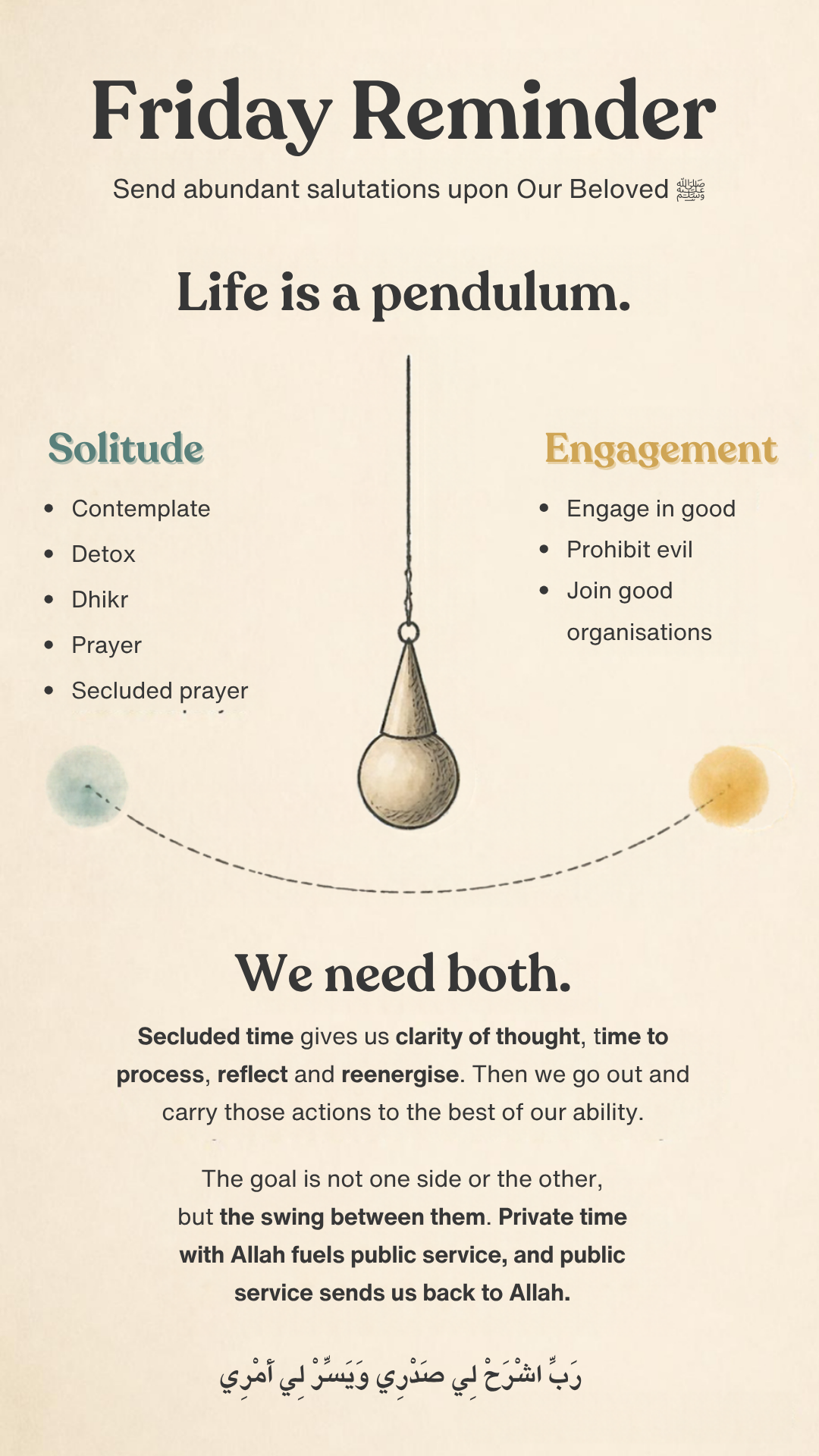
Life is a pendulum.
Some seasons pull us inward. We want quiet, space and time alone with our thoughts and with Allah. Other seasons pull us outward. There is work to be done, people to help, causes to stand for.
Many of us feel guilty about whichever side we’re on. When we withdraw, we worry we’re not doing enough for others. When we’re busy serving, we worry our hearts are running on empty.
But when we look at the Seerah, and at how Islam understands solitude and engagement, we find something freeing: the believer was never meant to live at one end of the swing. We need both.
It Began in a Cave
Before revelation came, the Prophet ﷺ would withdraw to the Cave of Ḥirāʾ for nights at a time, worshipping and reflecting away from the noise of Makkah (Ṣaḥīḥ al-Bukhārī).
Then came the command that changed everything:
يَا أَيُّهَا الْمُدَّثِّرُ قُمْ فَأَنذِرْ
“O you who covers himself [with a garment], arise and warn.” (Sūrah Al-Muddaththir 74:1–2)
The cave prepared him. The command sent him out. Seclusion was never the destination; it was the preparation.
The Inward Swing: Solitude
Solitude is where we contemplate, where we detox from the noise, the screens and the constant demands. It’s where our dhikr becomes unhurried and our prayer becomes personal, especially secluded prayer that no one else sees.
Allah addressed the Prophet ﷺ:
يَا أَيُّهَا الْمُزَّمِّلُ قُمِ اللَّيْلَ إِلَّا قَلِيلًا
“O you who wraps himself [in clothing], arise [to pray] the night, except for a little.” (Sūrah Al-Muzzammil 73:1–2)
And a few verses later, the reason becomes clear:
إِنَّ لَكَ فِي النَّهَارِ سَبْحًا طَوِيلًا
“Indeed, for you by day is prolonged occupation.” (Surah Al-Muzzammil 73:7)
The night was for standing before Allah, because the day would be full of people, responsibility and effort. The private hours fuelled the public ones.
The Prophet ﷺ described those who will be shaded by Allah on a day when there is no shade but His. Among them:
«وَرَجُلٌ ذَكَرَ اللَّهَ خَالِيًا فَفَاضَتْ عَيْنَاهُ»
“…and a man who remembered Allah in private and his eyes overflowed with tears.” (Bukhārī & Muslim)
No audience. No recognition. Just a servant and his Lord.
Secluded time gives us clarity of thought, time to process, reflect and re-energise.
The Outward Swing: Engagement
But we are not meant to stay hidden. Allah says:
وَلْتَكُن مِّنكُمْ أُمَّةٌ يَدْعُونَ إِلَى الْخَيْرِ وَيَأْمُرُونَ بِالْمَعْرُوفِ وَيَنْهَوْنَ عَنِ الْمُنكَرِ ۚ وَأُولَٰئِكَ هُمُ الْمُفْلِحُونَ
“And let there be [arising] from you a nation inviting to [all that is] good, enjoining what is right and forbidding what is wrong, and those will be the successful.” (Surah Āl ʿImrān 3:104)
Engagement means we engage in good, we prohibit evil in whatever way we’re able, and we join good organisations, because good work done together goes further than good work done alone. As Allah says, وَتَعَاوَنُوا عَلَى الْبِرِّ وَالتَّقْوَىٰ, “And cooperate in righteousness and piety” (Surah Al-Māʾidah 5:2).
The Prophet ﷺ said:
«مَنْ رَأَى مِنْكُمْ مُنْكَرًا فَلْيُغَيِّرْهُ بِيَدِهِ، فَإِنْ لَمْ يَسْتَطِعْ فَبِلِسَانِهِ، فَإِنْ لَمْ يَسْتَطِعْ فَبِقَلْبِهِ، وَذَلِكَ أَضْعَفُ الْإِيمَانِ»
“Whoever among you sees an evil, let him change it with his hand; if he cannot, then with his tongue; and if he cannot, then with his heart, and that is the weakest of faith.” (Muslim)
Engagement is messy. People can be difficult. But the Prophet ﷺ reminded us that this, too, is part of the reward:
«الْمُؤْمِنُ الَّذِي يُخَالِطُ النَّاسَ وَيَصْبِرُ عَلَى أَذَاهُمْ أَعْظَمُ أَجْرًا مِنَ الْمُؤْمِنِ الَّذِي لَا يُخَالِطُ النَّاسَ وَلَا يَصْبِرُ عَلَى أَذَاهُمْ»
“The believer who mixes with people and bears their harm patiently has a greater reward than the believer who does not mix with people and does not bear their harm patiently.” (Ibn Mājah)
Why the Swing Matters
Solitude without engagement can quietly turn into escape. Engagement without solitude can quietly turn into burnout, or worse, ego.
The goal is not one side or the other, but the swing between them. Private time with Allah fuels public service, and public service sends us back to Allah.
Allah captures this rhythm beautifully:
فَإِذَا فَرَغْتَ فَانصَبْ وَإِلَىٰ رَبِّكَ فَارْغَب
“So when you have finished [your duties], then stand up [for worship]. And to your Lord direct [your] longing.” (Surah Ash-Sharḥ 94:7–8)
Even Jumuʿah follows this pattern. We gather, we listen, we pray, and then:
فَإِذَا قُضِيَتِ الصَّلَاةُ فَانتَشِرُوا فِي الْأَرْضِ وَابْتَغُوا مِن فَضْلِ اللَّهِ وَاذْكُرُوا اللَّهَ كَثِيرًا لَّعَلَّكُمْ تُفْلِحُونَ
“And when the prayer has been concluded, disperse within the land and seek from the bounty of Allah, and remember Allah often that you may succeed.” (Surah Al-Jumuʿah 62:10)
In, then out. Out, then back in.
The Duʿā of One Being Sent Out
When Mūsā (ʿalayhis-salām) stood alone in the sacred valley and heard the words of Allah, it was the most private moment imaginable. Then he was told to go to Firʿawn, the most public and daunting task imaginable.
His first words were a duʿā:
رَبِّ اشْرَحْ لِي صَدْرِي وَيَسِّرْ لِي أَمْرِي
“My Lord, expand for me my breast and ease for me my task.” (Surah Ṭā Hā 20:25–26)
It’s the perfect duʿā for the swing: an open heart, nourished in private, and ease in the work that awaits in public.
This Week
Try giving each side of the pendulum its due:
- One moment of solitude: two rakʿahs at night, or ten minutes without your phone, simply reflecting.
- One act of engagement: help someone, speak up for what’s right, or give time to a good cause.
Then notice how each one strengthens the other.
May Allah expand our chests, ease our affairs, and make our private moments with Him the source of every good we do in public. Āmīn.