
 What is little but sufficient is better than that which is abundant but causes heedlessness.
There are moments in life when being fair feels almost unnatural.
Someone hurts you. They cross a line. They say something that lingers longer than it should.
And in that moment, something inside you shifts. You feel justified. Justified in being distant. Justified in being harsh. Justified in giving them exactly what they gave you. It feels right.
But then the words of Allah interrupt that feeling:
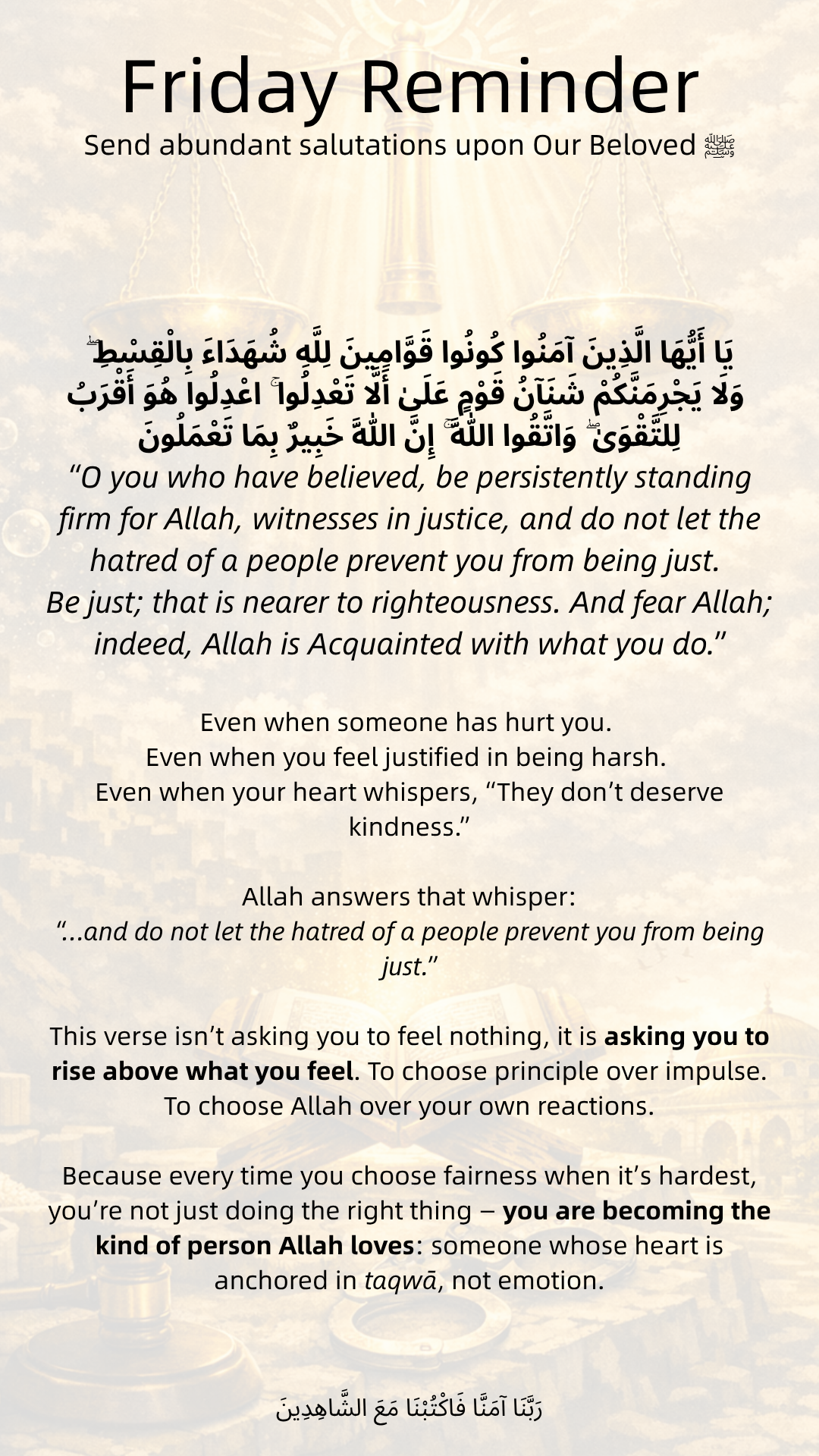
يَا أَيُّهَا الَّذِينَ آمَنُوا كُونُوا قَوَّامِينَ لِلَّهِ شُهَدَاءَ بِالْقِسْطِ
وَلَا يَجْرِمَنَّكُمْ شَنَآنُ قَوْمٍ عَلَىٰ أَلَّا تَعْدِلُوا
اعْدِلُوا هُوَ أَقْرَبُ لِلتَّقْوَىٰ ۖ وَاتَّقُوا اللَّهَ
إِنَّ اللَّهَ خَبِيرٌ بِمَا تَعْمَلُونَ
“O you who have believed, be persistently standing firm for Allah, witnesses in justice, and do not let the hatred of a people prevent you from being just. Be just; that is nearer to righteousness. And fear Allah; indeed, Allah is Acquainted with what you do.” (Surah Al-Ma’idah, 5:8)
This verse doesn’t come to you when you’re calm. It comes to you when your emotions are loud.
Islam doesn’t ask you to switch off your feelings.
You’re allowed to feel hurt. You’re allowed to feel anger.
But you’re not allowed to let those feelings decide what is right. And that’s where the real struggle begins.
Not the kind of struggle people applaud — but the kind that happens silently:
- When you hold back a response you could easily justify
- When you choose fairness even though your heart resists it
- When you refuse to twist the narrative in your favour
That moment — that tension — is عبادَة (worship).
The Prophet ﷺ said:
“The strong one is not the one who overcomes people by his strength, but the one who controls himself while in anger.” (Sahih al-Bukhari & Sahih Muslim)
Strength, in Islam, is redefined. It’s not dominance. It’s restraint.
What makes this verse so powerful is that it doesn’t just tell you what to do — it tells you when it matters most.
“Do not let the hatred of a people prevent you from being just.”
Not love. Not neutrality. Hatred.
Meaning: even when your heart is pushing you away from fairness — you are still commanded to return to it.
Because عدالت (justice) in Islam is not built on emotion. It’s built on principle. And principle doesn’t shift depending on who you’re dealing with.
Let’s be honest — choosing fairness when you’ve been wronged feels heavy.
Because your ego wants balance in a different way. It wants repayment. It wants recognition. It wants to win.
But Allah redirects you to something higher:
اعْدِلُوا هُوَ أَقْرَبُ لِلتَّقْوَىٰ
“Be just; that is nearer to taqwā.”
Because taqwā isn’t proven when it’s easy to be good. It’s proven when you could easily be unfair — and choose not to be.
Every time you choose fairness over reaction, something changes within you. You become less driven by impulse, and more grounded in purpose. Less controlled by people, and more conscious of Allah. And slowly, quietly, you become the kind of person this verse is describing:
قَوَّامِينَ لِلَّهِ — someone who stands for Allah, not for themselves.
We often think winning means having the last word. Or proving a point. Or making sure the other person feels what we felt. But this verse teaches a different measure.
Sometimes, winning is:
- Walking away without ظلم
- Speaking without exaggeration
- Acting without letting anger corrupt your integrity
And even if no one notices…
Allah ends the verse with a reminder that settles everything:
إِنَّ اللَّهَ خَبِيرٌ بِمَا تَعْمَلُونَ
“Indeed, Allah is fully aware of what you do.”
Nothing escapes Him.
Not the anger you swallowed. Not the fairness you upheld. Not the moment you chose Him over your ego. And maybe that’s the point.
That in a moment where you had every reason to follow your feelings— you chose to stand for something higher.
رَبَّنَا آمَنَّا فَاكْتُبْنَا مَعَ الشَّاهِدِينَ