
 The most truthful dreams are [seen] just before dawn

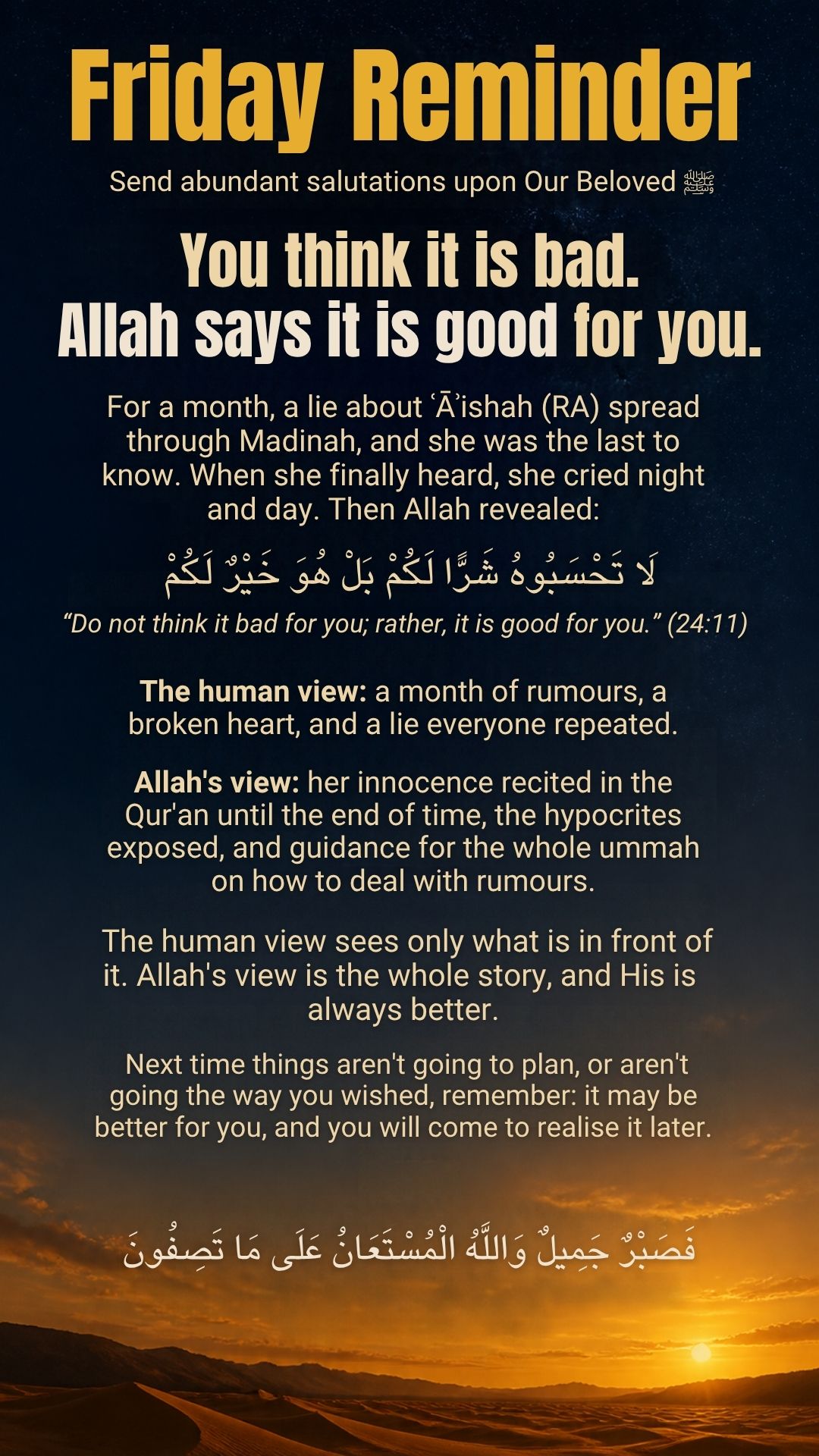
We usually judge a moment while we’re still inside it. A plan collapses, a door closes, someone says something untrue about us, and straight away we decide: this is bad.
But we only ever see one page of the story. Allah sees the whole book.
One of the most painful episodes in the Seerah teaches this better than almost anything else: the slander against our mother, ʿĀʾishah (raḍiyallāhu ʿanhā).
A Month of Rumours
On the way back from an expedition, ʿĀʾishah (RA) was accidentally left behind while searching for a lost necklace. A Companion, Ṣafwān ibn al-Muʿaṭṭal (RA), found her and brought her back to the army. That was all that happened.
But the hypocrites, led by ʿAbdullāh ibn Ubayy, saw an opportunity. They began whispering, and the whispers spread through Madinah. Some sincere Muslims were even drawn into repeating it.
For a whole month, the lie grew, and ʿĀʾishah (RA) was the last to know. She had fallen ill on returning and only noticed that the Prophet ﷺ wasn’t showing her his usual warmth. When she finally heard the rumour, she said she cried until she thought her heart would break. In her own words, her tears would not stop and she could not sleep (Bukhārī & Muslim).
Think about what that must have felt like: young, innocent, ill, the subject of gossip across the whole city, and unable to prove anything.
When the Prophet ﷺ came and spoke to her, she replied with the words of another grieving parent who had been told a lie, Yaʿqūb (ʿalayhis-salām):
فَصَبْرٌ جَمِيلٌ ۖ وَاللَّهُ الْمُسْتَعَانُ عَلَىٰ مَا تَصِفُونَ
“So patience is most fitting, and it is Allah whose help is sought against that which you describe.” (Surah Yūsuf 12:18)
She had no other defence. She handed her case to Allah.
Then Allah Spoke
Before anyone had even left the room, revelation came down. Allah declared her innocence from above the seven heavens:
إِنَّ الَّذِينَ جَاءُوا بِالْإِفْكِ عُصْبَةٌ مِّنكُمْ ۚ لَا تَحْسَبُوهُ شَرًّا لَّكُم ۖ بَلْ هُوَ خَيْرٌ لَّكُمْ
“Indeed, those who came with the falsehood are a group among you. Do not think it bad for you; rather, it is good for you.” (Surah An-Nūr 24:11)
Read that again. After a month of heartbreak, Allah’s verdict was not “this was bad, but it’s over”. It was: “It is good for you.”
ʿĀʾishah (RA) later said she had hoped Allah might show the Prophet ﷺ a dream clearing her name, but she never imagined this:
«وَلَشَأْنِي فِي نَفْسِي كَانَ أَحْقَرَ مِنْ أَنْ يَتَكَلَّمَ اللَّهُ فِيَّ بِأَمْرٍ يُتْلَى»
“I considered myself too insignificant for Allah to speak about me with something that would be recited.” (Bukhārī & Muslim)
Two Views of the Same Month
The human view: a month of rumours, a broken heart, and a lie that everyone repeated.
Allah’s view:
- Her innocence recited until the end of time. Every Muslim who reads Surah An-Nūr today is reading Allah’s defence of ʿĀʾishah. Her honour was raised forever, not just restored.
- The hypocrites exposed. Those who had been hiding inside the community were brought into the light.
- Guidance for the whole ummah on rumours. Allah taught every generation after how to deal with gossip:
لَّوْلَا إِذْ سَمِعْتُمُوهُ ظَنَّ الْمُؤْمِنُونَ وَالْمُؤْمِنَاتُ بِأَنفُسِهِمْ خَيْرًا وَقَالُوا هَٰذَا إِفْكٌ مُّبِينٌ
“Why, when you heard it, did not the believing men and believing women think good of one another and say, ‘This is an obvious falsehood’?” (Surah An-Nūr 24:12)
إِذْ تَلَقَّوْنَهُ بِأَلْسِنَتِكُمْ وَتَقُولُونَ بِأَفْوَاهِكُم مَّا لَيْسَ لَكُم بِهِ عِلْمٌ وَتَحْسَبُونَهُ هَيِّنًا وَهُوَ عِندَ اللَّهِ عَظِيمٌ
“When you received it with your tongues and said with your mouths that of which you had no knowledge, and thought it was insignificant while it was, in the sight of Allah, tremendous.” (Surah An-Nūr 24:15)
In an age of forwarded messages and screenshots, these verses could not be more relevant. The Prophet ﷺ said:
«كَفَى بِالْمَرْءِ كَذِبًا أَنْ يُحَدِّثَ بِكُلِّ مَا سَمِعَ»
“It is enough of a lie for a person to repeat everything he hears.” (Muslim)
Even the aftermath held good. Abū Bakr (RA) had been supporting his relative Misṭaḥ, who took part in spreading the rumour, and he vowed to stop. Allah revealed: أَلَا تُحِبُّونَ أَن يَغْفِرَ اللَّهُ لَكُمْ, “Would you not like that Allah should forgive you?” (Surah An-Nūr 24:22). Abū Bakr (RA) replied, “Yes, by Allah, I would love Allah to forgive me,” and resumed his support (Bukhārī). A lesson in forgiveness, born from the same pain.
You Only See One Page
The human view sees only what is in front of it. Allah’s view is the whole story, and His is always better.
وَعَسَىٰ أَن تَكْرَهُوا شَيْئًا وَهُوَ خَيْرٌ لَّكُمْ ۖ وَعَسَىٰ أَن تُحِبُّوا شَيْئًا وَهُوَ شَرٌّ لَّكُمْ ۗ وَاللَّهُ يَعْلَمُ وَأَنتُمْ لَا تَعْلَمُونَ
“But perhaps you hate a thing and it is good for you; and perhaps you love a thing and it is bad for you. And Allah knows, while you know not.” (Surah Al-Baqarah 2:216)
The Prophet ﷺ described the believer’s position beautifully:
«عَجَبًا لِأَمْرِ الْمُؤْمِنِ، إِنَّ أَمْرَهُ كُلَّهُ خَيْرٌ، وَلَيْسَ ذَاكَ لِأَحَدٍ إِلَّا لِلْمُؤْمِنِ، إِنْ أَصَابَتْهُ سَرَّاءُ شَكَرَ فَكَانَ خَيْرًا لَهُ، وَإِنْ أَصَابَتْهُ ضَرَّاءُ صَبَرَ فَكَانَ خَيْرًا لَهُ»
“How amazing is the affair of the believer! All of his affairs are good, and this is for no one except the believer. If something good happens to him, he is grateful, and that is good for him. If something bad happens to him, he is patient, and that is good for him.” (Muslim)
When Things Don’t Go to Plan
Next time things aren’t going to plan, or aren’t going the way you wished, remember ʿĀʾishah (RA). Remember that a month that felt like the worst of her life became a source of honour, guidance and reward that will last until the Day of Judgement.
It may be better for you, and you will come to realise it later. Perhaps in this life, perhaps in the next.
Until then, hold on to the words she held on to:
فَصَبْرٌ جَمِيلٌ ۖ وَاللَّهُ الْمُسْتَعَانُ عَلَىٰ مَا تَصِفُونَ
“So patience is most fitting, and it is Allah whose help is sought.” (Surah Yūsuf 12:18)