“Whoever recites Surah al-Kahf on Friday, it will illuminate him with light between the two Fridays.” (al-Ḥākim, al-Bayhaqī — graded ḥasan)
This chapter is not just a ritual — it’s a weekly realignment of the heart.
It teaches how to survive the subtle trials that repeat through life: wealth, knowledge, power, faith, and the ultimate deception of the Dajjāl.
Each story is a mirror — reflecting how easily blessings can become tests.

- Fitnah of Wealth — The Two Gardens (18:32–44)
وَاضْرِبْ لَهُم مَّثَلًا رَّجُلَيْنِ جَعَلْنَا لِأَحَدِهِمَا جَنَّتَيْنِ مِنْ أَعْنَابٍ وَحَفَفْنَاهُمَا بِنَخْلٍ وَجَعَلْنَا بَيْنَهُمَا زَرْعًا
“Give them the example of two men: for one We made two gardens of grapevines, surrounded them with date palms, and placed crops between them.” (18:32)
One man was blessed with abundance — fertile gardens, flowing rivers, and fruit that never failed. His companion, poorer but faithful, reminded him to thank Allah. Yet the wealthy man’s heart grew proud:
مَا أَظُنُّ أَن تَبِيدَ هَٰذِهِ أَبَدًا
“I do not think this will ever perish.” (18:35)
He forgot that permanence belongs only to Allah. His arrogance led him to say:
وَمَا أَظُنُّ السَّاعَةَ قَائِمَةً
“I do not think the Hour will ever come.” (18:36)
Then, in a single night, his gardens were destroyed — a vivid reminder that wealth can vanish faster than it grows.
Lesson:
- Wealth itself is not blameworthy; attachment and pride are.
- When blessings make us feel self-sufficient, we begin to lose sight of the Giver.
- Tie every success back to Allah, for gratitude protects the heart from arrogance.

2. Fitnah of Knowledge — Mūsā and Khidr (18:60–82)
فَوَجَدَا عَبْدًا مِّنْ عِبَادِنَا آتَيْنَاهُ رَحْمَةً مِّنْ عِندِنَا وَعَلَّمْنَاهُ مِن لَّدُنَّا عِلْمًا
“They found one of Our servants to whom We had given mercy from Us and taught knowledge from Ourself.” (18:65)
Prophet Mūsā عليه السلام, despite his immense wisdom, was told there was someone who knew what he did not. He humbly sought Khidr, asking to learn from him.
But Khidr’s actions — damaging a boat, killing a boy, repairing a wall — seemed unjust. Mūsā questioned each one, unable to see the hidden wisdom behind them.
Only later did Khidr explain:
• The boat belonged to poor men — damaging it saved them from a tyrant.
• The boy would have grown to oppress his parents — his death was mercy.
• The wall concealed treasure for orphans — repairing it preserved their future.
Lesson:
- Knowledge is a mercy, not a weapon.
- Even prophets must learn humility before divine wisdom.
- Not everything you don’t understand is wrong — arrogance in knowledge blinds faster than ignorance.

3. Fitnah of Power — Dhul-Qarnayn (18:83–98)
إِنَّا مَكَّنَّا لَهُ فِي الْأَرْضِ وَآتَيْنَاهُ مِن كُلِّ شَيْءٍ سَبَبًا
“Indeed, We established him upon the earth and gave him the means to everything.” (18:84)
Dhul-Qarnayn was a ruler of vast lands, blessed with strength and wisdom. He traveled to the ends of the earth, bringing justice wherever he went.
When he met oppressed people seeking protection from Yājūj and Mājūj, he could have exploited them — but instead, he empowered them to build a barrier with their own hands.
قَالَ هَٰذَا رَحْمَةٌ مِّن رَّبِّي
“He said, ‘This is a mercy from my Lord.’” (18:98)
He recognised that power is a trust, not a throne.
Lesson:
- Power can corrupt quietly.
- Influence, status, and control can either elevate or destroy you.
- True leadership is service — not domination.

4. Fitnah of Faith — People of the Cave (18:9–26)
إِنَّهُمْ فِتْيَةٌ آمَنُوا بِرَبِّهِمْ وَزِدْنَاهُمْ هُدًى
“They were young men who believed in their Lord, and We increased them in guidance.” (18:13)
In a society drowning in idolatry, a group of young believers refused to bow to false gods. They fled to a cave, seeking refuge in faith.
Their test was severe — isolation, fear, and the threat of persecution. Yet Allah preserved them miraculously, causing them to sleep for centuries.
فَضَرَبْنَا عَلَىٰ آذَانِهِمْ فِي الْكَهْفِ سِنِينَ عَدَدًا
“So We sealed their ears in the cave for a number of years.” (18:11)
When they awoke, the world had changed — but their faith remained intact.
Lesson:
Your environment shapes your īmān more than you realise.
Sometimes, protecting your dīn requires distance from harmful influences.
Faith may demand solitude, but Allah’s protection fills that silence.

5. The Ultimate Fitnah — The Trial of the Dajjāl
The Prophet ﷺ said:
“Whoever memorises the first ten verses of Surah al-Kahf will be protected from the trial of the Dajjāl.” (Ṣaḥīḥ Muslim, 809)
Dajjāl represents all previous trials — wealth, power, knowledge, and faith — but at their most extreme.
He will control resources, distort truth, and claim divinity.
His deception will make الحق (truth) appear as falsehood.
مَا مِنْ فِتْنَةٍ مُنْذُ خَلْقِ آدَمَ أَعْظَمُ مِنْ فِتْنَةِ الدَّجَّالِ
“No trial since the creation of Adam is greater than the trial of the Dajjāl.” (Ṣaḥīḥ Muslim, 2946)
Deeper Lesson:
Dajjāl is not just a future event — he is a warning pattern.
Every story in Surah al-Kahf trains you to resist his deception:
• The man of the gardens → don’t be deceived by material success
• Mūsā & Khidr → don’t be deceived by what you think you understand
• Dhul-Qarnayn → don’t be deceived by power and control
• People of the Cave → hold firm when faith is under pressure
Preparation:
Reciting Surah al-Kahf weekly is spiritual training — a shield for the heart before the greatest trial arrives.
Conclusion
Surah al-Kahf is a map for survival in a world of illusions.
Its stories teach that every blessing — wealth, intellect, influence, or faith — can become a test if detached from Allah.
]]>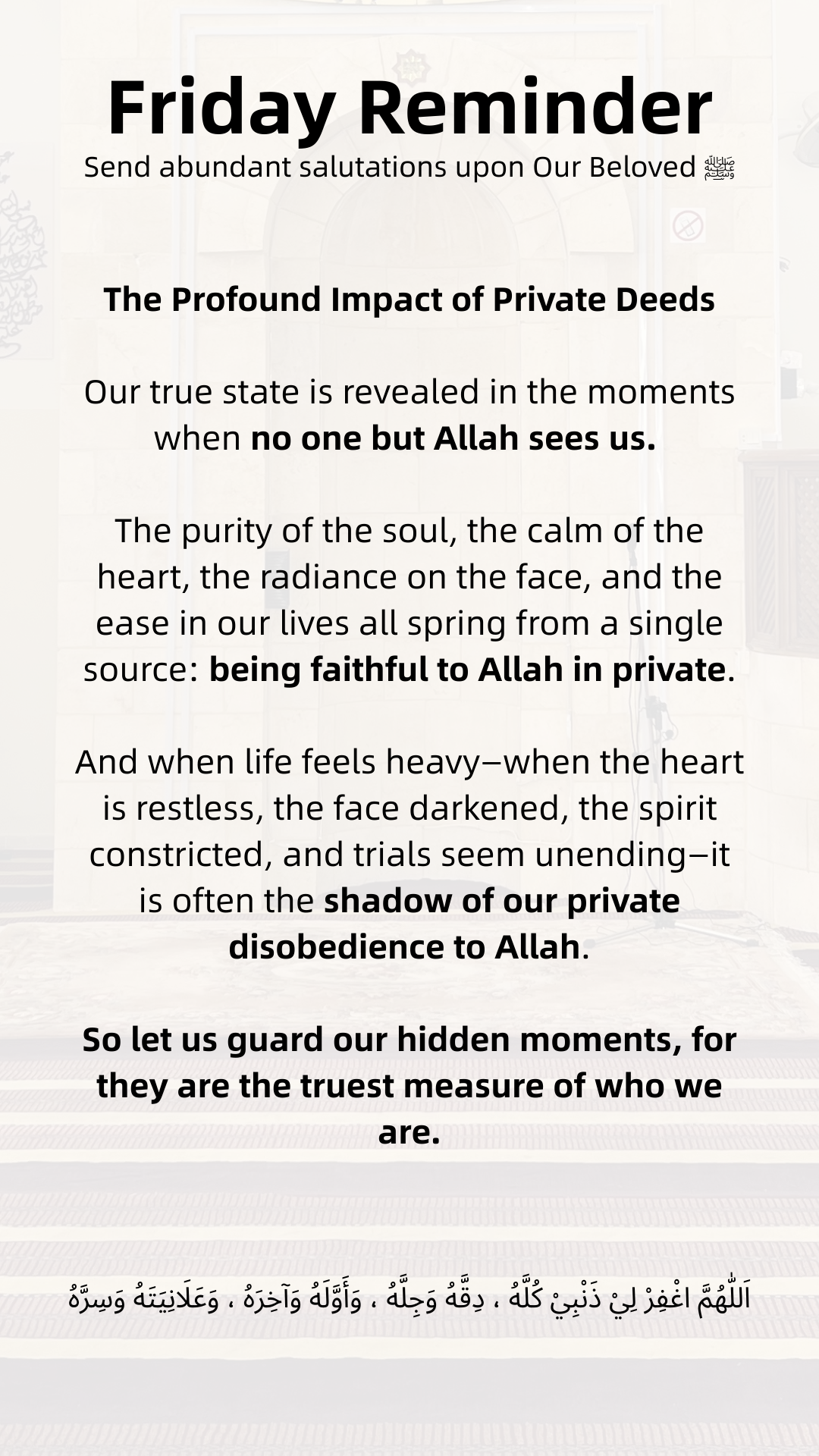
The truest measure of a believer is not found in public, where eyes are watching, but in private — when only Allah sees us. Our hidden deeds shape our hearts, our lives, and ultimately our destiny.
Allah tells us in the Qur’an:
إِنَّ الَّذِينَ يَخْشَوْنَ رَبَّهُم بِالْغَيْبِ لَهُم مَّغْفِرَةٌ وَأَجْرٌ كَبِيرٌ
“Indeed, those who fear their Lord unseen will have forgiveness and a great reward.” (Sūrah Al-Mulk, 67:12)
When the servant remembers Allah in solitude, the soul is purified, the heart is calmed, and a light radiates on the face that no cosmetic can imitate. Private acts of worship (a secret charity, a hidden du‘ā, or resisting sin when no one is watching) draw us nearer to Allah in ways the world may never notice.
The Prophet ﷺ said:
“Seven will be shaded by Allah on the Day when there will be no shade but His… [among them is] a person who remembers Allah in solitude, and his eyes overflow with tears.” (Saḥīḥ al-Bukhārī)
But just as secret worship brings light, hidden disobedience brings darkness. The Prophet ﷺ warned:
“I certainly know people from my Ummah who will come on the Day of Resurrection with good deeds like the mountains of Tihamah, but Allah will make them scattered dust.”They are people, he explained, “who, when they are alone with the prohibitions of Allah, they violate them.” (Sunan Ibn Mājah)
This is why life sometimes feels heavy: the heart restless, the face darkened, the spirit constricted. These are often the unseen effects of private sins that erode our souls from within.
Our unseen moments are a trust. If we are faithful to Allah in private, He will honour us in public, grant us ease in the grave, and raise us with light on the Day of Judgment.
يَوْمَ تُبْلَى السَّرَائِرُ
“The Day when secrets will be put on trial.” (Sūrah Aṭ-Ṭāriq, 86:9)
So let us guard our private lives with as much care as we guard our reputations. Fill solitude with Qur’an, remembrance, and sincere repentance. And when we falter — as all humans do — let us rush back to Allah’s vast mercy.
اَللّٰهُمَّ اغْفِرْ لِيْ ذَنْبِيْ كُلَّهُ ، دِقَّهُ وَجِلَّهُ ، وَأَوَّلَهُ وَآخِرَهُ ، وَعَلَانِيَتَهُ وَسِرَّهُ.
O Allah, forgive for me all of my sins: the minor and major, the first and the last, the public and the private.
]]>